Growing up, I was often labelled “too much”: too loud, too chaotic, too impulsive. What no one recognised early on was that I had ADHD and a nervous system wired for intensity, novelty and obsession. I struggled to sit still in classrooms, but I could disappear for hours into stories of exploration. When I was six, my nan read me The Turquoise Mountain – an adult book, because children’s stories no longer held my attention – and something clicked. Everest became my fixation. It never felt like a goal so much as a direction. A strange hero for a six-year-old, perhaps, but I wanted to be like Brian Blessed: out there, in the thick of raw, relentless adventure.
1. Kilimanjaro
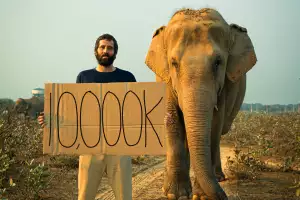
Mitch Hutchcraft at Kilimanjaro
I spent my childhood playing explorer in the woods near my house, imagining myself on a journey to Everest. Years later, aged 14 and 15, I worked two summers on a construction site with my dad to earn the money I’d need to climb the roof of Africa. At 16, after much searching, I found a company willing to take me on alone. I was the youngest client my guide, Wilson, had ever taken up in his 40-year career. Standing on the summit of Kilimanjaro taught me a defining lesson: most limits are not real. It showed me that my intensity wasn’t a flaw – it was fuel.
2. Dartmoor
When my dad died in his early fifties, I was 20. With him went the structure of my world. Without him, the fire inside me didn’t disappear, but I lost my sense of direction. We’d often talked about a career in the military, believing it would give me what I needed. After his death, I was told that two knee reconstructions meant I wouldn’t be able to join. The last promise I ever made to my father was that I’d make him prouder than he could imagine – and I had no idea how. I applied anyway. Because my application was processed in Australia, I was able to hide the injury. Somehow, I made it in. The next five years laid the foundations for an unbreakable mindset. Training across Devon and Dartmoor taught me that cheerfulness in the face of adversity can carry you through the darkest moments. Discipline was deeply ingrained. It would shape everything that followed.
3. The Atlantic Ocean
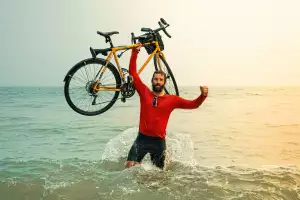
When I left the Marines in 2021, I again found myself lacking direction. I was invited to join a team of four rowing across the Atlantic. I’d never rowed before, but it seemed like a good place to start. Seven weeks in a tiny boat, battling waves across 3,000 miles of open ocean, pushed me beyond anything I thought possible. During those endless days, stripped back to pain and repetition, I found answers I’d been searching for. Most importantly, it was there that the idea for the expedition that would change my life emerged: a 13,157km human-powered journey from the UK to the summit of Mount Everest.
4. The United States
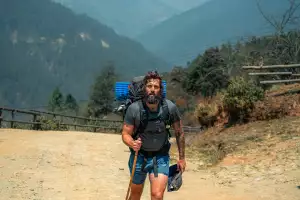
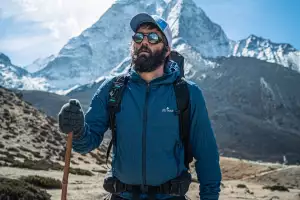
Mitch Hutchcraft
To train for Everest, I reasoned, I should first attempt half the distance. That meant cycling 3,000 miles across the US, from the Atlantic to the Pacific, passing through eight states. The self-supported journey taught me vital lessons: how many miles I could ride each day without breaking, and whether I truly wanted this kind of pain. It was my first prolonged experience of solitude. For someone with ADHD, quiet self-conversation had always been difficult. On the open road, it was unavoidable. I learned that plans rarely survive contact with reality.
5. Mount Everest
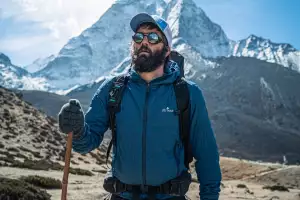
Mitch Hutchraft on Mount Everest
Everest had been the destination of my boyhood dreams. After Kilimanjaro, I’d travelled to base camp in 2011 and seen her peak glowing gold in the evening sun. I didn’t summit then, but I promised myself I’d return. Years later, after a gruelling triathlon from England that saw me swim the Channel, cycle from France to India, and run and climb from India to Everest Base Camp, I finally stood on the summit on 11 May 2025. After 237 days and 19 countries, a 27-year dream was realised.