"Careful of the walls,” my guide Seda Gül Toğlau cautions, as I shadow her through the volcanic-tuff tunnel below Argos in Cappadocia. “The dust will rub off on your clothing.” Crouching low, we shuffle past a shallow alcove.
“That’s where a Christian soldier would have hidden with a spear during an Arab raid in the 8th century.” The information does little to soothe my claustrophobia.
Eventually, we emerge into Bezirhane, the 2,000-year-old monastery uncovered during the property’s 1996 renovation. According to Toğlau, this immense stone-carved chamber has been many things over the centuries: a Hittite storage chamber, a Byzantine hideout, a caravanserai for camel convoys on the Silk Road during the Seljuk era.
As we move deeper underground, it feels as though we’re dropping down through the strata of time itself. As hotel tours go, this hits different.
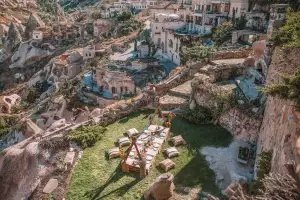
Monks is the perfect perch for sunny picnics
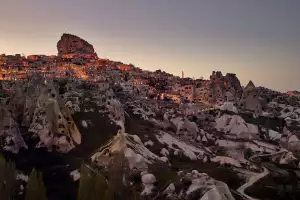
Above us rises Uçhisar Castle, the highest point in Cappadocia, a towering rock citadel carved into a 60-metre volcanic outcrop that once housed around a thousand people and served as the region’s primary watchtower.
Below it stretches a honeycomb of subterranean dwellings and tunnels. Turkey’s Ministry of Culture and Tourism estimates there may be anywhere between 40 and 200 underground cities across the wider region, with the largest capable of sheltering up to 20,000 people.
And now, me. As I mooch around my room, bassline thudding from a Bluetooth speaker, I feel far from a caveman.
The space is strewn with brocaded Turkish rugs and shaped by a series of interlocking arches that divide it into three gentle zones. There’s a long settee facing a marble fireplace set into the stone wall, a walk-in rain shower carved straight from the rock, and a king-sized bed topped with a hot-water bottle wrapped in a local knit.
Argos in Cappadocia has been restoring spaces like this for 14 years. Today, the hotel comprises 71 rooms and suites, plus nine mansions, spread across fifteen acres and many of the same cavities the Hittites once used for storage. In fact, some of them still are – utilised in exactly the same way, four millennia on.
Surfacing from my dwelling into pellucid daylight, I’m struck by the otherworldliness of the landscape – lunar doesn’t quite do it justice. Beyond the mosque and minaret immediately across from my suite, the Tıraz Castle ascends like a giant dorsal fin. A golden tabby cat perches on a ledge, staring inquisitively across the void, while a flock of pigeons wheel beneath it.
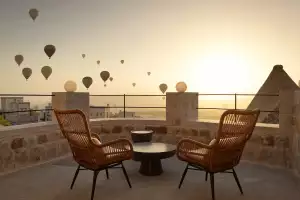
Cappadocia is world-famous for its incredible hot-air balloon displays
The valley is named for the birds and dimpled with ancient dovecotes where farmers reared pigeons and harvested guano for fertiliser.
It craters out into a sinuous system of winding arroyos and sentinel-like hoodoos. Behind it, about 80 kilometres away as the crow flies, looms the snow-covered caldera of Mount Erciyes, jutting nearly 4,000 metres into bright-blue rarefied air.
It’s a steep hike up to reception, and easy to get lost. Many guests rely on buggies for transportation between sites.
Outfitted in my running kit, I board a vehicle with Ramazan Kagar, our tour guide, who happens to be born within a few days of me, with a son born within a few days of my daughter. We drive eastwards toward Ürgüp, near his hometown.
When you’re in Cappadocia, the first thing you need to understand is how old human settlement here really is
“I’m local to the region,” Kagar tells me. “I’m from a small town called Mustafapaşa, once known as Sinasos, an old Greek village that was recognised as a heritage tourism village in 2001. My grandparents came from Thessaloniki. They were Muslim, but spoke a Macedonian dialect.” Cappadocia, it turns out, has always been a mixing pot.
As we motor north toward the Kızılırmak River, Kagar explains the region’s history. “When you’re in Cappadocia, the first thing you need to understand is just how old human settlement here really is. Not far from here is Çatalhöyük, a Neolithic, pre-pottery settlement dating back eight or nine thousand years BC. That’s around 11,000 years ago,” he says.
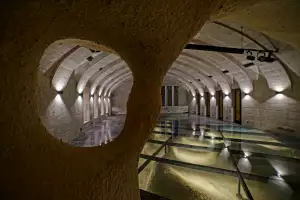
Museum Hall
GALIP HASAN TEMUR
“Anatolia has always been a bridge between continents. To move from Africa to Europe, or from Asia into Europe, you had to pass through here. Ancient sea routes, Assyrian trade roads and the Persian King’s Road all crossed this land. As a result, more than thirty civilisations have ruled parts of modern-day Turkey. The Hittites were here first, followed by the Phrygians, Persians, Greeks, Romans, Byzantines, Seljuks and Ottomans.”
We step out of the big black van at Imagination Valley and wander among its bizarre rock formations. Kagar points out three holes that resemble a ghost’s face – Casper the Friendly Ghost was his favourite film as a child – as well as a camel-shaped rock where busloads of Chinese tourists pause for selfies.
The tuff here has been sculpted over millions of years by wind and water through a process known as differential erosion. Randomly embedded harder caps and volcanic bombs have protected pockets of softer rock beneath them, leaving these improbable animal silhouettes as everything else wore away.
In nearby Monks Valley, those same hard caps have produced more Freudian results. St Simeon is remembered as the model and namesake for the hermit monks who carved cells high into the fairy chimneys, attempting to imitate his extreme, isolated way of life.
A chapel and multi-storey hermitage, cut into a three-headed chimney, are dedicated to him. Legend has it that he slept seated, his head resting on a very sharp stick in order to avoid the indulgence of lying down and bring himself closer to God.
For a few seconds, there’s absolutely nothing to do but trust friction
We scramble into a cave house nearby. “Many of the homes carved into these cliffs were lived in until the 1960s,” Kagar explains, “before they were abandoned because of the risk of collapse and the difficulty of installing infrastructure. Later, investors began restoring them as cave hotels. Fifty years ago, you might have traded one for a horse or a dinner set. Today, depending on size and location, they can sell for hundreds of thousands, even millions.”
As twenty shouting schoolchildren pile in behind us, I decide it’s time to leg it. I kick off a 20km trail run back towards Uçhisar and Argos in Cappadocia, slipping a steel fence and following a narrow footpath through undulating, caramel-coloured terrain that quickly decants itself of tourists. The trail skirts a broad plateau before ascending over it.
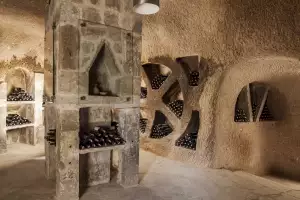
The wine cellar at Argos in Cappadocia holds over 25,000 bottles and is the largest in Turkey
@ 2017 Holden Creative
At one point, I follow a false track along its scarp and end up exposed and precarious on the steep valley wall. For a few seconds, there’s absolutely nothing to do but trust friction and focus on the breath. At the table’s southern edge, a crimson Turkish flag snaps in the wind as paragliders launch themselves into the ether.
From here, I drop into Rose Valley, and again it feels as though I’m passing through layers of time. The rock folds into blushing pink ridges and pillars, porous with caves once used as homes, monastic retreats and places of worship by Byzantine-era Christians.
I run through carved corridors and swales, descending towards the town of Göreme, then climb another spine before dropping once more into Love Valley, which is emphatically priapic.
Dozens of phallic fairy chimneys thrust up from the ground, some rising to around 40 metres. From here, it’s a steep, shifting climb back to Uçhisar. By the time I arrive back at Argos, I’m grateful to unspool in the quietude of the cave spa sauna, body humming, history still pressing in from every side.
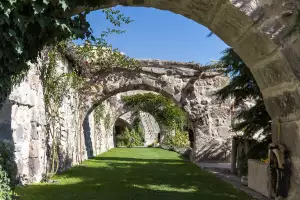
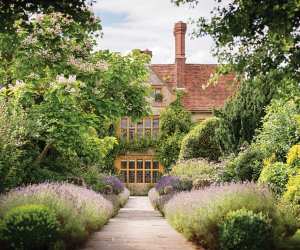
Garden details
Alle Rechte vorbehalten lt. §2UrhG.
If the run strips everything back to effort and breath, food and drink at Argos in Cappadocia rebuild it. Like everything else here, it feels less curated than unearthed, shot through with an earthy dose of luxury. Winemaking in the region stretches back more than 4,000 years to the Hittites, and that lineage is not treated as a footnote.
Argos tends its own vineyards and bottles its wine under the label Nahita Dokya. Its winery sits 45km away, closer to the soils best suited to the grapes, and beneath the hotel lies Turkey’s largest underground wine cellar and one of Europe’s top five, housing over 25,000 bottles, stacked deep into the rock where temperature and humidity have regulated themselves for centuries.
Then a beam of torchlight trains onto us, wielded by a tall, shadowy figure
The sommelier pairs dishes in the cellar’s lowest floor: local cheeses rolled in pistachio and wild thyme, muhammara topped with caramelised walnut, all washed down with lashings of bracing white wine fermented from emir grapes and rich red from kalecik karası.
Everything at Nahita, the hotel’s Turkish fine-dining restaurant, is sourced within a 60km radius of Uçhisar, and it properly slaps. I lose my mind over stuffed vine leaves scented with sour cherry and cinnamon; potato crisps from Nevşehir slicked with strained yoghurt, sumac and garlic; and dainty handmade mantı dumplings swimming in a creamy chickpea sauce.
By the time the doors open out onto Pigeon Valley, I am slightly crosseyed, standing above land that has been feeding people for more than 11,000 years, the flavours still ringing loud in my mouth, wine gone straight to the head.
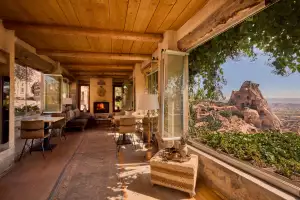
Seki Restaurant & Lounge
KORAY ERKAYA
Half-cut, with a few new friends, we stumble through the gardens and down into the valley as the sun slips away.
Dovecotes and old dwellings glow in the dusk, wrapping us in a softly lit amphitheatre, while the deepening dark sharpens the senses and leaves a few of the group twitchy about marauding dogs.
Then a beam of torchlight trains onto us, wielded by a tall, shadowy figure. For a split second, stress responses activate, before the shape resolves into Pelin Sayil, the hotel’s PR manager, who has thoughtfully arranged transport back for anyone feeling weary.
As I run through one of the valley’s tunnel systems, I’m sure I hear a child’s laughter
The next day, on a final run, I have an actual encounter with feral dogs. Jogging up through Göreme into Pigeon Valley, I pass a small croft where a sheepdog has just whelped a litter of four.
The puppies barrel towards me, all soft ears and unsteady legs, whimpering as they lick the salt from my calves. I’m briefly, dangerously, tempted to smuggle one home.
There’s something childlike about moving fast. That headlong, careless sense of speed collapses time and returns you to an earlier version of yourself.
As I run through one of the valley’s tunnel systems, I’m sure I hear a child’s laughter. Almost certainly a wine-and-exercise-induced auditory hallucination, but it lodges there and brings to mind something Ramazan Kagar told me during the day before.
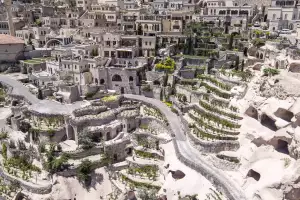
The hotel from above
“Not far from here, archaeologists discovered a homo erectus skeleton dating back 1.2 million years,” he’d said. “Another find near Ankara revealed a three-million-year-old goat skeleton. This land has been inhabited, crossed and reworked for an almost incomprehensible length of time.”
It feels indulgent, after such a luxurious few days cosplaying a troglodyte at Argos in Cappadocia, to compare myself to a child scampering among these rocks ten thousand years ago.
But the instinct isn’t entirely false; it’s something inherited. Every one of us descends from people who once lived in caves, who moved through landscapes like this at a human pace, alert and improvising, who almost certainly had a more attuned relationship to the elements and the seasons.
At a moment when the world seems permanently poised to burn itself down, being somewhere like Cappadocia, where human history runs as deep as it can, is a quiet corrective.
It suggests that we are all, fundamentally, kin. We just have a habit of forgetting.