Any sign of Tatum yet?” the man next to me asks when he returns from the bathroom. It’s a simple question that provokes an unreasonable amount of panic, like being targeted in a tutorial at university when you haven’t done the reading. This is partly because I am yet to become familiar with Jayson Tatum, the Boston Celtics superstar who has been out for 10 months with a torn Achilles tendon and is rumoured to be making his return against the Brooklyn Nets.
I’m at my first ever basketball game and, after forgetting to listen to the Bill Simmons podcast I had loaded up for research, I’m unfamiliar with all the players on the court, never mind the ones on the sidelines. My equally unknowledgeable dad and I are enjoying the game; however, once bafflement at some aspects of live sporting spectacle in America subsides – like the fact that music is blared regularly from the speakers while the ball is in play, or the Celtics’ Lucky Charms-style mascot.
Mainly, though, we are wildly impressed by the athleticism on show, especially by a particular Celtics player we rather unceremoniously refer to as ‘the short one’, who darts around the court scoring at will against opponents several inches taller. A Google search tells us this diminutive, Messi-like figure is, in fact, six-foot-two Peyton Pritchard, giving some impression of the median-height athlete on show here.
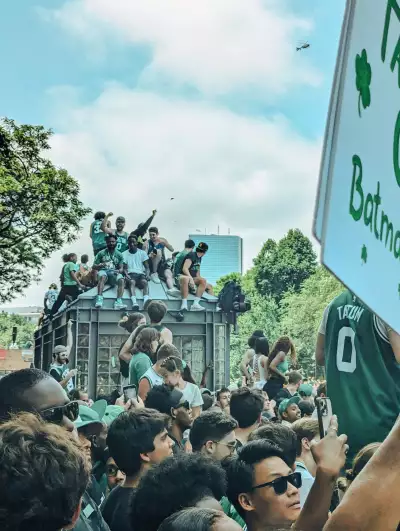
Boston Celtics fans
Mohammed Shonar
Despite my lack of knowledge, I went into the game eager to assimilate. My Dad and I are in Boston mainly for historical reasons – it’s one of those cities that he’d always been drawn to as a full-fledged history junkie, partly for its Irish connection, partly for its starring role in the formation of the US.
But, in heading to a famously sports-mad city, I suggest one of the best routes to its core is through sport. Thanks to an American housemate, I’ve met loads of US expats in London, and my advice is always, if you want to find the deepest insight into a city’s true culture, go to a football match. Roles reversed, I figure that rule is universal.
Now, as we enter into the third quarter my stomach is starting to show signs that I might be in serious trouble. Thankfully, though, it’s not a serious dose, and it does nothing to thwart a visit the next day to a Boston institution – Union Oyster House. “The oldest restaurant in Boston,” I remark to the manager.
“The oldest restaurant in America,” he cheerfully corrects me. “Continuously operating,” he quickly adds. Nausea has all but disappeared, but my appetite, usually ravenous to the point of inconvenience, has subsided significantly. I couldn’t be further from welcoming the prospect of necking shellfish, but it turns out these North Atlantic oysters are restorative in their freshness – after one, I’m almost set right again.
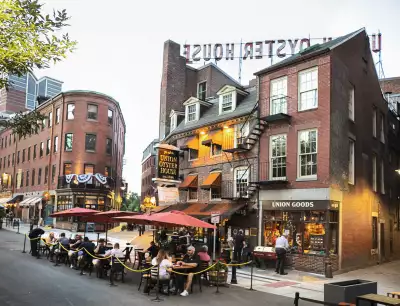
Ye Olde Union Oyster House
Dad, happily gulping them down, safe in the knowledge that I said I could only stomach one, is disappointed when I dive into another. “We have great oysters in Ireland”, he tells the waitress, displaying that evergreen Irish-dad trait of bringing everything back to the country, “but these are some of the best that I’ve ever had”.
The oyster house is located in the North End of Boston, an area of the city that captures what drew my dad and me to it. It’s a melting pot where first the Irish, then Italians and then Jewish immigrants all stepped off boats and used it as a foothold from which to integrate into the city, then the country, and even the White House.
In three blocks, you pass an Irish-founded Catholic parish, a street where Jewish peddlers once hawked goods from basement shops, and a tangle of trattorias under green-white-and-red bunting. It’s the Italians who have remained visibly most prominent to this day, with restaurants, cafes and delis packed into the labyrinthine streets.
An elevated highway, opened in 1959 and torn down in 2004, walled off the North End from downtown for nearly half a century until the Big Dig buried it, reconnecting the area with the rest of the city.
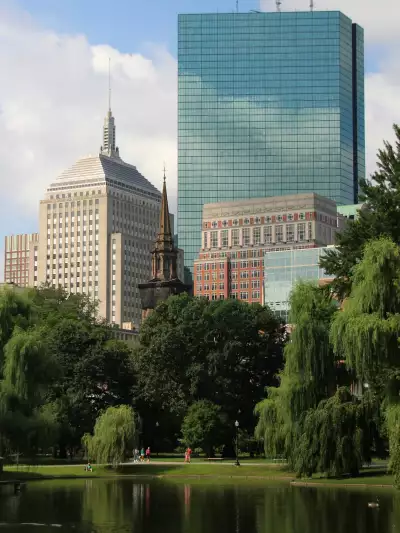
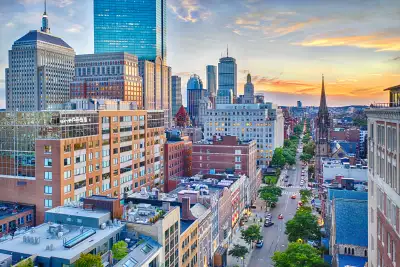
Boston Common
Federico Rancati
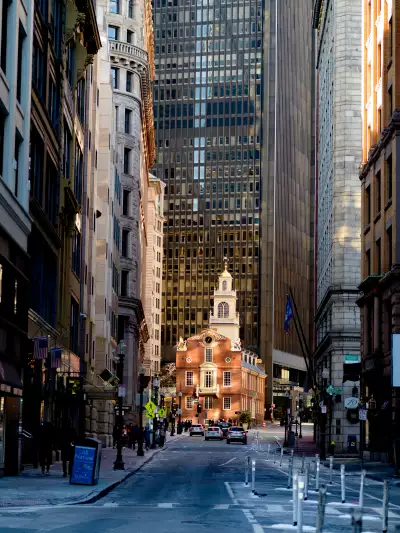
Old State House
Phillippe Murray Pietsch
Our guide, Tom, of Irish and Slovakian descent (“welcome to America”, he says) and who shares a first name with my dad, pauses. We look down one particular street just down from the North Square by Paul Revere’s house. Buildings from the 17th century all the way to the 21st century all sit right there in your sightline. “Maybe not that impressive for Europeans”, he says, “but for America, this is pretty rare”. Welcome to Boston, I say to my dad.
History tours, oysters, and close to 30,000 steps a day with your dad might have, admittedly, been a slightly tougher sell when I was under the age of 22. But now, mid-to-late 20s, it’s infinitely more enticing than lying on a beach for a week in the Mediterranean. Growing up, my sister and I would often laugh when we’d ask for his list of dream travel destinations. Our list would feature New York, the Amazon or Tokyo, while his veers towards St Petersburg, Derry and Munich – cities ripe for a The Rest Is History episode; the epitome of dad-core. Places that you couldn’t really justify bringing children to before they are all grown up. Boston, for the history nerd, is arguably America’s most interesting city. For the Irish history nerd, it definitely is.
My dad was in a generation that had to deal with a similarly large exodus in the 1970s and 80s to the one that originally brought the Irish to Boston, this time caused by a significant economic downturn. Every week, there was a going-away party for someone new, often to Britain, but also to America, which has always held a place in the national psyche. Boston saw a renewed influx of young Irish in the late 1970s and 80s, the largest sustained wave since the 19th-century famine era, as the Irish economy tanked.
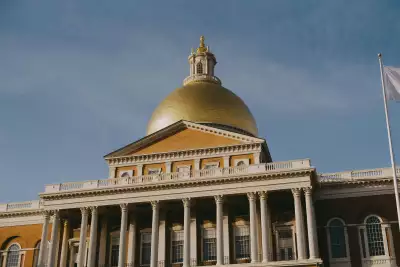
Massachusetts State House
Aubrey Odom
Few foreign countries have latched on to the American Dream mythology quite like Ireland. My dad was nine when JFK undertook the first-ever state visit to Ireland by a US President, one of a crowd of over 200,000 who turned out to see him, watching the parade from his father’s office on O’Connell Street. “We all had American flags and waved them from open windows,” he remembers, a scene we couldn’t be further from today. In the Oyster House, we sat in the booth Kennedy apparently favoured as a Massachusetts senator, and mull over how much has changed.
The significance of that moment was always mostly lost on me, illustrative of shifting generational perceptions of the US in Ireland. Generally, we don’t have a track record of being especially normal about state visits – Barack Obama’s arrival in 2011 was commemorated with Ireland’s most ludicrous landmark, a service station in his name near where his ancestors were from on the border of Offaly and Tipperary.
Although America has never been close to perfect, somewhere along the line it became a country that, while for his generation it meant prosperity, for mine is perceived more as an almost rogue aggressor. While in Boston, we receive constant newsflashes of the US and Israel launching a series of airstrikes on Iran, plunging the Middle East into chaos while joining forces with a state that has been accused of genocide, deliberate starvation, and other violations
of international law.
However, Boston, we found, feels culturally opposed to this 2026 version of America. Massachusetts has the highest concentration of Irish-Americans of any US state, at around 20%, and its influence feels even deeper than that. Almost everyone we meet claims some level of Irish heritage, but also backgrounds from all different corners of the world. It’s a city built from struggle, conflict, assimilation and perseverance, with a revolutionary history that, especially today, it feels immensely proud of. It’s a place where marrying a notion of returning America to past greatness with an aggressive, lethal immigration enforcement regime feels as nonsensical as it is insidious.
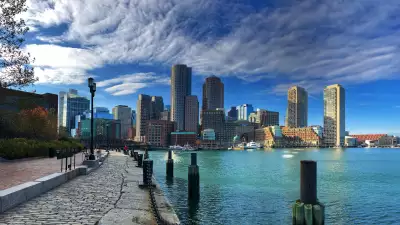
Boston Harbour
Jimmy Woo
On a crystal-clear, biting-cold morning, we tour the Freedom Trail, tracing the city’s key role in the American Revolution. It’s the birthplace of Paul Revere, Samuel Adams and Benjamin Franklin, the scene of many of the defining moments that created the country we see today. Snaking through Boston Common, where British soldiers set up camp, downtown to the Old South Meeting House, where the Boston Tea Party began, and towards the site of the Boston Massacre, where British soldiers opened fire on civilians, more through incompetence rather than bloodlust, accelerating revolutionary motivation through propaganda suicide.
“You probably know all about that,” our guide says, and we laugh. Revere especially has his DNA all over the city. My prior knowledge mainly involves his famous midnight ride, a historical story that, like so many of the best, is wildly misrepresented. “I’m not sure shouting ‘the British are coming’ at the top of his voice while trying to avoid capture would have been the best strategy”, our guide says.
On our final night, we head upwards towards Cambridge, pit-stopping at Harvard (you guessed it, America’s oldest university), before heading to Urban Hearth for dinner. Run by chef Erin Miller, it exclusively uses locally sourced ingredients to create sharing dishes like Brussels salad and kimchi pancakes with miso mustard dressing, and juniper-rubbed swordfish with parsnip creme.
I let my dad take the lead, maybe as payback for the times he had to eat at Flunch in France when I was a kid, or maybe my appetite hasn’t yet fully recovered. Either way, afterwards, he claims it was one of the best meals he’s had in years. We had expectations of Boston, but discovering it as a premium dining destination was one of the most pleasant surprises.
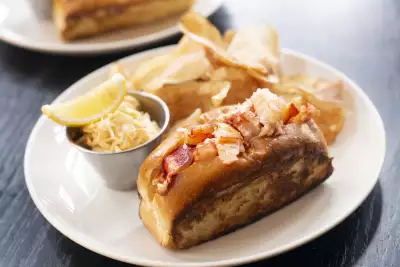
Lobster roll at Row 34
The next day, on the morning before our flight, we make plans to embed deeper into Boston’s Irish side by visiting Southie, but winter weather forces us to change tack, and instead we get oysters, New England IPAs and lobster rolls for the road at Row 34. The Irish know how best to take shelter from rain. Some of his age-old wisdom: always leave something you want to come back for. That list is long in Boston.
Do it yourself
For booking travel to Boston and the wider USA contact the experts at Journeyscape.com. For what to do in Boston meetboston.com