Sunday evening in the Polish city of Łódź, and I’m in a swimming pool changing room completely unclothed, save for a cerulean swimming cap and a half-peeled-off bikini, as an elderly lady tells me about boiling berries. I happened upon this pływalnia and its faded mint-green façade on Google Maps, swiftly wrapping up against the night chill to find it and join one of the three public swimming sessions that take place each week.
Swimming is something I like to do often, and enjoy even more when travelling to new places. After paying the 14 złoty entry fee (in cash, no cards) and depositing my high-tops and coat in the reception area, I was delighted to find the most pristine changing room and swimming pool of my life. Which is precisely why I wasn’t allowed to enter the water – sectioned into four with those red, white and blue plastic lane ropes that seem standard the world over – without securing my hair under a tight wrap of borrowed shiny silicone.
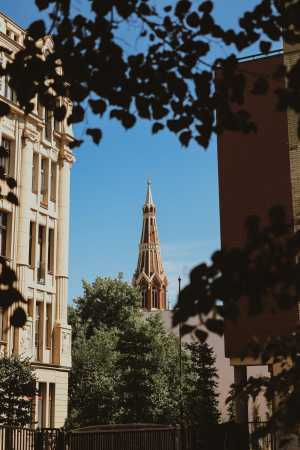
Church of Saint John Evangelist in Łódź
Drying off post-swim in a warm communal changing space, I forgot I was wearing the swim cap when a bushy eyebrowed woman turned to chat. To this day, I can’t remember exactly what sparked our conversation, but I do remember her talking excitedly about the upcoming arrival of the Cornelian cherry bushes’ berries since her favourite yellow flowering shrub was about to fruit. Describing the sour, bright red berries’ imminent arrival, she happily revealed she would be boiling them into a drink with plenty of sugar to counteract their tartness.
Minutes later, she was gone, dashing out of the changing room to catch her bus home, leaving me confused, half-clothed and wondering what a Cornelian cherry bush was. Once dressed, static-haired and back in the warm and homey studio apartment I was renting, I searched for the Cornelian cherry online, quickly discovering that this joyful-looking bush symbolises resilience and new life after the long, harsh winter. It was a theme, I was about to discover, that runs deep throughout Łódź’s long history, one that’s seen the city rise and fall, and thankfully rise once again.
Having spent the past decade visiting cities rarely written about in guidebooks, places like Timisoara in Romania, Sri Lanka’s colourful Jaffna and kooky Batumi in Georgia, there’s nothing that excites me more than visiting a new, unknown metropolis. Which is how I found myself in the edgy ex-industrial city of Łódź, drawn to it by its quirky name, which I later learned is, in fact, pronounced “woodge”. Upon arriving, I realised the place has been shaped by a remarkable industrial past.
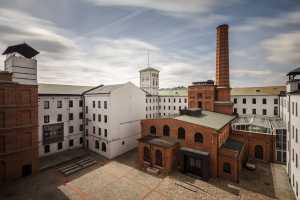
Textiles museum
Łódź is a city where generations of hard-working, supremely skilled women powered its prosperity, all from the towering textile mills and factories that can be seen scattered across town. Its downfall came swiftly after the Second World War, when sweeping unemployment, poverty and depopulation earned it the moniker “Polish Detroit”. Scarred, dilapidated and crumbling, the once booming city was nothing more than a cracked shadow of its former self.
Recent years have seen Łódź flourish anew, its revival closely woven with a vibrant, ever-growing creative spirit
Yet, despite these hardships, recent years have seen Łódź flourish anew, its revival closely woven with a vibrant, ever-growing creative spirit that’s seen art galleries, more than 170 large-scale street art murals and whimsical neon signs spring up in abundance. As an art lover, this creative revival provided yet another reason to visit (aside from its curious name), which is why I made a base in Łódź, for a week-long immersion into the street art world.
I had been in town barely five minutes when I was struck by the bold green and cerise tones of a piece called Out of the Jungle by Brazilian artist Nunca. Dominating the end of a five-storey-high apartment block, the piece mimics an etching style once used by conquistadors in portraying indigenous Brazilian tribes, in turn, a comment on the oppressive nature of colonialism and its long-standing aftereffects. Then, mere moments later, as I entered the enclosed car park where my flat was located, contemporary Polish art revealed itself in the form of a modern-day Michelangelo’s David, hyper-realistic with its swirls of gunmetal grey and silvery slate shades, and a blue-robed Virgin Mary, eyes closed, eclipsed a pale green painted tenement block. I quickly realised, this impressive urban city gallery, brimming with hidden meanings and subtle messaging, boasts street art that doesn’t need seeking out at all – from paste-ups to vast paintings, it’s literally everywhere.

Rubinstein's mural
During those first few days, as I walked past communist-era housing estates and 1950s socialist realist blocks of flats, the monochrome, devoid-of-colour murals I photographed matched the greyed-out late-winter sky. A colossal black-and-white painting of the Greek god Atlas holding the world on his shoulders beamed out from a high-rise block. Polish artist M-City’s (Mariusz Waras) graphic sepia design, alluding to the city’s industrial past with a giant, incredibly detailed metal cog and a couple of sad-looking chaps locked in an embrace, caught my attention from a mud-carpeted car park. Haunting, dramatic, exquisite, I became obsessed with hunting out more murals.
Then, halfway through my time in the city, I awoke to find brilliant blue skies. Skies, once described by the iconic filmmaker David Lynch as having “low-hanging grey clouds” and “beautiful winter light”. Drawn to the place for its cinematic quality, it turns out Lynch was a fan of Łódź too, having visited a handful of times to utilise the city’s abandoned factories as backdrops for various creative projects. As the days grew brighter, that beautiful winter light, as described by Lynch, wonderfully highlighted some of the more striking murals of the city.
I started to stumble upon murals full of colour, pieces like Plantacja Kakao (Cacao Plantation) by Paulina Kwietniewska, which depicts Nigerian cacao plantation workers tending their crops. Commissioned to draw attention to the need for sustainable cacao practices and ethical chocolate production, it proves that street art not only brightens and revives a city, but can also impact thought and bring about real change. And a few streets further, hundreds of delicate wavy lines of blue amassed to create a curling 50-foot-tall wave. Further still, a retro pale green, lemon and white image of a faded butterfly appeared – I later learned it’s one of the city’s oldest.
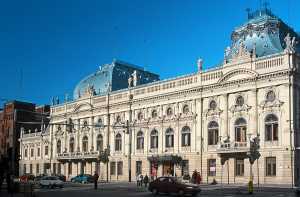
Poznanski Palace
Painted directly onto the side of a tenement house in 1987, the fascinating Art Deco-style creation is actually an advertisement for the state-run hard-currency retail chain Pewex and the most famous communist-era painting that remains in the city. Unlike Łódź’s latest additions, painted for creative prowess, the Pewex butterfly signifies a time when murals and neon signs were utilised to sell, sell, sell.
From the mid-1950s onwards, the approval of storefront advertising led to a wave of neon signs being installed outside shops along the city’s main thoroughfare (and the longest in Europe), Piotrkowska Street. Unfortunately, today, most of the advertising signs have long since burnt out and have been dismantled. Yet inspired by the city’s glowing past, a few new neon signs have been commissioned in recent years and installed in the name of art, which is how my nighttime strolls of Łódź became so wonderfully enchanting.
Standing under blue luminescence, I deciphered a couple of these new neons through my phone. The word Bałuty, the name of a long-standing working-class area of the city, switched to ‘Beauty’ every few seconds, commenting on the neighbourhood’s subtle yet alluring appeal. Similarly another flashed, from the word Wdech (breathe in) to Wydech (breathe out) and back again in what felt like a mini modern-day meditation.
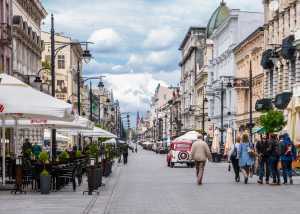
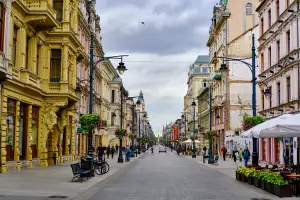
Piortkowska street
But my favourite – a small seagull with flapping wings, perched on one of the defunct weaving factory’s chimneys – I discovered on the night of my swim, just off Juliana Tuwima Street. What I didn’t realise during that brief exchange with the bushy eyebrowed woman in the changing rooms was that the small surreal encounter would become the lens through which I began to understand Łódź. As the days passed and I wandered alongside the city’s dormant factories, past cracked façades, the symbolism of that wintering Cornelian cherry kept resurfacing. At first glance, the city and its hushed courtyards can appear muted and greyed out, but linger a little longer, and its layered vibrancy reveals itself through painted concrete and the faint glow of neon.
From the female textile workers of yesteryear, who organised the largest strike in post-war Poland against rising food prices, and pioneering Polish artists who challenge stereotypes and spark conversation, to chatty half-naked locals, Łódź will always possess an exuberant energy. There’s no denying that at times, that spirit has simmered quietly beneath the surface, much like a Cornelian cherry bush lying dormant through winter, biding its time. But now, at last, Łódź and its residents are experiencing their moment in bloom, flourishing once again, spurred on by the transformative and wonderfully addictive power of art.