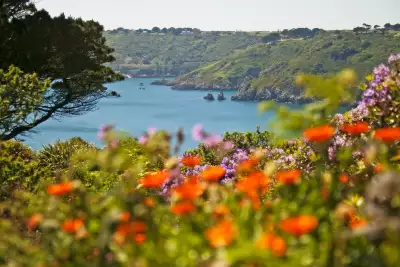
As I bend down to pluck what I’ve just been told is a wild leek from a patch of grassland which abuts the rocky, windswept beach at Grand Havre, on the northwest tip of Guernsey, my foraging guide, Tara Brimson, issues a quick warning: “Don’t try and pick shorter plants which grow close to a pathway,” she explains – “they’re at perfect dog-peeing height.” Canine urine is certainly one dressing I don’t want on a wild salad, but it’s clearly an occupational hazard for Tara from Wild Guernsey, who runs foraging walks and retreats. When the whole land and sea are your larder, there are bound to be a few unwanted extras on occasion.
Today’s foraging session is aimed at showing muggles like me (read: city dwellers) what edible bounty is available in the great outdoors here: in fields, in grassland, and on beaches. Within the first ten minutes she’s pointed out – and got our small group to taste – nettles (you avoid getting stung by crushing the leaf into a ball with your hands), ribwort plantain (found commonly in people’s gardens, apparently, and with a nutty, mushroomy flavour), sea radish (a coastal plant from the cabbage family with a spicy kick similar to wasabi or horseradish) and the aforementioned wild, or Babington’s, leek, a pungent allium. All of these can be used as highly palatable ingredients in dishes, or as a garnish, and Tara also highlights the plants’ nutritional value when she’s describing them.
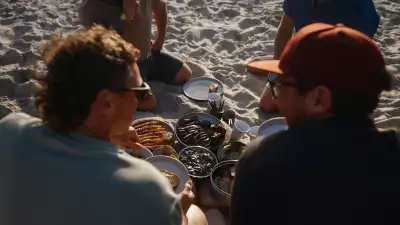
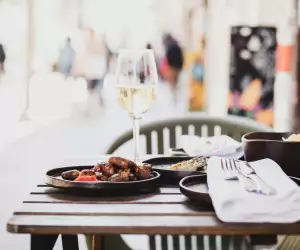
A summer beach barbecue spread at Grandes Rocques
This value increases exponentially as we head to the shore and rummage through vast clusters of different seaweeds. Seaweed is high in antioxidants, iodine, protein, vitamin C, and essential fatty acids, and Tara explains that there are over 700 types. “Because none of them is toxic or poisonous in any way,” she explains, “you can, technically, eat all of them.’” However, she would only describe around 25 or so as ‘delicious’. These include rock samphire – whose little branches remind me a bit of mistletoe – which has a citrus-like piquancy; sea spinach, with its thick, waxy leaves and similar taste and texture to its namesake; and sea lettuce, a bright green alga with a slightly salty, cucumber-like flavour which Tara often makes into pesto. Personally, I’m childishly enjoying popping the little bulbs that bulge from clumps of bladderwrack (you can use the tips in broth or make them into a condiment) and running my hands through the wide, slippery strands of brown kelp, which remind me of ribbons of pappardelle.
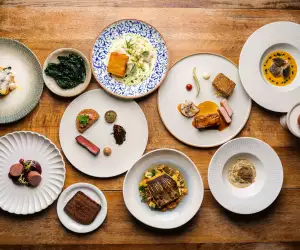
It turns out, however, that my favourite way to consume seaweed is in a martini – specifically the one on the menu at Vraic, the island’s first Michelin-starred restaurant in over a decade, which just happens to be a short walk from the beach. I’m having lunch here with Jo Dyer-West from Visit Guernsey, to find out more about The Big Eat, a food festival which is having its inaugural edition during my visit in April. The martini is made with kelp-infused vodka, plus sake instead of dry vermouth, while the glass is spritzed with a pepper dulse vodka made from Guernsey seaweed and draped with a piece of channel wrack; it’s beautifully briny and savoury. Over this, and an insanely good tasting menu carefully put together by head chef Nathan Davies (seaweed features prominently; shout out to the cup of deeply umami seaweed broth, and the zingy crab and seaweed tart), I find out more about the month-long festival. Jo explains that it was created earlier this year to help visitors discover what Guernsey has to offer in terms of food and produce. “We’ve got great seafood, great dairy, and great farmers and producers,” she says. “It’s a celebration of chef innovation, of new flavours and experiences, and also of our heritage.” The next iteration runs throughout October; Tara will be leading a foraging retreat as part of it, while Vraic may also create a special menu again.
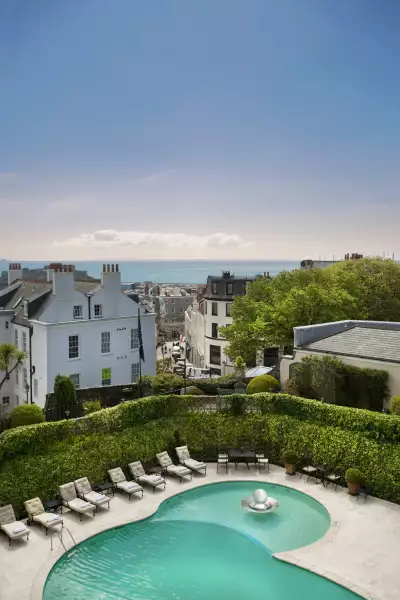
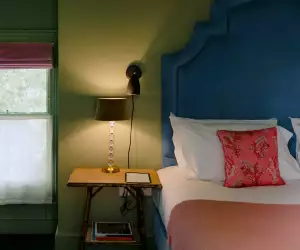
The Old Government House Hotel
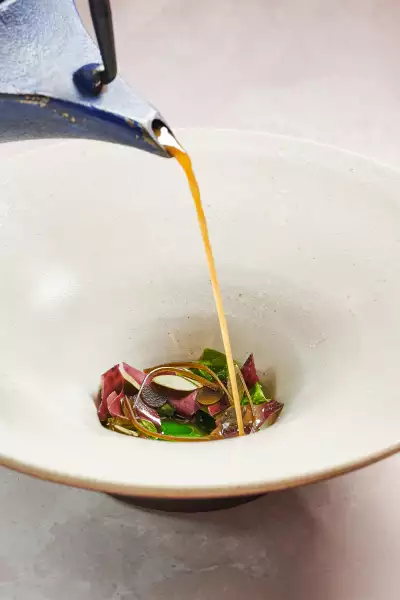
Vraic seaweed broth
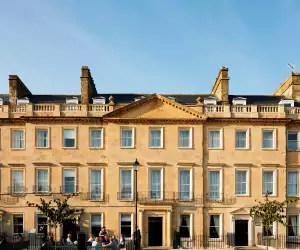
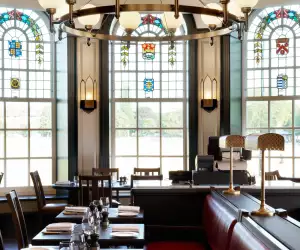
Afterwards, I head back to St Peter Port, Guernsey’s cute but compact capital, and stop off at Rouge, a chic wine and cheese bar which is part of the festival’s Guernsey Grand Fromage Tour. Participating bars and restaurants offer a wine and cheese pairing, usually for around £12, which you can mark off on a special passport (the aim, of course, is to do them all). Rouge is offering several selections, and between myself and the friends I’m with, we demolish – variously – a Spanish cava, a French merlot, some kind of port, a truffle-infused hard cheese, a cool, creamy Brillat-Savarin and an intense blue. Another participant in this fromage frenzy is the hotel I’m staying at, the historic, five-star Old Government House. A grand, nay, stately, structure, it dates from the 18th century and was formerly the official residence of the Governor of Guernsey (which includes the islands of Sark, Herm and Alderney) before becoming a hotel in 1858. Murano glass chandeliers, marble flooring, walnut wood panelling and cushions embroidered with pictures of dogs in military dress are all present and correct. However, the restaurant is a little more rooted in the 21st century, its menu including gluten-free and vegan options, and its Grand Fromage offering a very modish spiced butternut cheesecake.
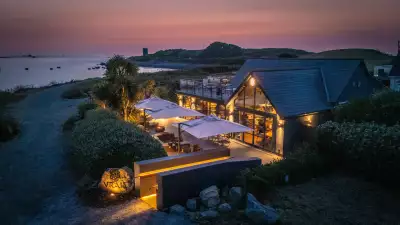
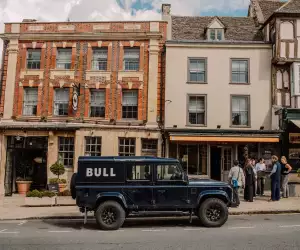
Vraic exterior
While I’m here, I also get the opportunity to meet a few passionate producers. At the Little Big Brew Company, a ten-minute walk from the town centre, I chat to director and head brewer Dan O’Brien. A Guernsey local, he founded the brewery and taproom in 2020, and makes a range of beers with names linked to sailing. “When I was growing up here, there wasn’t a great deal of choice [of beers],” Dan confesses. “I started the brewery to bring that element of choice to the island.” His beers are brewed to the Reinheitsgebot principle, a historic German purity law that ensures only water, barley, hops, and yeast are used in the brewing process. Breaker is a crisp, fresh helles lager while Mainsail is a refreshing session IPA, and Zero Knots is – you guessed it – alcohol-free. The taproom draws a regular stream of residents and visitors and, as I sip a Breaker against the backdrop of a large mural of a bulldog wearing a Guernsey jumper at the helm of a boat, I make friends with two real-life pups whose owner has popped in for a quiet drink.
Later, I spend a couple of hours with Sasha Marsh, who established The Soil Farm, a regenerative farm located towards the northwest of the island, 15 years ago. It’s home to a handful of pigs (two of which are amusingly named Del Boy and Rodders), a sizeable flock of chickens, and a few cows. Sasha and her partner Jock started the farm to ensure people could access organic fruit and vegetables free from chemicals and pesticides. “When I started researching how a lot of food is grown, Jock and I came to realise that the soil is absolutely everything – it’s the vital component to how we get nutrition into food and then into our bodies,” explains Sasha. “Now even more people here have become interested in this kind of regenerative growing.” Today they grow almost everything you can think of, from tomatoes to courgettes, asparagus, peas, mustard leaves and edible flowers – even bananas and figs. Much of her produce, when it isn’t being shipped to supply local restaurants, is sold through her Farm Shop, a kind of collective that also allows other producers to sell their goods here.
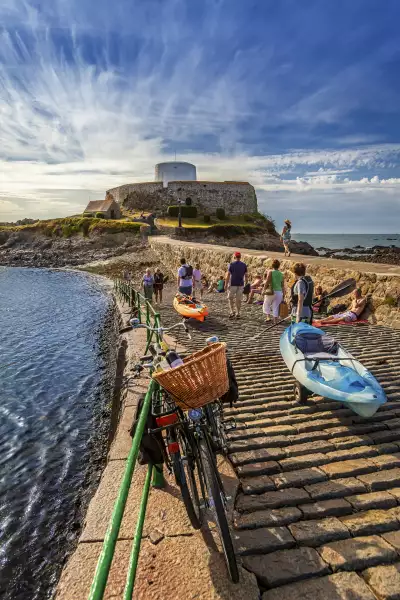
Fort Grey in Guernsey
Chris George / Visit Guernsey
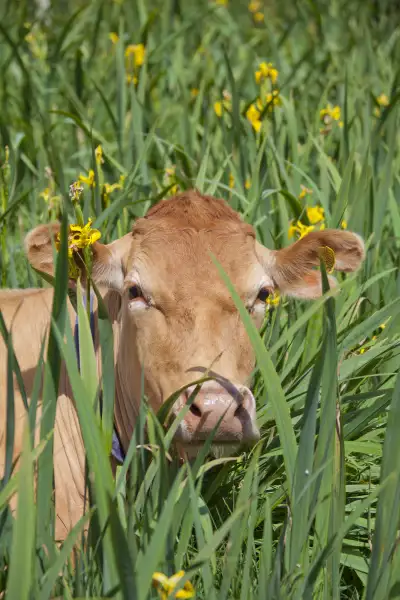
A Guernsey cow
Chris George / Visit Guernsey
Perhaps my favourite day, however, is spent on the island of Sark, a 50-minute ferry journey from Guernsey. Famously, no cars are allowed here, so transport is done either by bicycle or tractor. It’s the kind of idyllic, pastoral, picture-perfect setting that features horses grazing peacefully in fields, pathways lined with hedgerows, and wildflowers blooming everywhere, all to the soundtrack of mellifluous birdsong. Setting off on a beautiful walk towards the south of the island, I drop into Caragh Chocolates, a local company established over 20 years ago which makes mouthwatering treats, often using rich Sark cream, and sample a few (obviously). Afterwards, I have lunch at one of the independent restaurants that line The Avenue, the island’s one main thoroughfare. Time and Tide has a seafood-focused menu which includes the likes of whole spider crab and catch of the day. Sitting in the sunshine, enjoying a glass of chilled rosé with my pan-fried pollock – freshly caught that morning – alongside crushed potatoes and capers, feels like the very definition of heaven. And armed with everything I’ve learned since coming to Guernsey, now I can identify even more of the leaves in my accompanying salad. Next time, I might even pick them myself.
Flights to Guernsey start from £69.99 one way, aurigny.com. Double rooms at The Old Government House Hotel from £295 per night; theoghhotel.com. For more information, visit thebigeatguernsey.com and visitguernsey.com