I’m about twenty minutes off the plane when my guide, Viktoria, admits to me with a wry smile that Finland is a nation of introverts. “A joke went round during Covid,” she says, “that when the world was mourning only being allowed within two metres of one another, Finnish people said, ‘Does that mean we have to get closer together now?’”
For certain travellers seeking escape, this sounds like nirvana – although limits can be tested. On a ferry in the country’s eastern archipelago, a German tourist, evidently starved of small talk, clocks my accent and quickly engages me. Travelling as an Irish person contains certain benefits, chief among them a certain approachability.
In Finland, this is more like a shining beacon. He tells me he is half-Finnish and loves the country – spending months at a time in the summer with his husband, attracted by the peace and nature on offer. He has, however, been dying for a yap.
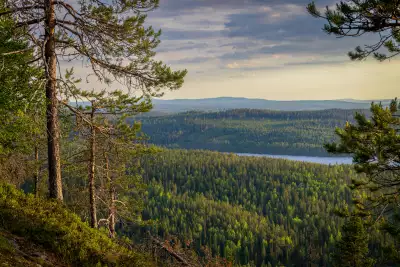
Lakeside forest in Eastern Finland
As your most Myers-Briggs-pilled friend might tell you, introversion does not mean anti-social – a nation of lonely souls won’t get you to the top of the happiness rankings. Every year, the UN publishes its World Happiness Report, attempting to quantify a question that has plagued philosophers into a neat, if nebulous, table.
This report throws up some results you may not have guessed – the UK ranks 12 spots above Spain, and Israel ranks in the top 10. Nordic countries, unsurprisingly, lead the list, but it is Finland that really shines, currently in the middle of a nine-year streak at the top of the rankings.
It’s seen them dive headfirst into the recently coined ‘happiness tourism’, travel aimed at boosting your brain’s serotonin levels through, generally speaking, a mix of nature immersion, mindfulness, urban detachment, and a search for meaning in travel beyond queuing to snap the same photo every tourist also gets.
The ferry is taking me to Kaunissaari, a barely inhabited island in the Gulf of Finland. For most of the year, the island's permanent population is just ten. In the summer, this expands significantly – into triple figures. It translates in Finnish to ‘beautiful island’, and this is not idle boasting.
It’s in the same region that recently launched an initiative offering all-expenses-paid trips to travellers to ‘teach them about happiness’, building on the country’s expertise in the area. Strictly, I’m not here to be taught how to be happy. But I am here to experience the things that, apparently, make people so – nature, fresh air, escape, clean food, and, of course, sauna.
Gulf in class
Kaunissaari is one of 400 islands easily reachable from Kotka, the port city at the mouth of the Kymijoki River. Its national importance outweighs its population of just 50,000: Hamina-Kotka is Finland’s largest port, connecting the country to the Baltics and the rest of mainland Europe from the Gulf of Finland.
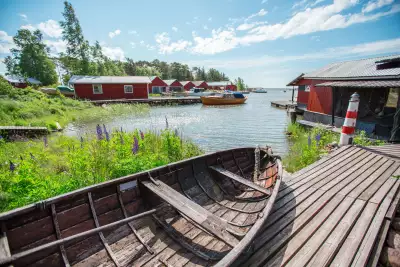
Old wooden boat on Kaunissaari Island
Julia Kivela
Until 2023, it was also where Finland linked to Russia through trade – before the war, the stream of European purchases, such as cars, was constant on the road from Helsinki to St Petersburg, which Kotka intersects – and also through tourism. This was a major stopping point for Russian cruise ships, and Russians have been visiting for generations.
After Kaunissaari, we stop at a fishing lodge by the Langinkoski rapids, built by Tsar Alexander III, who visited Langinkoski in the 1880s and was so taken with the rapids and salmon fishing that he ordered the lodge to be built.
The border is now closed, leaving Finnish tourism somewhat imbalanced. While hordes of tourists from Europe, America, the Middle East, and India continue on a steady conveyor belt to Lapland, head south, and it remains somewhat overlooked, where island-hopping and outdoor adventure fill the summer months.
As a handful of us step off the ferry, the museum and main restaurant remain shut, and most of the island’s summer huts remain uninhabited – in some ways, visiting Finland in May feels a little like arriving at a party just slightly early. The weather has taken a turn for the better – sunlight in the evenings does its best to stretch to midnight, the temperature an idyllic 20 degrees – but summer locales have yet to shake off hibernation.
One spot does remain open, the Blueberry Café on the far side of the island, so we resolve to navigate the circumference with it as a pit stop, a two-hour loop through forest and sand, rewarded with a blueberry pastry.
That even here escape from the relative crowds is considered a necessity says something about the national psyche
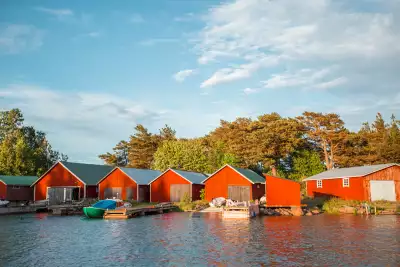
Evidence of settlement on Kaunissaari dates back to the 1500s, and by the 19th century, it had grown into a fishing village, which still lends much of the island’s charm through traditional red Nordic huts. Now, it is primarily a summer holiday destination for those seeking a slow pace of life, long stretches of sandy beaches, maritime pine forests, and recent Merlin app obsessives (Finland, in general, is something of a twitchers’ mecca).
Island escapes are a well-established Finnish pastime. There are over 150,000 islands in the country, the third most in the world. Finland is the eighth-largest country in Europe but only its 24th most populous, with just 5.6 million people. That even here escape from the relative crowds is considered a necessity says something about the national psyche.
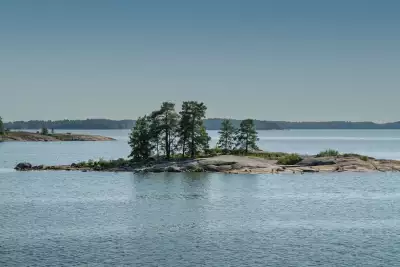
A small island in Finland's Eastern archipelago
Hot and steamy
Arguably, Finland’s most famous export is the sauna, and although most will be aware of the country’s association with sitting and sweating in a hot room, the extent may still surprise. Finland has over three million saunas; there is one in every government building, and it plays a vital role in the country’s social life.
The first written descriptions of a sauna in Finland emerged in the 12th century, but it’s only recently that other countries, Britain included, have really caught the bug. British coasts are now littered with pop-up hot boxes, which have doubled year-on-year since 2023 according to the British Sauna Society, and British Vogue even declared the sauna would overtake the pub as a socialising hub of choice.
We needn’t worry too much about this, however – in Finland, sauna is not a replacement for drinking. As a common saying around here goes: “If booze, tar, and the sauna won’t help, the illness must be fatal”.
Just outside Kotka, I’m staying at Santalahti, a resort of self-catered wooden cottages on the sea that feels a little like a summer camp. The real trump card of the resort is that every cottage comes with its own private sauna. After a late evening run in the nearby forest – and two nearly twisted ankles – I fire it up, enjoying my first, and what I imagine will be my last, experience of a private sauna.
By the time I’ve reached the shore, my body temperature has regulated to the point where wading out into the Baltic Sea no longer holds the same appeal it did in the sauna
I liberally conjure up löyly, the vapour that rises when water is ladled onto the hot stones, safe from worrying about the steam etiquette of public saunas. To sauna-maxx, it’s best enjoyed interchangeably with submerging yourself in some icy water. If it’s the sea or a lake, even better. The resort may be on the shoreline, but my cottage is about 100m up into the woods – close enough to try it, far enough for it to backfire. I deploy more löyly as if it’s a power-up boost in a video game, and knowing speed is my friend here, quickly pull on my boots and make a beeline for the sea, emerging out of the forest like a milky spectre.
By the time I’ve reached the shore, half-naked and afraid, my body temperature has regulated to the point where wading out into the Baltic Sea no longer holds the same appeal it did in the sauna. After a doomed exploratory toe-dip, I sprint back to my cottage, resolving that a cold shower would be a better idea.
Branching out
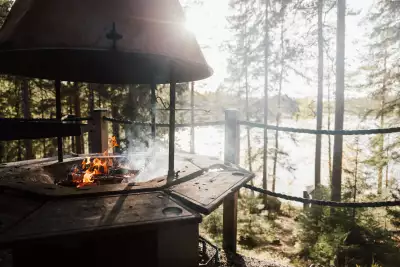
Fire pit in Kukuljarvi
The next day, after leaving Santalahti, I meet Simo, a wilderness and nature guide, for a hike through the Kukuljärvi nature trail in Uusimaa. He spends the winter doing northern lights and cross-country skiing expeditions in Lapland, and returns south in the summer for kayaking and rafting trips.
A few hours in, we sit and enjoy another of Finland’s favourite pastimes – a coffee break (Finland has the highest coffee consumption per capita in the world), and we talk about jokaisenoikeudet, a term which defines outdoor adventure in Finland. Of all the Finnish phrases I learn, it might be my favourite – or at least the closest I can get to distilling what might make Finland so content.
Essentially, it means ‘everyman’s right’, a national entitlement to wander, forage and camp in forests and natural areas that may be privately owned. It’s an expression of trust, an acknowledgement of common interest and greater social good.
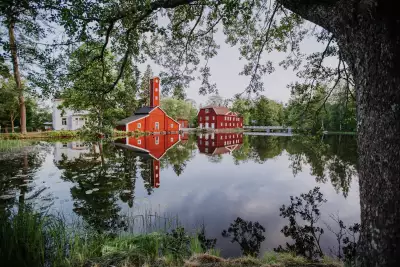
Traditional building in Strömfors
At the end of the hike, we descend into Strömfors, a preserved 17th-century ironworks village established when the region was under Swedish rule, its location at the westernmost junction of the Kymijoki River ideal for transporting goods. It’s visually striking, defined by Nordic red-and-white wooden buildings and a sleepy procession of trinket shops that only really start opening their doors after 11.
It’s also here that Laawu Wellsters is based, my accommodation for the night, only accessible by paddling via kayak or canoe down the estuary of the Kymi River, flanked by wooded pine, to a small island where a diminutive wooden hut sits. This is glamping done Finnish style – the bed is proper, but it’s remote. After two hours paddling, despite it being a balmy Sunday afternoon, I’ve not seen a soul, save for some seabirds and a beaver’s lodge.
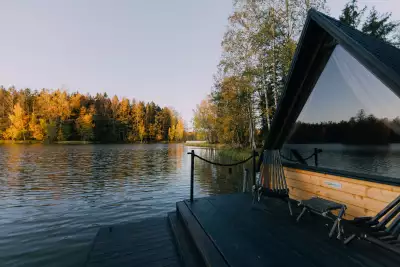
Accommodation at Wellsters on the Kymijoki River
As in many countries with harsh, often unforgiving climates, appreciation for nature runs deeper. The political explanations of Finnish happiness are well documented – access to health care, education and welfare protection – but its relationship to its vast natural environment shouldn’t be underestimated.
These summer days on the lake, sunlight lingering towards midnight, are earned in the sub-minus-thirty-degree darkness of deepest winter. For those seeking a quieter, restorative form of adventure, Finland is hard to beat. For those seeking happiness, if Finland’s nature doesn’t help, it might be fatal.