An estimated one in eight of us has claustrophobia – the fear of confined or enclosed spaces, driven by the dread of being trapped, running out of air or losing control. My mum is profoundly claustrophobic, particularly underwater – the legacy of a near-drowning off the Devon coast when she was small. It doesn’t trouble her day-to-day unless she’s confronted with an underwater scene on film, at which point she taps her chest, goes very quiet, and leaves the room. Inconveniently, my father’s favourite franchise is James Bond – which reliably involves Pierce Brosnan (or, more honestly, his stunt double) conducting an underwater knife fight in an ill-advised tuxedo, firing at a villain while the limp body of a covert agent lolls in his other arm. I’m not as bad as my mother, but I’m claustrophobic enough: small lifts, underground tunnels, the specific horror of being pinned underwater with no air. Which is why it feels like a dark joke that, when I collect my wetsuit for my first proper scuba dive, the identifying number drawn on the back reads 007.
Why am I learning to dive when I can barely hold my breath for 10 seconds underwater without feeling caged? Some pull towards doing things that feel hard, perhaps, or the fact that every single person I know insists scuba diving isn’t really claustrophobic at all. Mostly, though, I want to see more of what covers over 70% of the planet. Satellite images show we live in an ocean world – vast blue, freckled with green.
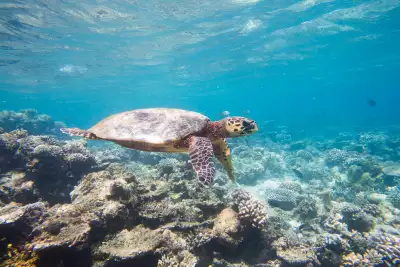
Turtle
Whatever my motivation, I’ve signed on the dotted line, and I’m locked in. The reward is Gili Lankanfushi in the Maldives, where I’ll try to conquer my fears (worse places, eh?). But every good thing starts somewhere less glamorous, and mine starts at Stratford’s Olympic swimming pool.
The Living Daylights
Three hours into an eight-hour intensive PADI open-water course, and things aren’t going to plan. To qualify, you have to tick off what my instructor, a bouncy teenager of no more than 18, calls “the very simple procedures.” One involves ducking under, flooding your mask, and clearing the water out through your nose. It matters because if someone kicks you in the face mid-dive and you can’t clear it, you’re effectively blind. Nose-based water clearance, it turns out, is not my calling. I try it five times, each attempt ending with me inhaling and spluttering like a broken kettle. He persists, but firmly lets me know we can’t move on until I manage it. A whole 40 minutes later, we can finally move on to the next skill.
The rest of the day passes in the Olympic diving pool, much of it spent sitting on the bottom, waiting for others to have their skills signed off. I’d be lying if I said it didn’t feel quite claustrophobic, with my focus increasingly fixated on the sensation of water weight on my shoulders, five metres deep. I keep trying to inflate my jacket to bob up for air (which makes no sense – I’m breathing through a regulator feeding me perfectly good air) until the instructor wags a finger, encouraging me to stay on the pool floor. Eight hours in the pool, ten pruned fingers I fear will never uncrinkle, and I’m half-qualified. To the Maldives I go, packing my suitcase but hoping my claustrophobia is left firmly behind.
For Your Eyes Only
The Maldives, to the uninitiated, is a good deal nicer than Stratford. Gili Lankanfushi sits in the South Malé Atoll, a 20-minute speedboat from Velana International Airport. Guests arrive to a “no news, no shoes” policy (pedicures in, notifications off) at one of the largest lagoons in the country, a soft-serve swirl of beach, sandbank and reef. Not one of the thatched villas stands on dry land – the bulk are strung along wooden walkways, and the Crusoe residences, out at sea, can be reached by boat alone.
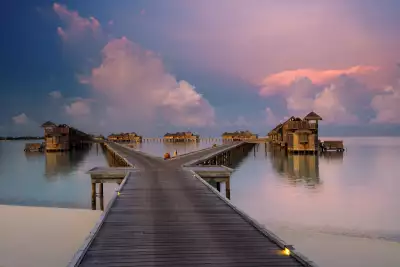
Overwater villas at Gili Lankanfushi
Each bedroom is its own clapboard cocoon, where you awake each morning to a meditative lap of waves. Every villa comes with a snorkel, a gateway drug to scuba diving. A reef rings the buildings, and I spend my mornings among the Nemos and Dorys, the water as clear as vodka. Wildly relaxing – apart from the morning my internal GPS fails, and I let myself into a stranger’s villa, walk into a bedroom that is emphatically not mine, and beat a retreat (running in flippers is genuinely impossible) back to base.
Live and Let Dive
I squeeze into my 007 wetsuit and meet Franco, my scuba instructor (claustrophobia therapist / spiritual guru?). I lug my kit to the boat and try to steel myself, the sashimi now sitting in my stomach like tuna set in aspic.
This is nothing like the Stratford pool. Maldivian water is balmy, and the visibility is excellent – being able to see your own arm in front of you does wonders for the fear of drowning in the dark. We swim past shipwrecks and coral, clownfish and batfish that hang around chasing the air bubbles we exhale. We work through the drills – the dreaded mask clear again – but down here, surrounded by a cast of creatures I’ve only ever met at the London Aquarium, there’s a meditative calm to it, and I go through the procedures methodically. Some manoeuvres feel deeply unnatural – surrendering your air supply; pulling off your mask and clearing it half-blind – but they’re a lesson in staying calm. If you don’t, you can’t breathe.
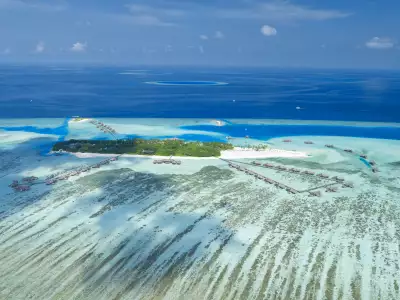
Seagrass flourishes by the overwater villas
A storm rolls in, during which a plant-based feast by chef Hari Govindaraj is nearly swept off the table by biblical rain. The next morning it’s clearing, but Franco warns me that the visibility won’t be up to much. How bad can it be? Bad enough that when I turn up with my GoPro, Franco actually laughs – which I think little of until the boatman looks nervous about ferrying us out. We go anyway. We drop in, I deflate my vest and sink like a stone, and I’m swallowed by a flat, hazy teal. The sand stirred up from the seabed turns the dive into a swim through a swirled-up glass of Ovaltine. I can see almost nothing, and all I can hear is the eerie ting of netting and metal clasps knocking together. This is not doing my claustrophobia any favours. But Franco has brought me all this way, and I refuse to be a princess about it, so I press on – 15 metres down, calmly removing my weight belt and recovering a dropped regulator.
The sand stirred up from the seabed turns the dive into a swim through a swirled-up glass of Ovaltine
Before my final dive, I visit Gili’s marine biology station, where the two biologists in residence, Matthew Patrick and Renald Yude, monitor the health of the reef around the atoll. Climate change has had brutal consequences here – during the 2015-16 El Niño, bleaching hit an estimated three-quarters of Maldivian coral. Their answer is the Coral Lines Project (coincidentally once worked on by a marine biologist called Coraline), which has been running since 2014 and regrows the reef by nursing healthy coral fragments on ropes before transplanting them into the house reef. Fragments are hand-monitored every three months, and guests can adopt a line and track its progress by number. They’re also working to re-establish three species of seagrass, vital to the health of these atolls, which many luxury resorts are tempted to rip out because honeymooners find it an eyesore – the meadows an affront to the blank turquoise canvas they were promised.
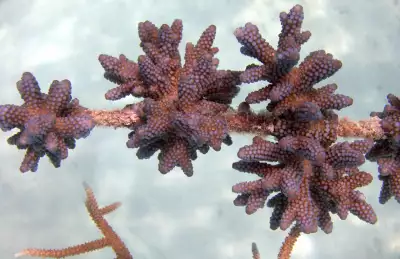
Coral Lines Project
We swim out to see the house reef for ourselves – thick with anemones and fish the colours of a nail-bar swatch card. It would be the easiest thing to come to the Maldives, collapse onto a sunlounger, drink the Piña Coladas and stay entirely disconnected from the wildlife that makes the place magical – so it’s a pleasure to paddle around with Yude and see how far ahead Gili is in making the other option possible.
Octopussy
My final dive is to the Lankan Finolhu Manta Point, a smudge on Franco’s laminated map that turns out to be a cleaning station: a cluster of coral heads where reef mantas queue up and submit to being picked clean of parasites by cleaner wrasse – a full valet service, gills included. They also come in October to feed because the monsoon shunts plankton across the atoll. I’m thrilled and, simultaneously, terrified – this will be the longest, deepest dive I’ve done – at around 18 metres – and there's the chance to meet creatures I’ve only ever seen on a Steve Backshall programme. Ten minutes out from the spot, Franco tells me we might see one or two mantas if we’re lucky.
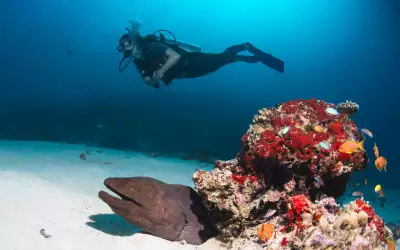
A diver swims over a vibrant coral reef near a giant moray eel in the Maldives
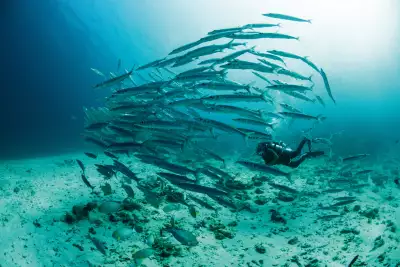
We descend into the deep blue, equalising our ears by pinching our noses to make them pop. Within moments, there’s a shark, an octopus, a pufferfish, and vast schools of fish that flash silver in one motion like a Venetian blind snapped shut. You really do slip into a flow state down here – not something I’d expected of someone this frightened of being underwater for any length of time. The mellow rasp of your own breath through the regulator, the discipline of staying calm so you don’t gulp through your air, the whole troupe of fish indifferent to you – all of it is strangely soothing.
I feel the light dim above me as a shadow falls. I look up, and I’m metres away from five manta rays. They’re simultaneously impressive and bizarre-looking creatures – four metres across, flat as a bath mat, two cephalic fins scrolled tight at the front, and a comically tiny face set into all that bulk. Not one or two, but 15 mantas on that single dive – an unusually high number, Franco tells me afterwards. It seems every dive from here on is destined to disappoint, my very first having set an absurd bar. Transfixed by the rays, I’m grateful to be diving with Franco, because I’ve burned through nearly all my air without noticing. Something that would have terrified me months ago barely registers now, as I hang at the safety stop, before finally surfacing.
Manta rays are four metres across and as flat as a bath mat, with two cephalic fins scrolled at the front
Afterwards, I settle in for a Japanese spread at By the Sea. The food is delicious, but I can’t shake the feeling that I’m distinctly odd and dizzy. Diving at that depth drives home how little business humans have being down here – and, in the same breath, the sheer ingenuity of having engineered a way to see the deep blue safely at all. There’s so much to learn from it, particularly at Gili Lankanfushi, whose shallows are among the most beautiful and wildlife-rich anywhere on the planet. To dive is to grasp, in a way you never quite do topside, how interconnected and how fragile all of this is. We’re so used to seeing our own fingerprints on the land that it’s easy to forget what’s happening beneath the surface. And that matters far more than an irrational fear of breathing underwater.
Nightly rates at Gili Lankanfushi Maldives start from £1,060 for two adults sharing a Villa Suite with breakfast included. For more information visit gili-lankanfushi.com. To learn how to scuba dive visit padi.com