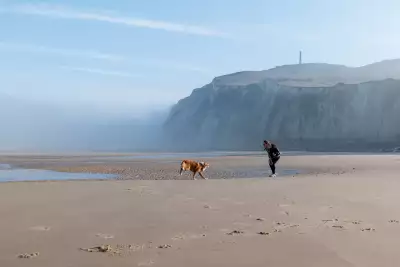
By the time the seal appeared, the beach had vanished. What had been a vast expanse of sand half an hour earlier was now a thin ribbon of wet stone, the tide climbing quickly through Baie de la Canche in Le Touquet. My dog stood where the water had been moments before, while the seal’s dark head rose and fell in the swell.
These rhythms had begun to make sense. At sunrise, the coastline stretched impossibly wide, dissolving into a soft horizon where sand and sea became indistinguishable. By midday, it contracted again, the returning tide leaving behind marbled pools and clusters of plasticky-looking whelk eggs scattered along the rocks. My dog Mimolette chomped on them in a revolting, gulping way, as though someone had stuck a feeding tube down his throat, afraid I’d take away his spoils.
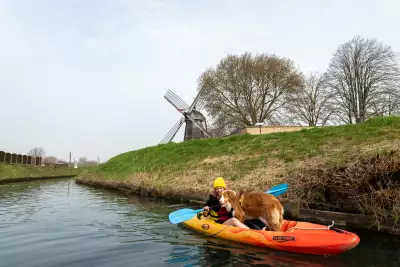
Richards and Mimo cruise together along St-Omer’s waterways in a kayak
I’d been guilty of passing through Pas-de-Calais, north-east France, without stopping. Most Brits arriving by car or ferry are obliged to go through here, as the arrival point for ferries from Dover and LeShuttle. I’d ignorantly dismissed the beaches as inferior to Brittany’s gnarled Finistère coast, the flatness as uninteresting compared to the Alps on my doorstep from my home in Lyon, the architecture as hastily built concrete blocks to replace bombed-out husks in the aftermath of the Second World War. I was wrong on at least two and a half counts. But as a proud dog owner and Francophile traveller, I began to see it differently when I heard the region was making a concerted effort to welcome canine travellers.
My dog is a Nova Scotia duck tolling retriever named Mimolette, Mimo for short, and he is well over half my body weight, closer in size to a Shetland pony than a Parisian pooch that snacks on beef tartare in bistrots. It felt like an opportunity to challenge my preconceptions of the region and, finally, to justify taking him on a proper adventure. That meant long, wind-cut walks, salt drying on his coat, and a landscape that revealed itself at his pace rather than mine.
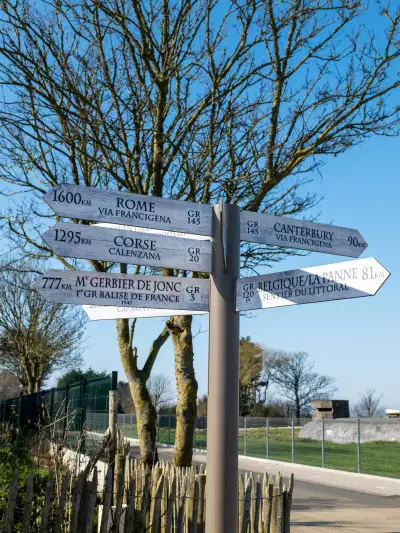
A white, wooden fingerpost marks different hiking trails in Calais
In dismissing Pas-de-Calais’ flatness as boring, I’d overlooked something important: flat is perfect for bikepacking. Why, after all, is Amsterdam full of fixies? A section of the Vélomaritime, a 1,500km trail from the Belgian border all the way to Brittany, was to be the first part of my adventure with Mimo.
In dismissing Pas-de-Calais’ flatness as boring, I’d overlooked something important: flat is perfect for bikepacking
“It’s not at all flat,” I was told when I unveiled my plans and the weight of my stocky, shire-horse lookalike. And so, although I typically mutter “cheaters” whenever an e-bike overtakes me on my morning commute, I was upgraded to a gorgeous burnt-orange e-bike and trailer. Thank god I did. Although it’s no Tour de France, the 85km section of the Vélomaritime between Calais and Le Touquet has almost 1,000m of elevation gain – not insignificant when towing a large ball of fluff, plus luggage. The Opal Coast, as this stretch is known, rolls like a ship in a swell, only between wheat fields rather than waves.
Calais, port of arrival from Dover and for mine and Mimo’s train, has had some bad press. In 2015–16, the Calais Jungle was the largest shanty town in Europe, and migrants hoping to enter the UK often head here. Away from the port, though, a quiet cultural revolution has been happening. The old slaughterhouse has been turned into a theatre; a giant steel-and-wood model dragon walks down the seafront each day; and the beach is so soft it reminds me of my childhood sandpit… until my little sister repeatedly used it as a litter tray.
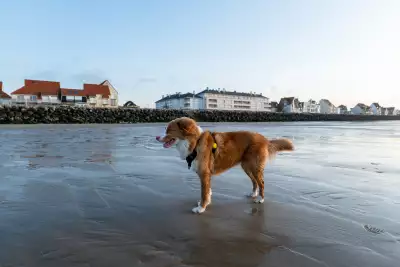
Mimo stands on the windy shores at Wissant beach
Mimo and I trundle west from here along the Vélomaritime, following the bike trail through farmland just back from the coast, making detours to stop at each beach so that he can play with seashells and cake his fur in wet sand. We take it easy on the first day, and spend the night in a little town called Escalles, just back from the positively enormous Cap Blanc-Nez Beach, which we had to ourselves morning and evening. Wissant, a 25-minute cycle away, is like an overgrown fishing village, with whitewashed walls and terracotta roofs. Wimereux has Belle Époque-era half-timbered mansions, and an ice cream parlour where thick squirts of molten dark chocolate are deposited in the base of my cone, like a grown-up Cornetto. By the middle of the second day, we are in Boulogne-sur-Mer, whose seafront is a 1950s concrete monstrosity – bombed badly during the Second World War, although it was marginally redeemed by its excellent fish market. Everywhere we stop, the beaches seem infinite, like how the school playground feels when you’re five.
There’s no escaping Pas-de-Calais’ grim past – the first half of the 20th century and two World Wars changed this region
Just before Le Touquet, the Vélomaritime runs past a humbling sight. Lines of thousands of uniform, white gravestones spill down the hill. There’s no escaping Pas-de-Calais’ grim past – the first half of the 20th century and two World Wars changed this region forever. Étaples Military Cemetery, the largest First World War cemetery in France, has almost 11,000 gravestones, many dated after the Armistice, for soldiers who died of their wounds after the war ended. Le Touquet itself bears scars too, in the form of concrete blocks scattered among the sand dunes, hasty replacements for bombed-out shells after the Second World War. Just back from the coast, these austere-looking buildings are replaced by half-timbered manor houses, ringed with maritime pines. This is a wealthy town: its little international airport is said to be one of the fastest places to clear customs and, as such, is popular with anyone arriving in France by private jet. I imagine the views are better by e-bike, though.
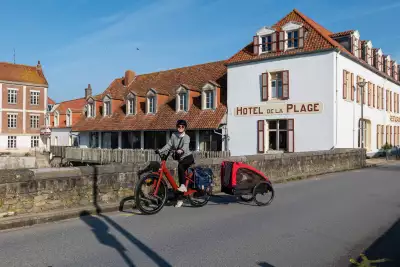
Richards and Mimo at Hotel de la Plage
The activities Mimo could have tried in Le Touquet were seemingly endless. Char à voile, land sailing on three-wheeled dinghies across the vast stretches of sand, was advertised with a poster of a brilliant white samoyed, tongue lolling out of the side of the kart, but I didn’t trust Mimo dinghy racing at 60 km per hour. There was paddleboarding and sea kayaking too, with canine life jackets provided, a welcome pack of treats, a toy and a dog bowl at our beachfront hotel, the Novotel Thalassa. Running down the sand dunes, Mimo and I triggered miniature avalanches.
The 7th-century town of St-Omer, 90 minutes by train via Calais or a 70km cycle from Le Touquet, doesn’t have a concrete block in sight, rather red brick, weeping willows and a Gothic cathedral. The town originally grew around a monastery, before becoming an important trading post in the Middle Ages. The monks, and later farmers, hollowed, drained and reclaimed land from the Audomarois Marshes just north of the town, creating a 700km network of muddy waterways. Farmers still live here, mostly cultivating vegetables, although some keep sheep and poultry too. I tried putting Mimo in a cargo bike to explore, but it was a short-lived venture when he hurled himself to the side of his box, throwing both of us and the bike to the ground. Fortunately, some 170km of St-Omer’s waterways are open to the public, with bâcoves (traditional, flat-bottomed wooden boats) and kayaks both available for hire. I decided to try both.
Although Mimo’s a practised paddleboarder, kayaking is much more complicated, because he thinks he’s a lapdog. The fact that I was seated in the kayak was the perfect opportunity for him to smother me in love, so my view of Dutch-style windmills, blue-shuttered marsh houses and storks nesting atop energy pylons was somewhat impeded by ginger fur. The range of my paddle is also restricted, and progress is much slower than when I kayak alone, but the marshes, so still and so quiet, seemed perfect for this kind of slow adventure. Mimo noses at the treats in my shorts waistband and trails his tail in the water to catch fish. I hoped an eel wouldn’t latch on – La Maison du Marais, the natural history museum and information centre from which we’d hired the kayak, had several of the fish in aquariums, and they were whoppers.
Mimo’s a practised paddleboarder, but kayaking is much more complicated, because he thinks he’s a lapdog
To rent a bâcove, we headed deeper still into the marshes. Les Faiseurs de Bateaux make their own bâcoves in a workshop in the middle of the wetland, and their methods have changed very little for centuries. They’ve been used for transporting produce around the town of St-Omer since the Middle Ages, and now they were transporting a very happy canine, who tried to catch the boat’s wake, impervious to the gaggle of geese hissing at him. Local dogs on the shore barked at him in confusion, and Mimo didn’t care about that either. Supersized beaches, plenty of hills and not so much concrete as I’d thought, I’d been wrong about Pas-de-Calais. And if Mimo could speak his mind, I’m pretty sure he’d vote it his best trip ever, tail thumping in emphatic agreement, sandy paws and all.