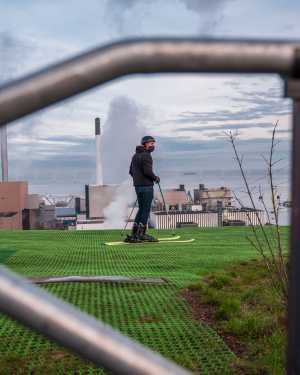
As the magic carpet conveyor belt trundles me uphill, snowboard attached and dignity in question, the view from the piste feels wildly unfamiliar. Instead of alpine peaks, I am met by the industrial warehouses and wetlands of Amager and Refshaleøen.
Beyond them, I can see the steel-clad roof of the Royal Danish Opera House, then across the water into central Copenhagen, where the star-shaped ramparts of Kastellet sit heavily, flanked by the spires of the old city.
CopenHill
Daniel Rasmussen
To the north, the Øresund Strait stretches towards Sweden, while to the south, the Øresund Bridge cuts a faint line across the water, stitching Denmark to Malmö.
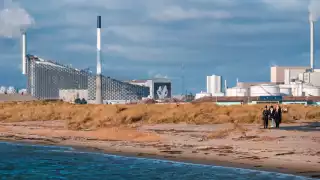
I am ascending to the summit of CopenHill, where a smokestack vents steam into the air like an enormous silver straw. On the site of an ageing incinerator, it has been reborn as a combined heat and power waste-to-energy plant that also functions as an urban playground.
I slither down the plastic on my belly like an old snake
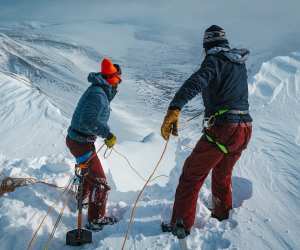
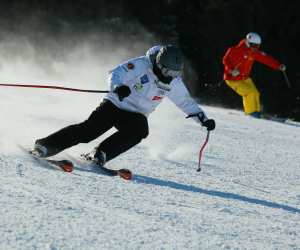
There are hiking trails etched into its flanks, a vast climbing wall, and an artificial ski and snowboard run that coils down its curving roof. The winter sky glowers as I tip forward onto the green baize of the slope. Grass pushes up through the hexagonal grid of the plastic piste. I ratchet my bindings tight.
Ready to slash some gnarly eurocarves, I do a little hop onto the board’s tail to see if I can butter it – I can’t – then take off down the decline. The first heel turn goes well, but as I lean into the toe edge, the board shoots out from underneath me like a rocket, and I slither down the plastic on my belly like an old snake, grass stains on my knees and elbows.
I’ve been on skis and snowboards since the age of five, and breezily dismiss the rental attendant and lift operator when told it might take a second to get the measure of it. It’s a bit like skiing on ice, they say. I learned on icy New England mountains, I tell myself. But I don’t expect to fail so abjectly.
CopenHill
wonderful copenhagen
The next run goes slightly better. I only fall once, bouncing off the hard surface like a brittle bone. During the third, I’m joined by a man in late middle age, tottering down the tilt at a snail’s pace. I pass him, smugly, then stack it hard soon after. Pride before the fall, as it were.
After just five descents, bruised and battered, tail tucked firmly between the legs, I return the snowboard to the attendant, explaining that I don’t want to injure myself before the season begins. Nonplussed, he grunts as I hand him the equipment. Experience, it turns out, is mostly knowing when to stop.
Copenhagen regularly tops happiness rankings because daily life combines strong social security, high levels of trust, and human-scaled urban design with a culture that prizes community, simple pleasures, and outdoor activity.
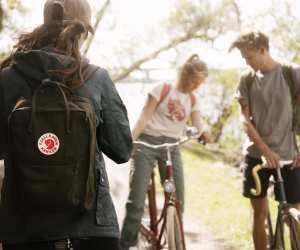
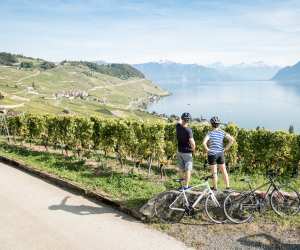
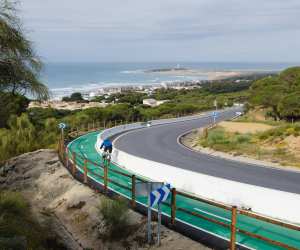
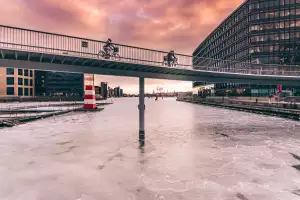
I think about this as I cycle through the city on my DonkeyBike – a sturdy orange workhorse that’s part of Copenhagen’s easy app-based bike-rental system – named Kimi. It bends the mind how different it feels from cycling in London, where ‘Lime bike leg’ has entered the vernacular and NHS funding is steadily funnelled, one shattered tibia at a time, towards Palo Alto.
Cycling over the Kissing Bridge
wonderful copenhagen
In Copenhagen, the cycle lanes are entirely separate from the road and neatly cordoned off from the pavement, broad, calm and largely empty. They feel a world away from the terrifying civic experiment that is Old Street Roundabout.
Sofiebadet, a small heritage bathhouse dating from 1909, sits just a few kilometres from CopenHill in Christianshavn, and proves ideal for licking one’s wounds. It was built as part of a social initiative in Copenhagen in the early 20th century which provided washing facilities for working-class residents at a time when many homes had none.
I chat with the manager, Johanna, a tall yogi in her mid-fifties with a rasping voice who looks at least a decade younger. She leads me through the high-ceilinged rooms of the slightly crooked building, its pale tiles, marble floors and vintage fixtures giving it a museum-like quality that somehow still feels intimate and warm. Guests scrub themselves with salt before unwinding in the steam room, cycling between sauna, cold showers and icy plunges in claw-foot tubs.
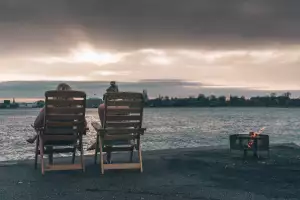
Sunbathing hits different during a Danish winter
wonderful copenhagen
Sitting in a minimalist steel chair in a bathrobe, I sip an espresso with Johanna. When I ask whether she believes communal bathing offers mental and physical health benefits, she answers, “Of course.”
I ask instead about the idea that Copenhagen is one of the happiest cities in the world. She waves it away. “Somebody says so. I don’t understand this high happiness score. When I look at people, they are stressed, their schedules are too busy, they have family issues.” Then she pauses. “But we are good at doing things for ourselves here.”
What kinds of things? “I keep my schedule clear. I do yoga. I try to laugh every day. And I try to stay in contact with my body.”
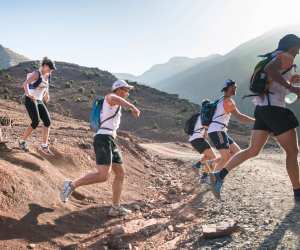
The weather has turned dark and stormy, yet there are still plenty of Danes on the road as I wheel Kimi south towards Vesterbro and Kødbyen, Copenhagen’s Meatpacking District. Inside Warpigs, the beer brand’s cult barbecue joint, I join the Mikkeller Running Club. The runners stand out instantly, shrugging off jackets, stowing bags, lacing trainers and stretching around a long table.
Lungs are lit up and endorphins high
I introduce myself to Casper Højsgaard, one of the club’s founders. Alongside brewer and former elite runner Mikkel Borg Bjergsø and his friend Søren Runge, he started the club as a low-key Saturday meet-up to shed a little beer weight and earn a post-run pint. It has since exploded, spawning hundreds of chapters across multiple continents and tens of thousands of members worldwide. There’s even one in Liverpool.
I opt for the Space Race group, led by Højsgaard: 11km with two 3km efforts at 4:45 minutes per kilometre. As he herds us outside, we swap race stories, and I feel a flicker of nerves when I learn he runs a half-marathon in 1:09:28. We head west, skirting the southern edge of the Carlsberg district, once home to the brewery, before turning south to loop Vestre Kirkegård, the largest cemetery in Denmark.
By the time we roll back into the bar, lungs are lit up and endorphins high. Over an ice-cold jar of Mikkeller’s Visions lager, I ask Højsgaard about my impression of the Danes. He and a friend laugh when I mention how readily people make eye contact and smile compared with London. “We don’t see ourselves as particularly open people,” he says. Still, the warmth is palpable.
Across the lot, I enjoy a restorative supper at Kødbyen’s Fiskebar, one of my favourite seafood restaurants on the planet, murdering oysters like a Lewis Carroll walrus before settling in with melting crab doughnuts and halibut served with pan-fried cabbage, green tomato and mild horseradish mashed potatoes, finished with smoked mussel.
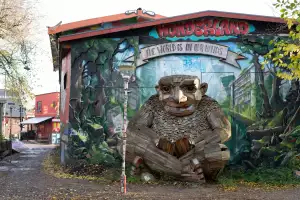
Green George
Nick Savage
The air is crisp as I cycle back to the hotel where I’m staying, Kanalhuset, and put Kimi to bed for the evening. Feeling restless, I decide to walk through Christiania, the self-proclaimed free town in Copenhagen, born from a 1970s squatter movement, where colourful homes, communal living and a fiercely independent spirit thrive.
I stop in at Loppen, wandering through a cold corridor tagged with a palimpsest of graffiti, watch a soul band perform a few songs, and then visit Green George, a giant wooden troll crafted by artist Thomas Dambo.
After clambering up and over his outstretched hands, I continue to stroll through the neighbourhood, which functions autonomously through collective ownership and locally agreed rules on housing, commerce and daily life.
Circling the bathhouse and a towering disused chimney, largely overgrown with ivy and crowned with an aviation warning light that gleams red like the eye of Sauron, I arrive at Pusher Street, the former cannabis market.
Modern Greenlanders have a visible, if often vulnerable, presence in and around Christiania
A giant mural of a Greenlandic woman sweeps across a building. Greenland is an autonomous territory within the Kingdom of Denmark, with extensive self-government since 2009, but Denmark still controls its foreign, security and defence policy while both sides formally accept that Greenland has a recognised pathway to complete independence if its people vote for it.
I wander into Café Woodstock, a local institution. Frost nebulas across the windowpanes. Intimate steam wafts off bodies. I’m surprised by how many Greenlandic people I count. It reminds me of the Top of the World Club in Thule, where I used to drink when I worked on scientific research expeditions in Greenland during my twenties.
Modern Greenlanders have a visible, if often vulnerable, presence in and around Christiania, which has long functioned as an informal refuge for Greenlandic people who struggle to navigate Danish systems and mainstream life.
I wake early at Kanalhuset, the design hotel where I’m staying, which has built its identity on shared daily rituals as much as on its rooms and restaurant.
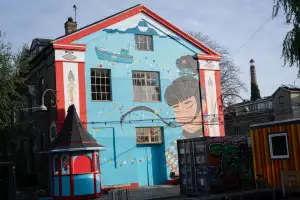
A mural of a Greenlandic woman on Pusher Street, Christiania
Nick Savage
It hosts a Wednesday morning ‘dip and sing’, inviting people to meet at a nearby harbour bath for a cold plunge in the canal, followed by coffee and a communal song, and turning cold-water immersion into a small, shared ceremony rather than a purely solitary wellness practice.
Ole Sørensen waits outside the hotel. Alongside founding the club, he runs a grassroots project called Run Buddy Copenhagen, inviting visitors and expats to explore the city on foot. He blows into his hands to warm them as the rest of the Kanalhuset Run Club trickles in.
In contrast to the pace-led session I joined the night before, this feels more like a social start to the day than hard training.
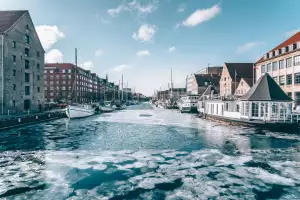
We set off at an easy lope northwards, crossing Inderhavnsbroen, the ‘kissing bridge’ linking Christianshavn with central Copenhagen, passing an outdoor skating rink before running alongside the brightly coloured 17th-century houses of Nyhavn, with wooden sloops moored along the canal. Within ten minutes, we pass three other running clubs, some numbering fifty or more.
I fall into conversation with Christoph, a high school sociology teacher. We talk about why running clubs have become so popular in Copenhagen. “Denmark has always been tribal,” he says. “It’s a small country. That makes it easier to maintain community.”
It’s a startling reminder that even the world’s safest societies are shaped by forces beyond their borders
We jog past the rococo Amalienborg Palace, skirt the star-shaped ramparts of Kastellet, then turn back near Edvard Eriksen’s Little Mermaid, gazing across the water towards CopenHill. I wonder briefly whether she witnessed my many falls the day before.
Back at Kanalhuset, I drink coffee with the crew, tucking into a breakfast set, a bento-style spread of homemade bread, jam, cheese, yoghurt, granola, coulis and a soft-boiled egg. Like many things in Copenhagen, the meal is carefully balanced.
For the final time, I pepper a Dane with a silly question and ask about the happiness index. He explains that the statistics actually were more about how safe and financially comfortable they were. “That’s the Danish community,” he says. “We feel safe. That’s probably the thing. We’re not worried.”
As I write this, Donald Trump rattles his sabre over Greenland. It’s a startling reminder that even the world’s safest societies are shaped by forces beyond their borders, and that security, like happiness, is never entirely self-determined.