I’m standing in front of a vending machine at Omichō Market, transfixed. Back home, these illuminated glass coffins dispense Kit Kats and Hula Hoops, but this one is stocked entirely with sashimi. “Japan is living in the future” is a phrase that crops up with algorithmic regularity while scrolling my phone, shorthand for the small but uncanny ways Japanese life seems perpetually a few software updates ahead of the West. Heated toilet seats with deodorising functions; anti-splash urinals; hyper-realistic plastic food displays designed so you never misorder; AI-powered tuna grading; taxis with automatically opening doors; even loneliness services offering the short-term rental of a family member or friend, should the need arise.
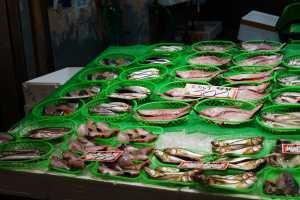
Omichō Market
Christy Spring
Many people flock to the Land of the Rising Sun to experience how its cities seem to be living in this so-called future. However, I’m here for the opposite reason: to understand how one urban settlement has chosen, quite deliberately, to keep one foot rooted firmly in the past.
I’m in Kanazawa, the capital of Ishikawa Prefecture, about three hours by Shinkansen from Tokyo, with a population just shy of half a million. It’s a city with a distinctive and radical history because, unlike so many places whose success stories are written in blood, conquest and plunder (I can think of at least one nation currently run by a man with Wotsit-hued skin), Kanazawa’s endurance is in craft.
In the 17th century, the Maeda samurai clan, who ruled the region, were second in economic power only to the Tokugawa shogunate. Concerned that a formidable arsenal or over-trained army might appear threatening, the Maeda opted out of the usual feudal feedback loop of violence and war that dominated the period. Instead, from workshops within Kanazawa Castle, they redirected their weapon-making infrastructure into developing more than 200 crafts. Twenty-two of these are still practised today, including gold leaf, pottery, kintsugi, lacquerware, metal inlay, embroidery and silk dyeing.
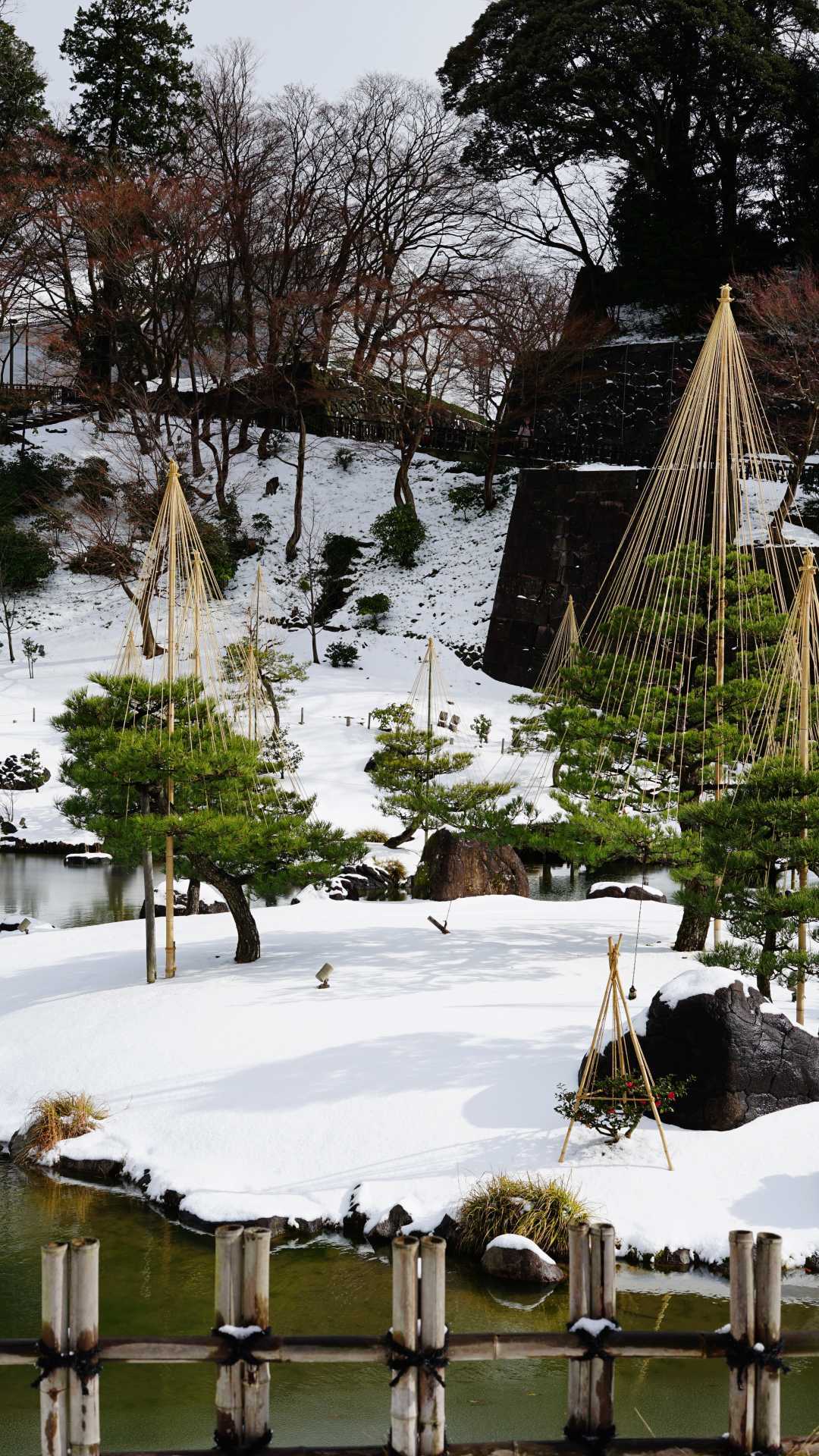
Kenroku-en
Christy Spring
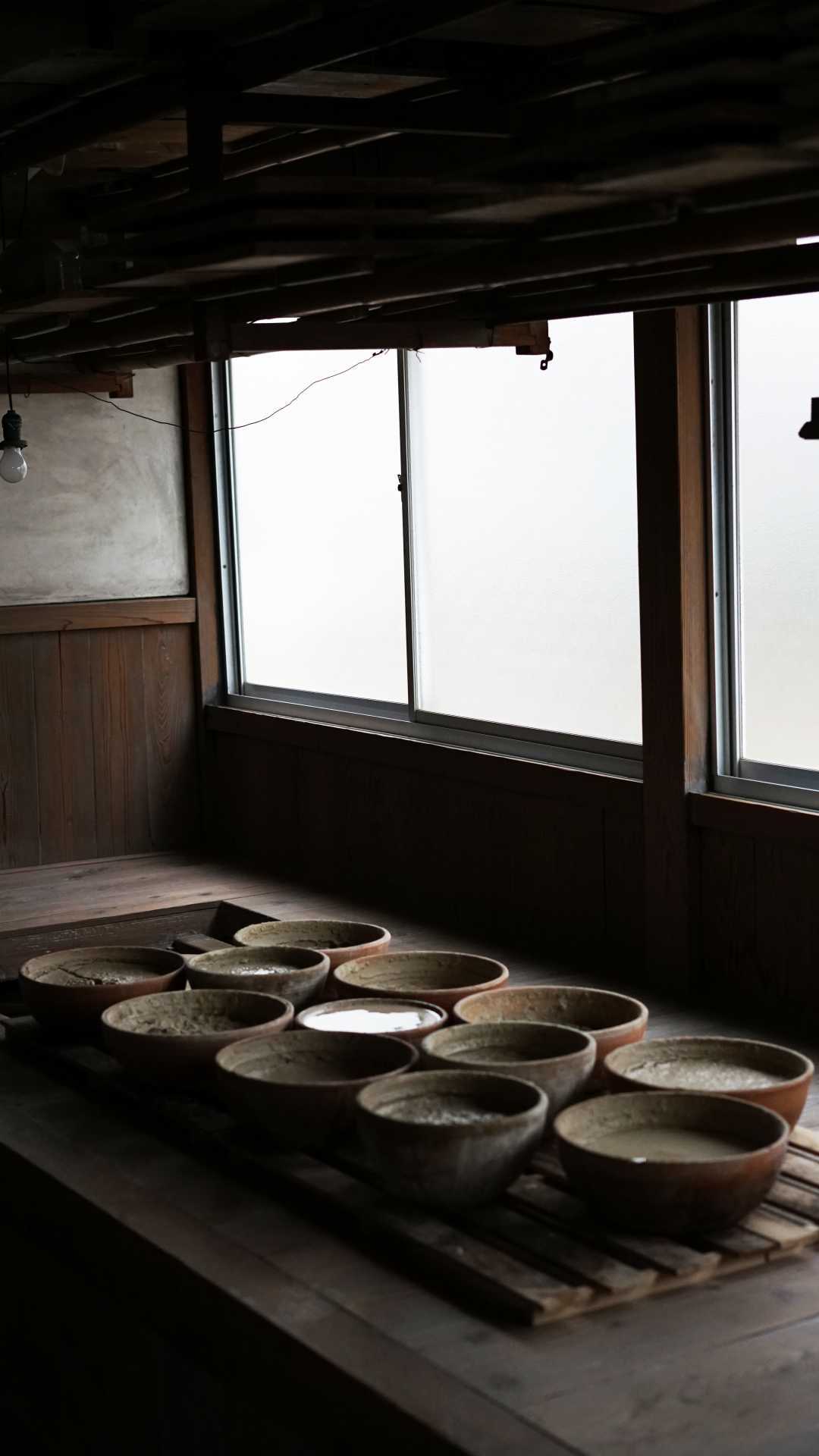
Kanazawa’s last remaining Kutani Kosen Kiln run by Koichiro Toshioka
Christy Spring
With fighting off the table, there was suddenly a surplus of samurai with an unfamiliar problem: free time. No longer busy plunging swords into enemies, they turned their attention to refinement. Contrary to the popular image of grunting warlords, these men became highly accomplished cooks, potters, painters, ceramic menders, kimono dyers and lacquerware makers. They perfected pursuits such as the tea ceremony, which demands not only exquisite ceramics but also mastery of kintsugi – the art of repairing broken vessels with lacquer and gold – ensuring that even damage could be made beautiful. During this period, Kanazawa became one of the wealthiest cities in Japan. Choosing creativity over killing turned out to be an excellent economic strategy.
The city’s craft lineage announces itself the moment you arrive. In London, a tube station tends to present you with vermin or a Vitabiotics advert, but in Kanazawa station, the platforms are held up by gold-leaf-covered pillars. Waiting rooms have the same attention to detail, displaying locally made objects: glossy lacquerware bowls, Kutani-ware tea cups and intricately dyed Kaga Yuzen silks. Even the Hyatt Centric, where I’m staying for the next few days, leans Tate – its walls lined with work by regional artisans rather than the usual corporate abstractions favoured in chain hotels.
Keiichi Mimura, who works for the Kanazawa city government, points this out with justifiable pride. Kanazawa has the second-highest proportion of full-time craftspeople of any city in Japan and produces 100% of the country’s gold leaf. But this legacy is under strain. “Young people are increasingly drawn to Western aesthetics,” he explains. Where hand-made ceramics or embroidered kimonos once signalled taste and status, today’s shorthand for cool is more likely imported streetwear and handbags heavy with Labubus.

Snow-covered roads near Kanzawa station
Christy Spring
As Japan’s population contracts and ages, Kanazawa’s craft economy – like many across the country – now relies heavily on visitors to survive. The number of practising artisans is declining, threatening techniques that take decades to master. One response is the city’s Ichigo Ichie programme, which connects tour operators with craftspeople offering studio visits and workshops. It creates meaningful cultural encounters for visitors and, crucially, income for artisans.
Over the next few days, I visit several workshops: Kanazawa’s last remaining Kutani Kosen Kiln run by Koichiro Toshioka, a fifth-generation master potter, and Sakuda Gold Leaf Store, run by Kazunori Sakuda, a producer with the largest capacity in central Kanazawa. Their approaches to producing their crafts are wildly different, but the underlying philosophy is still the same. Survival doesn’t come from rigid obedience to tradition but, like a well-fermented sake, by letting it breathe a little. For some producers like Sakuda Gold Leaf, that might mean selling gold leaf no longer to temples for altars, but to cafes for gold-leaf-covered soft serve you’ll see sold around the old geisha districts.
I see this most clearly at a Kaga Yuzen kimono-dyeing studio called Akaneya. I chat to Masako Okuda, a Kaga Yuzen silk painter whose family have practised the craft for over 120 years. Okuda’s decision is increasingly rare, she tells me; many of her contemporaries from art school now work in graphic design or other screen-based professions that offer more financial stability and sociable working hours.
Okuda describes it as wabi-sabi – the Japanese concept that beauty is found in imperfection
A single kimono requires around thirteen metres of silk and materials that are becoming alarmingly scarce. One blue flower, dried, crushed into a powder, and transformed into paint used to trace the kimono illustrations, is now grown by a single farmer in the region, Okuda explains. We walk past wide belts of silk, squinting at the designs. Kaga Yuzen motifs from the feudal period favour insects, fading blossoms, and leaves nibbled at the edges – a humbler aesthetic compared to the flamboyant imperial style of kimonos seen in Kyoto. Okuda describes it as wabi-sabi – the Japanese concept that beauty is found in imperfection. Nature is intrinsic not just to the imagery but to the method itself. Traditionally, finished silk was washed in the nearby river, using icy meltwater from Mount Hakusan to intensify the dyes.
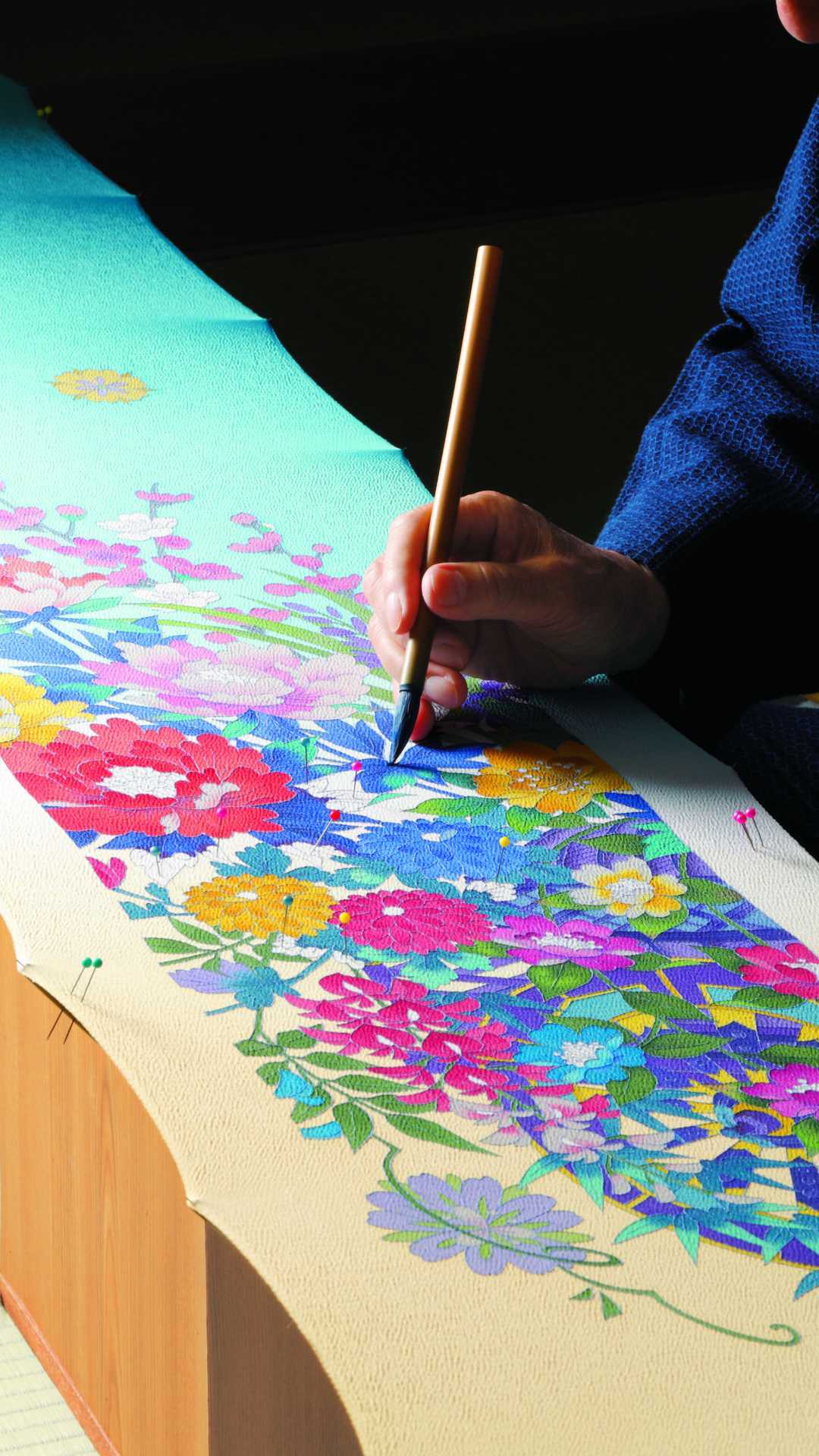
Kaga Yuzen
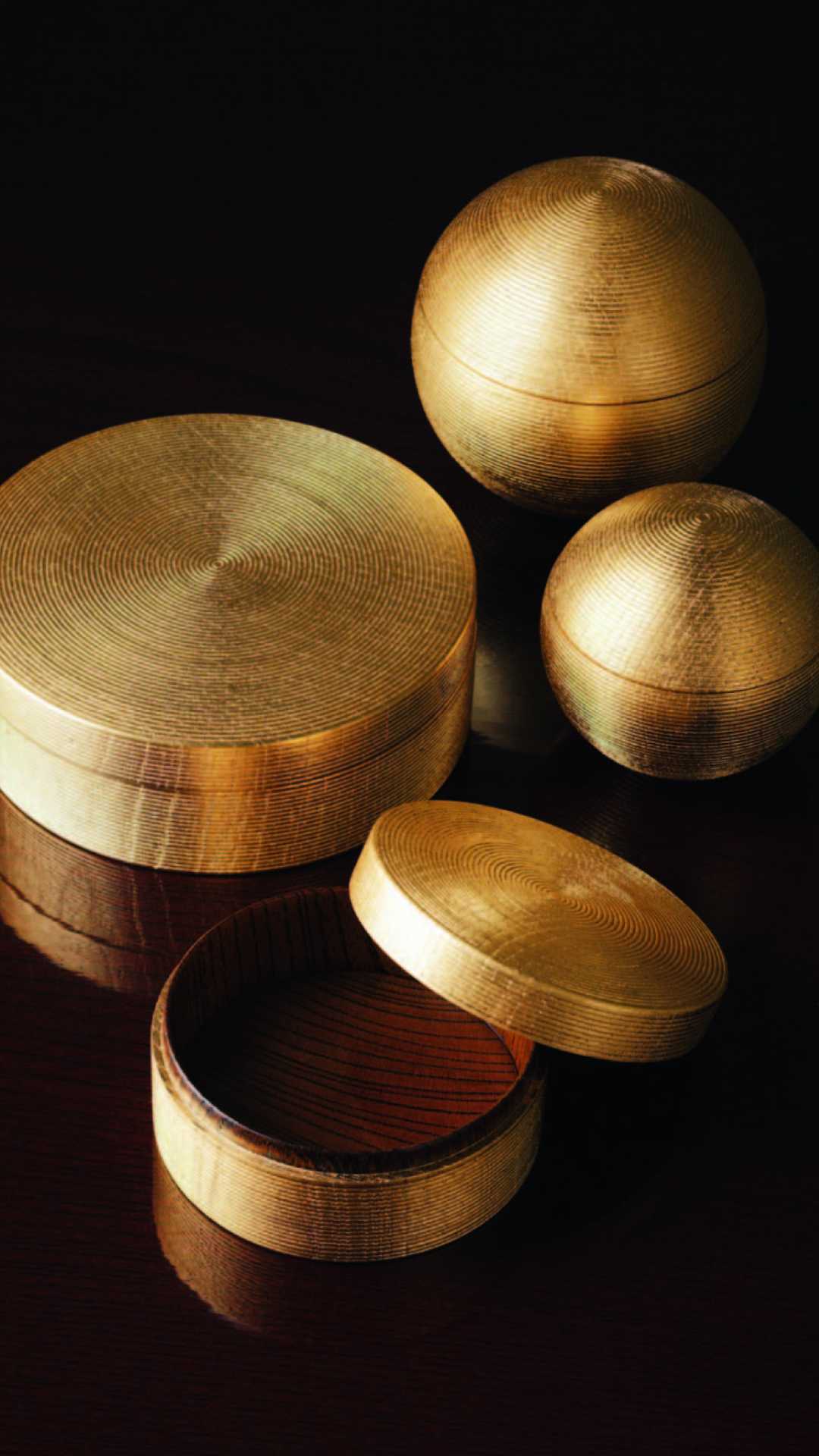
Gold leaf bowls
Upstairs, Okuda produces a leather-bound ledger: an analogue database listing all licensed Kaga Yuzen makers. There are around 120 names, though she estimates only 20 remain active, producing roughly 2,000 kimonos a year across Ishikawa prefecture. The pressure to keep the craft alive extends beyond personal legacy; it sustains an entire ecosystem – the dye farmers, brush-makers, glue producers. Tradition matters, she says, but being trapped by it is fatal.
Her studio now collaborates on anime tie-ins, including the popular TV show Love Live!, and produces Pokémon and manga-inspired designs to attract younger audiences. On the day I visit, to my surprise, the shop is full of teenage boys painting silk handkerchiefs. That evening, I eat at Crafeat (a portmanteau of craft and eat) – a 14-seat kaiseki restaurant run by Takahiro Taya, the head of the Taya Shikkiten lacquerware company. Each course arrives on hypnotic lacquerware: lids, boxes, bowls, all dusted with glittering motifs from Japanese folk tales. Taya, like many artisans in the region, was heavily affected by the 7.6-magnitude Noto earthquake that devastated Ishikawa in January 2024, killing over 700 people and destroying businesses, including his own offices and atelier.
Craft, which gave Kanazawa a lifeline 400 years ago, provided similar salvation last year. Since the quake, the city has offered displaced artisans grants of up to ¥500,000 (around £2,355) to relocate to Kanazawa, alongside waived selling fees and fundraising exhibitions – including one I visit at the 21st Century Museum of Contemporary Art.
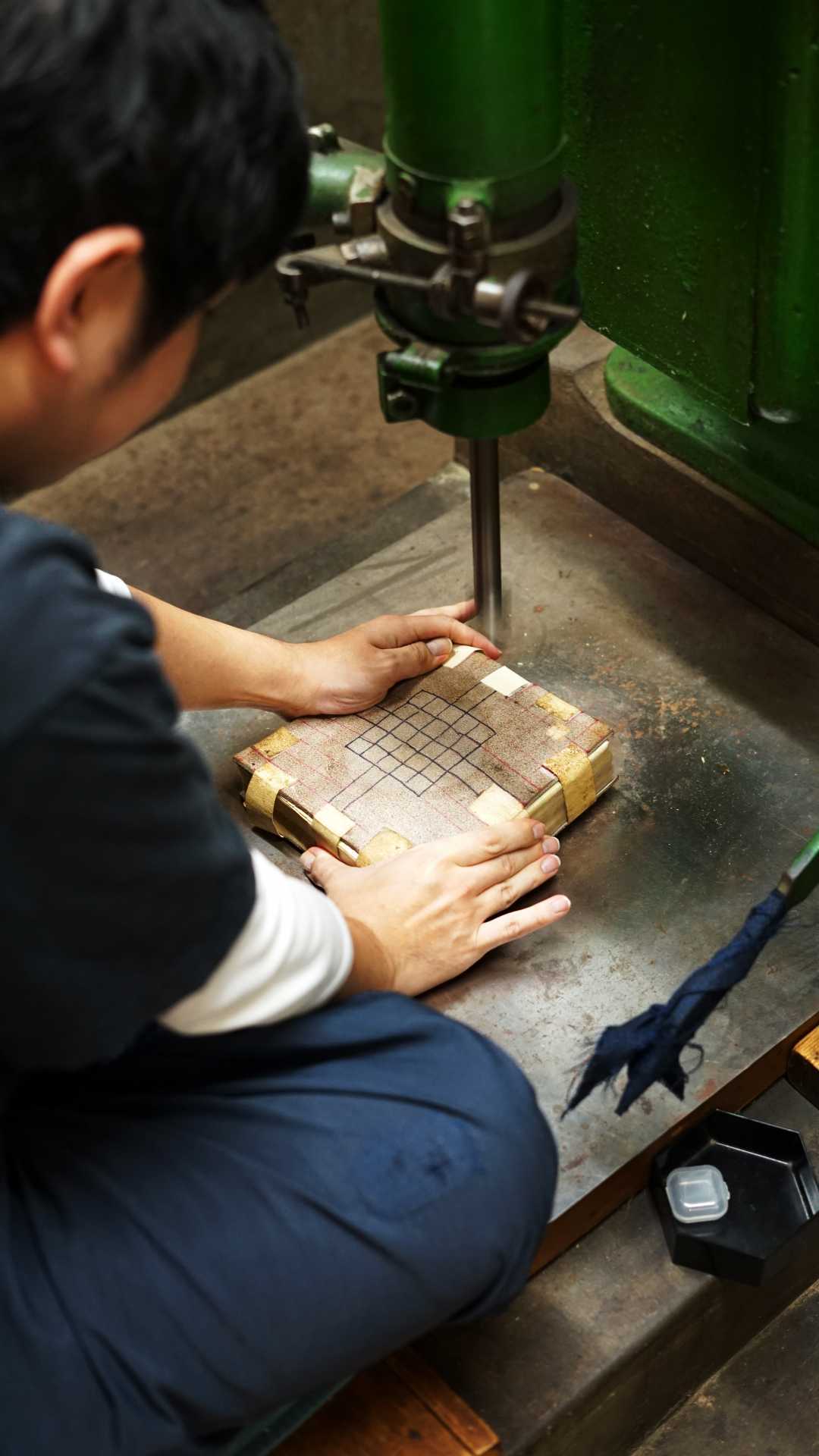
Hammering sheets of gold leaf
Christy Spring
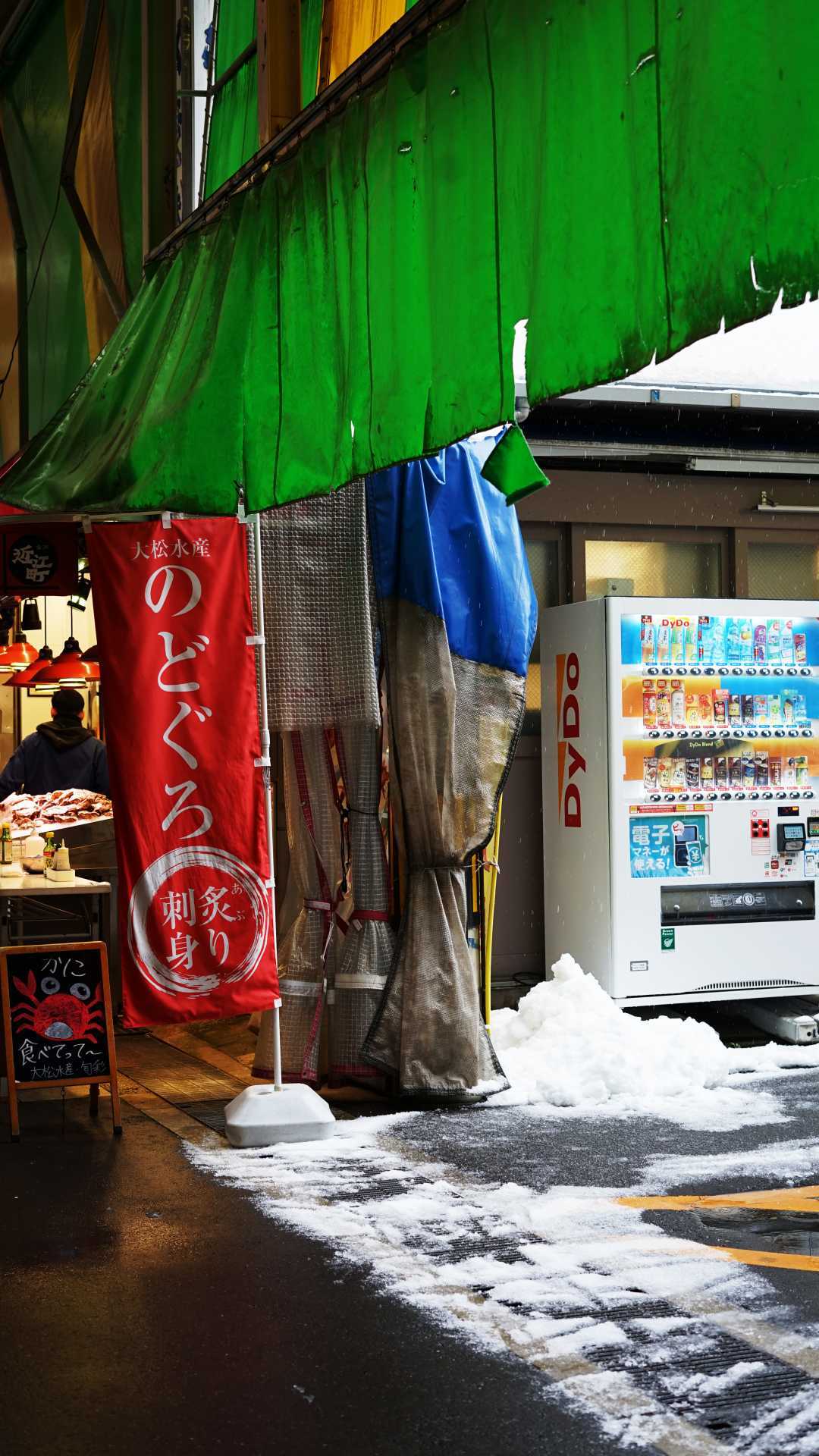
Omichō Market
Christy Spring
As one of the most seismically active countries in the world, faultlines are a very real part of Japanese life. In a culture obsessed with symbolism, these cracks draw easy parallels with kintsugi, practised by several artisans in the city. Born from tea-ceremony culture in the early 1600s, it’s the art of mending broken ceramics using urushi lacquer (resin tapped from a particular tree) and powdered gold. Prized tea bowls, once exchanged in place of land or money, were repaired so meticulously that the mended object could surpass the original.
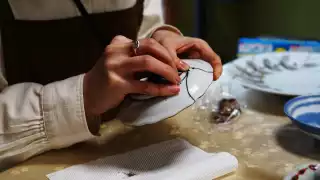
I visit a kintsugi studio run by Momo Omukai, a young woman with three children who used to be an art teacher at a junior high school. Her mother died a decade ago, the day before her teaching exams. Years later, when one of mum’s favourite bowls broke, she learned kintsugi as a way of holding onto something that felt otherwise unsalvageable. She trained under a master repairer just outside of Kanazawa for several years, mending other bowls and plates from her mother’s home, some of which had been damaged during the Noto earthquake. Two years ago, she left teaching to practice kintsugi full-time – a decision complicated by the fact that her mother had wanted her to be a teacher. But Omukai believes teaching people how to repair objects they love would have pleased her just as much.
Momo Omukai learned kintsugi as a way of holding onto something that felt otherwise unsalvageable
Watching her work is strangely absorbing. Mixing resin, aligning shards, filling cracks and dusting the seam with powdered gold. It’s not a hobby for puny attention spans, with repairs taking weeks if not months and requiring very specific conditions (chiefly humidity) for the lacquer to cure.
I wasn’t new to kintsugi when I arrived in Kanazawa. I’ve been a keen ceramicist for years and, being both curious and spectacularly clumsy, taught myself how to mend broken pots with resin and gold around two years ago. At first, it was practical – a way to salvage favourite plates and mugs I’d dropped with the enthusiasm of a Greek bride. But last year, it developed a new meaning as a way to cope with damage without trying to erase it.
Higashi Chaya is one of three teahouse districts in Kanazawa
To be alive, I’ve learned, is to ride a conveyor belt towards difficulty. Loss, illness, betrayal and grief are stitched into the fabric of existing, and until my late twenties, I’d travelled relatively lightly. That changed last year, when I almost lost someone very close to me. And nearly lost them several times.
The experience defied comprehension. It produced this physical sadness that sat on my chest like wet concrete, as I cycled through fear, guilt and hypervigilance. The aftermath, much like a broken bowl, was fragmented: ambulances, long stints in A&E, phone calls, raw conversations and hovering by doorways. I felt like I was existing on standby on a diet of cortisol, desperately trying to help keep someone else intact while having very little idea how to do so.
I remember vividly when things started to settle last April, I went to the park near my flat alone for the first time. The sky was beautifully clear for such a miserable time, and I lay in the grass. Things felt so heavy, but there was this unexpected euphoria that came with peace and the fact that the worst hadn’t happened. It was like breathing pure oxygen. I listened to ‘Space Song’ by Beach House on a loop. It’s a track I’ve loved for many years, but this time it took on a new meaning as I listened to the repeated line: fall back into place.
During the spring season Kanazawa’s streets erupt in cherry blossom
The months that followed were slow and shaky. Recovery is rarely linear and tidy, but month by month, it began to feel as though I was watching fragments falling back into place. Now, sitting with Omukai, watching her work, I think of repair not as reversal but rather as continuation. Kintsugi doesn’t pretend that breakage didn’t happen, but instead covers it in gold. As Omukai wisely says, the gold line drawn during repair didn’t exist before, and no two are ever the same. New paths are pregnant with hope and possibility.
My time at Omukai’s studio ties an almost sickeningly neat bow on these few days spent in a city with such a deep history of using craft to survive times of trouble. Four hundred years ago, the decision to build an economy around making rather than fighting brought peace and prosperity. Last year, in the aftermath of an earthquake, craft offered people something practical and stabilising amid the destruction. Survival, I’m learning, isn’t about restoring what was there before, but about holding onto what remains – and parading it, if you can, with a gold seam. I encourage everyone to start dropping their crockery on the kitchen floor and seeing what piecing it back together with resin does for your mind. Although preferably not your mum’s best china.
Do it yourself
Stay
Hyatt Centric Kanazawa, rooms from £78 per night; hyatt.com
Rooms at Ryokan Kinjohro, rooms from £329 per night kinjohro.co.jp
Do
Omichō Market tour and handball sushi making workshop; in-kanazawa.com/cooking
Private tour of the only Kutani Kosen kiln in Kanazawa; kutanikosen.com
Kaga Yuzen kimono studio tour and workshop at Akaneya; akaneya-web.com
Kutani ware kaiseki dinner at Crafeat; craft-eat.com
Tea ceremony experience at Kenrokutei; kenrokutei.com
Kintsugi workshop with Momo Omukai; kintsugi-kanazawa.com
Goldleaf workshop at Sakuda Main Store; kinpakuya.jp
Ask Xperisus to streamline your journey in and around Kanzawa. Visit lp.xperisus.com for more details