Papa, I need to show you something.” The pitter-patter of four-year-old feet coursing over cold marble, the crinkle of small hands worrying linen, retrieve me from the liminal static of half-sleep. “I heard a voice. Let me show you.”
Half-dressed, I step out from the Tuscan villa’s cobbled terrace onto dewy grass and walk across the rustling brown detritus of oak and stone pine toward the olive orchard. My daughter turns, slumping. “I think I heard it here. It was calling my name.” Maybe it was the wind, I suggest. Nature. She insists that it was a fairy.
DH Lawrence suspected something otherworldly moved through these lands. The English author was fascinated by the belief systems of the Etruscan people, who first settled in southern Tuscany around 900 BC, and particularly their attitudes toward death (his own, from tuberculosis, was swiftly approaching).
In 1927, after visiting the Etruscan necropolis at Cerveteri, Lawrence penned his poem The Ship of Death, with the words: “Now it is autumn and the falling fruit / and the long journey towards oblivion.” About a hundred miles away and as many years later, barefoot among beech and cypress, the next line comes to me: “The apples falling like great drops of dew / to bruise themselves an exit from themselves.”
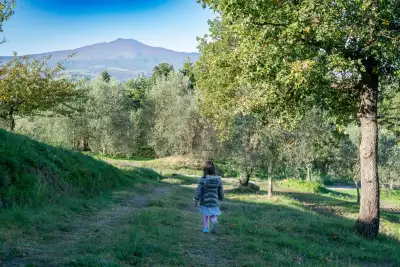
Wandering the orchards underneath Monte Amiata
When my wife and I had our first miscarriage, I called my dad. His advice was measured. “For men, it’s projection – we plan into the future, it’s kind of theoretical. For women, it’s physical. They lose a part of themselves. Be supportive and understand it may take longer for them to come to terms with the loss.”
We all grieve differently. I took my laptop to the emergency room. While the doctor explained what had happened to our unborn child, I sat beside my partner and worked to meet a deadline.
Over the next year, two more miscarriages followed, each one more painful than the last. I couldn’t shake the sense that it was a reflection of me: that I was letting my family down as the feckless, less generous partner; that they were atoning for the sins of the father.
Etruscan art points to a culture that refused to isolate death, instead absorbing it into the same current as everything else
Back in the present, we are projecting ourselves into the heart of a storm. We were meant to be in Jamaica, but that plan collapses as Hurricane Melissa gathers strength. It was already a substitute for Brazil, abandoned after a sudden change in visa laws, and the accumulation of false starts has begun to feel uncomfortably familiar.
On the phone to British Airways, we plead our case: we don’t want to take a toddler into Hurricane Melissa. They demur, and we pay a few thousand pounds to change the flight.
That same morning, I call my friend Ben Franchetti. “Why are you always going somewhere exotic?” he says. “Just come to Italy.” And so we do, that afternoon, on a flight from London City to Milan Linate.
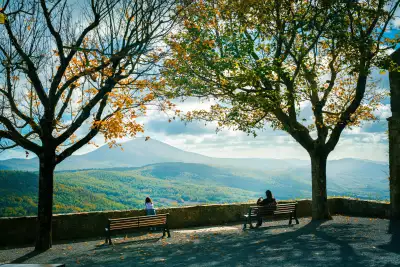
Looking out over Monte Cetona
Nick Savage
After a weekend spent with Ben’s family in Milan, he hands me the keys to his Volvo and the fob to his wine estate in Tuscany, Tenuta di Trinoro, in the southern part of Val d’Orcia.
The rural valley follows the course of the Orcia river from Siena in the north to Monte Amiata and the border with Lazio and Umbria in the south, and was designated a Unesco World Heritage Site in 2004 as an outstanding example of a Renaissance-era agricultural landscape, with rolling cultivated hills, cypress-lined lanes, farmhouses and hilltop villages. The foundations of those hill settlements were laid by the Etruscans long before the Romans and the Renaissance.
There’s a marked difference between a northern town like Pienza, made famous in films like Ridley Scott’s Gladiator and Franco Zeffirelli’s Romeo and Juliet, which have been optimised for the tourist trade, and those in the south of Val d’Orcia, which are empty and quiet in the autumn months.
Enea Barbieri
As night descends and rooks alight from the belfries of stone churches, we pull into the medieval town of Sarteano and dine on hand-rolled, worm-like pici pasta with a Chianina beef ragú at an oaken-beamed taverna. Ears pop as we depart Sarteano and crisscross the switchbacks of the long, wooded limestone spine between the Val di Chiana and Val d’Orcia, passing by the silent Etruscan tombs of Molin Canale.
Lawrence saw in the Etruscans a way of living that was wholly immersed in the vividness of the world around them – their role within it was to move through that vitality.
“What one wants is contact,” Lawrence writes. “The Etruscans are not a theory or a thesis. If they are anything, they are an experience.” Their art and tombs point to a culture that refused to isolate death, instead absorbing it into the same current as everything else – life continuing, altered yet unbroken.
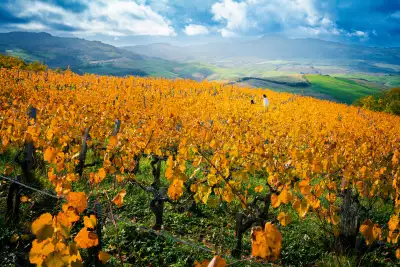
Olive groves sieve the morning light through silver-grey leaves; pomegranate trees slip their split fruit to the ground
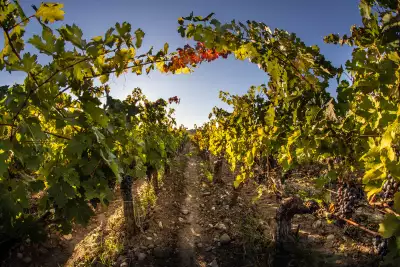
When we reach the top of the ridge, the road transitions from tarmac to gravel. Clouds of dust obscure the high beams as I feather the brakes on the descent. We arrive at a wrought-iron gate, press a button on a remote, and watch it swing open into Tenuta di Trinoro and its 22 hectares of vineyards.
Drive through this part of southern Val d’Orcia and it becomes clear why there are so few wineries. The ground is heavy, the weather unpredictable, the summer heat unforgiving. It takes a certain mindset to look at that and see potential.
Ben’s father Andrea Franchetti did, establishing Tenuta di Trinoro in the early 1990s and planting varieties more commonly associated with Bordeaux than Val d’Orcia, with planting material from prominent châteaux in Pomerol.
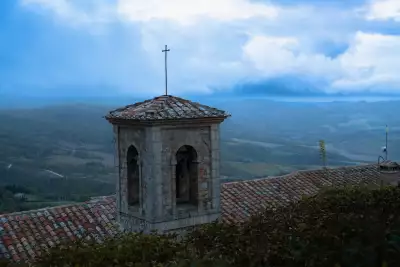
A cupola at Castiglioncelo del Trinoro
Nick Savage
The gambit paid off. Today, the estate sits firmly among Italy’s most respected producers, its reputation built on a site others dismissed.
Andrea’s life followed a similar trajectory – unconventional and intuitive, shaped as much by literature, art and travel as by wine, with well-documented family ties to Cy Twombly and Ernest Hemingway and stories to rival Jack London and Hunter S Thompson.
When Franchetti died in 2021 at 72, the estate passed to his son Benjamin, who had recently founded Agricola Moderna, a leading agricultural engineering firm.
“Before my dad arrived in Val d’Orcia, people were hesitant to visit the area where the winery was, because it was too wild,” Ben tells me over the phone. “This side of Val d’Orcia retained its wildness. You could say it’s the more Italian part of the valley, compared to the tourist towns of the north.”
The next morning, after the fairy hunt, we begin exploring, starting with the grounds of Palazzo la Nuta, which was eventually abbreviated as Palazzi. The casale stands in opposition to the slick and sometimes clinical luxury villas peppered across Tuscany.
The long, terracotta-topped stone structure was made with local fieldstone and brick, the facade weathered into a soft, mottled palette of ochre, ash and lichen that only comes with centuries of age; the building’s plaster is worn back in places to reveal the bones beneath.
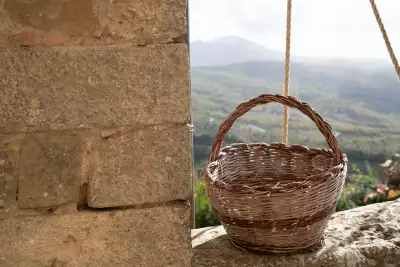
A basket at Monteverdi Tuscany
Nick Savage
An incongruous palm tree emerges from the stone retaining walls, foregrounding a bold, almost surreal pink dome that deliberately disrupts the pastoral tranquillity.
Stretched across the horizon on the opposite side of the valley is the ridgeline of Monte Amiata. It’s crowned by the caldera of the dormant volcanic massif, which juts 1,738 metres above sea level.
To the south, a closer ridge shoulders the Fortezza di Radicofani, the crenellated embattlements of its turret standing in stark relief against the hazy blue sky. Below, undulating sweeps of broad woodland and farmland tapestry together like a patchwork quilt.
My daughter natters and darts through the orchard. Ancient olive groves sieve the morning light through their boughs and silver-grey leaves, while pomegranate trees slip their split fruit to the ground – seeds spilling out, bright as blood.
When she is fast asleep, I walk out into the vineyards – the earth is rich; bruised and metallic on the air
Further afield, we explore the town of Cetona, which sits just beyond the southern edge of Val d’Orcia and feels noticeably less curated than its more photographed neighbours; all warm stone, shuttered windows and hushed vibes.
On the drive home we stop off in Sarteano, an ancient settlement with Etruscan roots that later became a strategic medieval stronghold, its hilltop position still watched over by a 15th-century fortress. Today, its narrow lanes and weathered stone buildings carry that long continuity lightly, feeling lived-in rather than preserved.
Near Sarteano lies the Necropoli delle Pianacce, a network of rock-cut tombs carved into the hillside in the fourth century. The standout tomb in the necropolis is the Tomba della Quadriga Infernale, which was discovered only in 2003. It boasts extraordinary painted frescoes depicting a demonic chariot scene, indicative of the people’s complex belief system when it came to the afterlife.
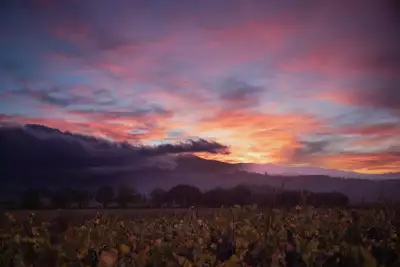
The sunset over Tenuta di Trinoro
Enea Barbieri
“And death, to the Etruscan, was a pleasant continuance of life, with jewels and wine and flutes playing for the dance.” DH Lawrence wrote in his posthumous travel essay Sketches of Etruscan Places. “It was neither an ecstasy of bliss, a heave, nor a purgatory of torment. It was just a natural continuance of the fullness of life. Everything was in terms of life, of living.”
Yet excavations at tombs like the Quadriga Infernale suggest a more ambivalent vision than Lawrence allows for, one in which the dead embarked on a perilous journey through a demon-haunted underworld before reaching that continuation of life.
In this Etruscan view, death was not an end or a simple moral judgement, but a charged transition: a crossing that had to be properly negotiated so that the dead could go on feasting, dancing and inhabiting a richly furnished existence beyond the grave.
The call of an apennine wolf carries across the valley, long and thin
Standing among the tombs, it becomes difficult not to consider what it means to carry the dead with us. The Etruscans ritualised that crossing; the rest of us, divorced from rite and less certain in our atomised western lives, find our own ways of negotiating it, often without realising.
“Papa,” Isla implores during her bedtime ritual on our last evening at Tenuta di Trinoro. “I really heard something. A voice called my name.” I tuck her in. Consciousness slowly begins to ebb from her small dark eyes.
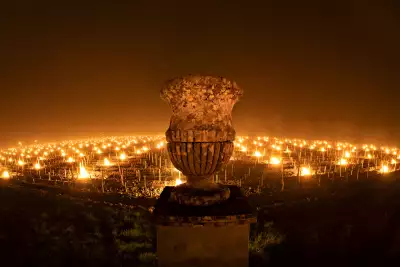
Fires lit to ward off a late frost in Val d'Orcia
Enea Barbieri
When she is fast asleep, I walk out into the vineyards. The earth is rich; bruised and metallic on the air. I lie back between rows of rootstock and watch the stars, twinkling indifferently, while the call of an apennine wolf carries across the valley, long and thin.
Lawrence writes at the end of The Ship of Death: “the heart renewed with peace even of oblivion.” The words land gently, like leaves drifting from the vines.
It comes to me that perhaps the advice offered by my father stood in the way of feeling what I should have felt, and that, improbably, the voice calling out across the Tuscan half-light is my three children, deceased in utero, trying to greet the older sister they never could.
Loss doesn’t resolve so easily; it settles into the landscape of one’s life, resurfacing when it chooses. In the stillness, I find myself listening for something I can’t quite define.