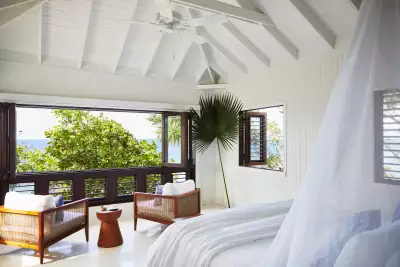
At Strawberry Hill in Jamaica’s Blue Mountains, Chris Blackwell, ever the gentleman, gestures to his son, Chris Jr, to pull out a chair for my wife at the breakfast table, where black coffee vies for space with tropical fruit and toast.
It feels faintly surreal to find myself sitting across from someone whose influence echoes through so much of modern music, but any temptation towards reverence is quickly punctured by our daughter Isla, face smeared with chocolate, shouting excitedly as she demolishes a stack of pancakes at a nearby table.
“Don’t worry about them,” says Blackwell’s daughter-in-law. “They’re in good hands.” Right on cue, the butler catches our eye, smiles and offers a reassuring wave.
This isn’t how I had imagined meeting the man who founded Island Records, helped carry reggae around the world and later turned some of Jamaica’s most storied private addresses into hotels. The conversation with Blackwell Sr is brief – he’s 89 years old – but it’s an encounter I’ll mull over throughout my time in Jamaica.
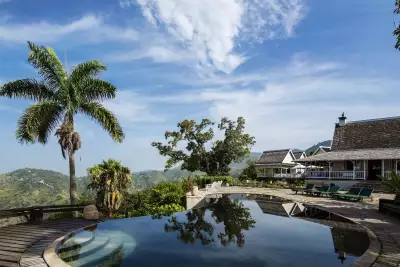
The pool at Strawberry Hill
Island Outpost Images / (c) Nikolas Koenig
Perched 1,000 metres above Kingston, the estate is a vision of serenity: whitewashed clapboard buildings, iconic infinity pools, broad porches and manicured lawns, with rooms filled with gold and platinum records, handwritten lyrics and musical memorabilia.
The cottages seem to hover above the mountain range, cantilevered over the steep hillside so that every veranda opens onto sweeping views across the rainforest canopy to the hazy plains of Kingston far below. Artistic flourishes, from Jamaican sculpture to vibrant local craft, are woven throughout, such as the hand-carved fretwork fanlights above the lintel of each doorway.
Blackwell bought Strawberry Hill in 1972, having become attached after visiting as a child for afternoon tea. It would go on to become a creative sanctuary for artists, including the Rolling Stones, Marianne Faithfull, Grace Jones, Black Uhuru, and Bob Marley.
Bob Marley famously convalesced at Strawberry Hill after being shot during an assassination attempt in 1976
I’m introduced to Blackwell by Michelle Toyloy Carter, the hotel’s public relations manager, who tells me that guests tend to arrive for one of two reasons: the music or the Bond connection (more on that later). Asked why Strawberry Hill has long attracted so many musicians, however, she offers a simpler explanation.
“Nature. That’s really what it is. We have no televisions or radios in the rooms. We do have them in the public spaces, but not in the guest rooms. We don’t get requests from guests for outside noise or entertainment. I think it’s because they can listen to the birds, hear the breeze going through the trees, and simply rejuvenate and relax.”
Bob Marley famously convalesced at Strawberry Hill after being shot during an assassination attempt in 1976. The property is replete with stories about recovery, retreat and famous people hiding in plain sight.
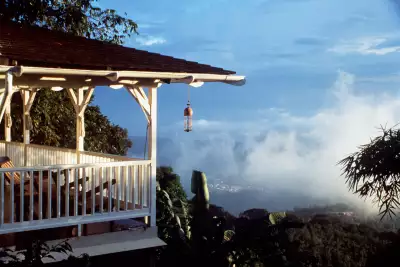
A cottage at Strawberry Hill
(c) islandoutpost / Cookie Kinkead
Yet with children in tow, it becomes something much simpler: a mountaintop village with paths to run down, verandas to take over and adults who keep appearing from Jamaica’s rich cultural history.
The day before, nursing a Blackwell Rum Punch and listening to dub on the stilted veranda, I watch doctor birds and bees flit between hibiscus and blue jade vine before noticing my daughter waving enthusiastically at someone in the cottage next door.
Travelling with only her parents, she’s been longing for other children to play with. Unbeknownst to us, she’s spotted Blackwell’s grandchildren, who are staying in the neighbouring cottage. Within minutes they’re racing across the gardens together while I make small talk with Blackwell Jr.
Children have a way of collapsing distance
Children have a way of collapsing distance. Travelling with them can make you slower, sweatier and more logistically compromised, but it also makes you less sealed off from the places you visit.
In Jamaica, where the country’s cultural influence can make it feel oddly familiar before you even arrive, children have a way of returning everything to human scale. While I’m occasionally greeted with “Bless up” or “One love” as I wander around Kingston or jog through mountain villages, conversations become warmer and more natural when there’s a curious five-year-old perched on my shoulders.
She’s handed fruit and flowers while we chat about where we’re from and where we’re going. We spend just two nights at Strawberry Hill, but leave feeling as though we’ve explored every winding path and hidden corner.
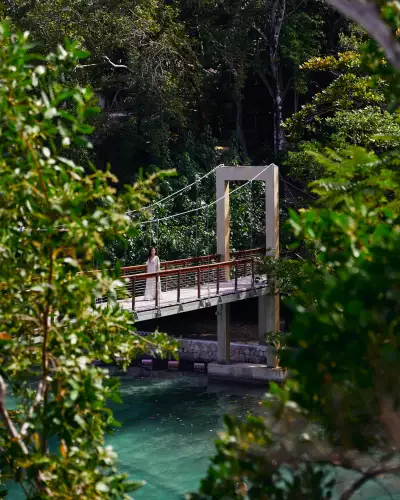
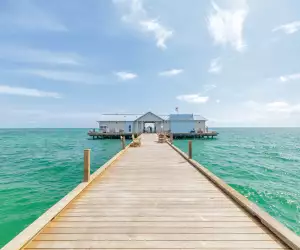
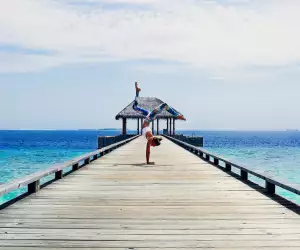
The arrival bridge at Goldeneye
My daughter is practically vibrating with excitement as we climb aboard the shuttle on a misty morning and descend the Blue Mountains on steep, serpentine roads. Beyond Kingston, the landscape softens into plains of banana and sugar cane before opening out to a sweeping panorama of the luminous Caribbean.
We continue east past Ocho Rios to Oracabessa Bay. In the space of a morning, we’ve travelled from cool mountain lawns to a Caribbean lagoon. If Strawberry Hill is Blackwell’s Jamaica in mountain key, Goldeneye is the full production: sea, lagoon, villas, huts, Bond ephemera and, yes, a martini bar.
Most visitors arrive at Goldeneye through the front door of Bond mythology. Fair enough: Ian Fleming purchased the property 80 years ago, lived here, wrote here and left enough 007 residue on Oracabessa Bay to power a thousand linen-shirted, Rolex-wristed fantasies.
Chris Blackwell convinced Bob Marley to purchase the property in 1976
But I find myself drawn more to the second life of the place – the one shaped by music. Chris Blackwell convinced Bob Marley to purchase the property in 1976, and when Marley decided he didn’t want it, Blackwell bought it himself as a place for friends and family to stay. Since then, it’s hosted musicians and producers such as Quincy Jones, Fatboy Slim and Bono, while Sting wrote ‘Every Breath You Take’ here in 1982. That vibe continues to this day.
Blackwell said in a Vogue interview that he wanted Goldeneye to be a place where people mix, meet people and become friends; he describes that as “the most important thing”.
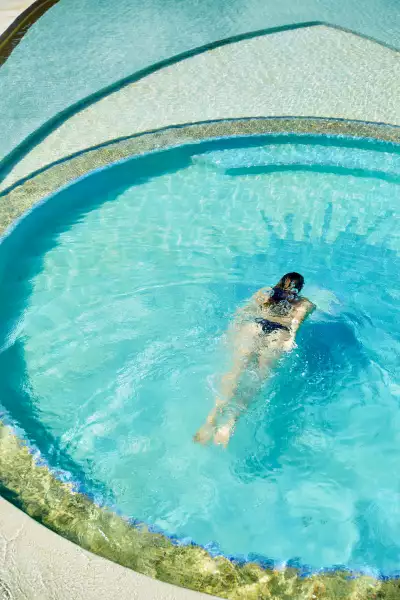
The Goldeneye pool
(c) Brie Williams / Island Outpost Images
The cool thing is that it actually happens. At Bizot Bar, on the western arm of Low Cay Beach, we enjoy rum cocktails and Red Stripe under torchlight, snacking on jerk chicken and curry goat, while our daughter plays in the sand and befriends a girl her age at the table next door.
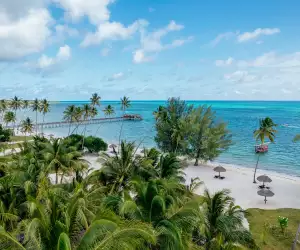
Goldeneye unfolds as a series of distinct little worlds, each with its own rhythm. Low Cay Beach is its social centre of gravity, a broad sweep of white sand lined with spacious villas, Bizot Bar and a freshwater pool, while the lagoon feels more private and elemental, its cottages opening directly onto the water from decks furnished with kayaks.
Further along the coast, the freestanding beach huts (where we’re staying) rise among tropical gardens between Snorkeler’s Cove, Button Beach and Shabeen, their louvred windows, high ceilings and outdoor showers designed to let the sea breeze and sounds of the night straight in.
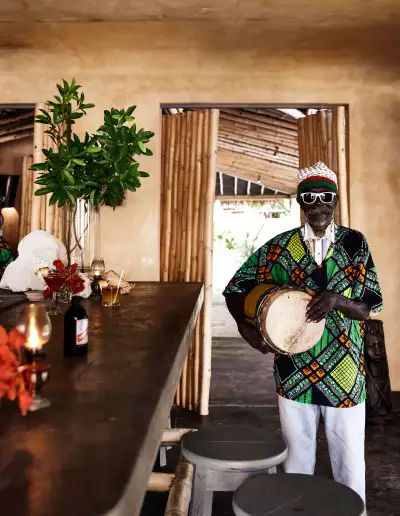
Rastafarian Nyabinghi drummers at Shabeen
Shabeen is a breezy gathering place, with a pool, cocktails and a rooftop overlooking the Caribbean; Button Beach is scruffier and more playful, its little Bamboo Bar serving rum, jerk and fish brought in by local boat – a hub of activity for young families.
Unlike many hotels, the choreography of separation collapses here. Within minutes, your carefully maintained adult boundaries have been destroyed by a shared bucket, a ball, or lunch.
At Button Beach, we meet the parents of the girl our daughter played with the night before. As the children catch hermit crabs together below a palm tree, we trade stories with the adults – the father is a fashion photographer and the mother a producer.
Before long, we are drinking rum out of coconuts and exploring the lagoon by kayak and paddleboard. The kids make another friend soon after – her mother sings in one of our favourite bands.
My daughter squeezes in around a drum with the two friends she has made
Our final evening ends with a drum circle beside the sea at Shabeen. Cocktails pass between guests while Rastafarian Nyabinghi drummers play in front of the breaking surf, the rhythm carrying across the water.
Blackwell has said that a boating accident off Hellshire Beach in 1958, followed by his rescue by Rastafarians, first drew him towards the music and culture that would later help define Island Records.
Decades later, I find myself sitting beside him as the children take over. My daughter squeezes in around a drum with the two friends she has made, and Blackwell’s grandchildren join them.
Jamaica is full of larger-than-life stories, but this is the image that stays with me: children drumming together after dark, oblivious to the history gathered around them.