It’s 7am on a Sunday morning. I am eating a fried fish sandwich. Unlike most of the people around me, I’m drinking water rather than beer. I’m watching a cover band and they’ve just stopped telling the crowd they “can’t get no satisfaction” and are now telling us how they “wanna whole lotta love”. The liveliest couple on the dance floor is, I would estimate, somewhere in their early seventies. I don’t really know what I expected to find in Hamburg, but it absolutely wasn’t any of the above…
So. Yes. Hamburg. What does one expect to find in Hamburg? Aside from some Beatles history, and maybe some good beer, bread, and sausages, I didn’t really have any idea of what I’d find there. In terms of great European food destinations, like most people, if asked, I’d suggest the usual shortlist – Paris, Rome, Barcelona, Lisbon, Copenhagen et al – but Hamburg? Not a chance. Before visiting I’d have thought that the city’s biggest (and only) contribution to world cuisine was when German sailors took chopped beef to America, named it after the city and thus put a clown, a king and at least five guys onto a billion-dollar idea. After visiting, I’m saying, “Seriously, people, what are you waiting for?”
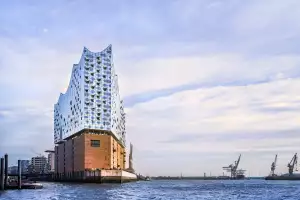
The Elbphilharmonie was inaugerated in 2017
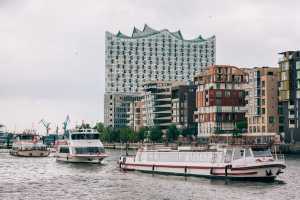
As a tourist destination, Hamburg is nothing short of stunning. Water plays a major role, from the walkable, beautiful Alster Lakes at the city’s heart to the River Elbe and the multiple, fascinating harbour tours available. Architecture runs the gamut from the historic 17th-century merchant houses of the Deichstraße to the ultramodern. The new riverside HafenCity development, home to the newly iconic, wave-like Elbphilharmonie concert hall, is the sort of modern, inner-city / urban development that has architecture publications making noises only dogs can hear.
Even to the architecturally unaware, it serves as a stunning contrast to the Unesco-recognised historic red-brick warehouses of Speicherstadt. A tour of the Old Town is also a fine way of spending an hour or three, from the stunning Rathaus (city hall) to the remains of the St Nikolai church, which neatly encapsulate around 800 years of Hamburg’s history, from its 12th-century origins, through the 19th-century neo-Gothic redesign by George Gilbert Scott following Hamburg’s Great Fire of 1842, to its current place as an impressive and deeply poignant memorial to the Second World War.
You may also pick up on Hamburg’s long history with the United Kingdom. Centuries before the Beatles arrived, the city had long traded with England, creating such a strong sense of Anglophilia that, as my guide Therese tells me, there’s a local saying: “if it rains in London, they open an umbrella in Hamburg”. While certainly an excuse to return and explore more, all of this is merely a rather delightful bonus to the main point of my visit: an immersion into the city’s food scene. And what a food scene it turns out to be.
All of this is merely a rather delightful bonus to the main point of my visit: an immersion into the city’s food scene. And what a food scene it turns out to be
The main hook of the visit is Open Mouth, a culinary festival launched in 2024 which celebrates Hamburg through impressive numbers: 11 restaurants, ten top chefs, 12 Michelin stars, and seven Green stars. “Hamburg has always been a city where people eat well,” explains Stevan Paul, one of Open Mouth’s organisers. While the city has been recognised by the likes of Michelin since the late 1970s, Stevan recognises that it’s over the last 15 years where the city’s culinary scene has really become something extraordinary, switching from venues with classically staged fine, elaborate service and a sometimes very conservative clientele, to the vibrant, diverse and internationally shaped fine-dining scene that has emerged, rivalling that of Berlin and Munich.
“Kevin Fehling’s The Table gained Hamburg its first three-star restaurant in 2015, and its sweeping counter instead of classic tables, highly composed, cosmopolitan cuisine, and deeply personal storytelling sent a clear signal that top-level dining no longer needs to look like a grand hotel from 1985, and a young, innovative scene emerged which has turned Hamburg into one of Europe’s gastronomic capitals.”
Ironically, my first meal in the city is at Haerlin, which is located in the very grand Fairmont Hotel Vier Jahreszeiten. It’s the city’s second and most recent three-star restaurant, all three being earned over some two decades by chef Christoph Rüffer. It is, inevitably, spectacular, from opening snacks to final petit fours and, particularly, the three different types of butter blended and patted tableside. While it doesn’t necessarily give a great sense of place or even whisper “Hamburg” – and yes, I know such a comment marks me down as an ingrate or a bell-end or, most likely, both – it is a genuinely spectacular experience.
It’s the following day, however, where the promised “vibrant and diverse” dining scene comes to the fore, starting with what, as far as I can tell, is a unique situation: two Michelin-starred restaurants sharing one kitchen. I’m in one of the city’s more industrial districts, in a former warehouse converted to a flexible, loft-style interior that, aside from the creative use of colourful Le Creuset lids and pots as artworks and shelves heaving with assorted ferments and pickles, pretty much defines the concept of industrial chic.
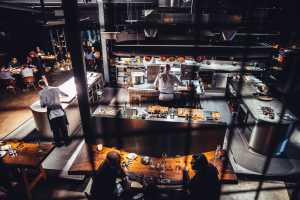
Kitchen at 100/200
René Flindt
At its heart is the quietly bustling kitchen where chef Thomas Imbusch and exemplary sommelier Sophie Lehmann are doing remarkable things with food and drink. And, indeed, doing it twice. At 100/200, there’s a tasting menu that changes with the seasons. It has two Michelin stars and one Green star. Overlooking this from the mezzanine, sister restaurant Glorie offers a la carte food Imbusch calls the “old school, reimagined”, classic dishes made with the occasional twist, from select ingredients and with an eye to sustainability. Glorie has one Michelin and one Green star.
I graze through a few dishes, and it’s dazzling and delicious and deceptively straightforward.
“The real complexity is simplicity,” agrees Imbusch as I sneak another Käse Toast 2018, perhaps their signature dish, which, despite the name, is layer upon layer of umami from 24-month-old gouda, aged vinegar, and a reduction of mushrooms in a handheld, two-bite snack of joy. “Although sometimes it’s a happy accident,” adds Imbusch, explaining how the beefy topping to an oyster came about from necessity when he and the team had an idea for a dish, somewhat miscalculated matters and ended up with 90 kilos of beef sausage that needed to be used somehow. Some got sprinkled on an oyster and, well, the rest is savoury history. I don’t hear the story of how they came up with macarons flavoured with cardamom and caviar, but I’m jolly glad they did…
Lunch is walked off with a look around the St Pauli district, home to the massive repurposed site, the St Pauli Bunker. A former anti-aircraft bunker that towers across the skyline, it’s reminiscent of many a dystopian future-set video game but has been recycled into a remarkable hub of viewing spaces, event spaces, a Hard Rock Hotel and additional green spaces, which apparently help to cool the average temperatures in the St Pauli area and provide shelter for birds and insects.
The surrounding area is dotted with thrumming markets, cool bars, and the sort of businesses you’d find in newly gentrified areas of any city. It’s an interesting place to stroll, and one that takes you to the once infamous Reeperbahn, its legendary (and historical) decadence at odds with the more puritan attitudes of the city, and only permitted because, as evidenced by markers and insignia on bits of street furniture, the region was once under Danish control.
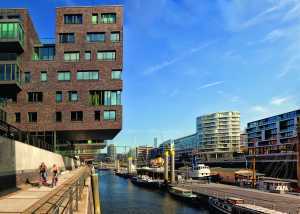
HafenCity, located on the former port of Hamburg
These days, there are still hints of its recent wilder past – and frequent nods to places the Beatles stayed, played and slept – but the neighbourhood is also home to many of what Stefan describes as “second-row restaurants”. Not that that’s an insult in any way. “They’re a particular asset to Hamburg,” stresses Stefan, “with young, highly ambitious kitchens in relaxed settings, with less fuss, spanning styles from innovative to regionally rooted. They operate all over the city, and are defined by their warm, unpretentious hospitality.”
Dinner takes me to a couple of such places. The evening starts at Crudo, for their excellent Nikkei-influenced cuisine – big flavours, welcome licks of acidity and an artfully charred, cheese-laden, crispy rice dish that tests every ounce of my limited willpower – before moving to XO Seafood Bar, a sleek and chic spot from Michelin-star chef Fabio Haebel for, unsurprisingly, seafood in myriad, delightful forms. Moules à la provençale is a curious yet successful mix of mussels, olives, rosemary, vermouth, and garlic. Bread and butter comes with seaweed caviar, and a plate of chunky fish goujons makes this Brit very nostalgic for the fish finger suppers of my youth.
The signature dish pasta krabbe – pasta coated in a rich bisque of North Sea crab – is every bit as good as that sounds: Fabio tells me, quite understandably, that “there would be riots if we take it off the menu.” Dessert also takes an aquatic route to the palate: Coupe Denmark Royal is a combination of vanilla ice cream, chantilly, chocolate and sturgeon caviar. It’s the best dish of the night (and almost the weekend), the sort of sweet-and-savoury combo that genuinely has me reminiscing about the first time I tried salted caramel.
There’s a brief detour to Fabio’s Restaurant Haebel opposite – Hamburg’s most intimate, 16-seat-only Michelin-starred restaurant – for a takeaway ice cream cone, before the evening rounds out at the city’s “Bar of the Year 2025”, The Rabbithole Bar, where Constanze Lay and Florian Sonneborn are creating some quite astonishing libations. My “Say Cheese” brings together sherry, hazelnut, pear, soy and gorgonzola in something as mind-bending as it is delicious. Florian hands me one of their coasters. On one side, there’s a John Tenniel-style/Alice in Wonderland-esque rabbit. On the other, there’s a QR code. “Scan that,” explains Florian, “and you get a list of my and Constanze’s favourite spots in Hamburg.” It’s an idea that gives a great indication of the supportive nature that’s common in Hamburg’s hospitality scene. It’s also one I shall steal and pass off as my own one of these days. Obviously.
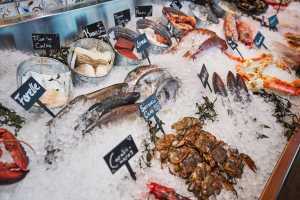
Westfield 2025 fish market
Christian Brandes
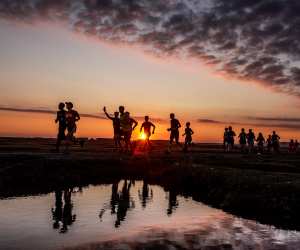
And then it’s Sunday, it’s 7am, and I’m at the remarkable Fischmarkt, listening to Led Zeppelin covers, eating crispy-coated fish in a bun and wondering how this is even a thing. According to a local I meet, the best way to visit the market – which runs weekly from around 5am until 9am or so – is to drink through the night in St Pauli and/or Altona and stop for breakfast and beers on your way home and it seems many, of all ages, are doing exactly that.
I stroll back along the river, playing tourist a while, before heading to the Open Mouth event that brought me here, the Kitchen Party at foodlab Hamburg. The selection of restaurants has been curated by Maurizio Oster of the one-starred Restaurant Zeik. Each restaurant is offering a signature dish or two – Thomas Imbusch is here, producing more Käse Toast 2018 (I force myself to tap out at three) – and, as ever, it’s a fascinating process to watch teams of two, three, four, and more chefs working in unity and precision to produce bowl after identical bowl for the assembled crowd.
Dishes range from the elaborate to the simpler and, well, everyone’s a winner. If I have to pick a favourite, though, it’s the offering from Haebel: barbecued / smoked peas, fig leaf, preserved lemon and buffalo yoghurt. In an ideal world, this would be my final meal in Hamburg, allowing for a poetic closing line about how this dish, and the way it straddles several cuisines and techniques, the traditional and the modern, sums up Hamburg’s enormously impressive and varied culinary scene.
But that wouldn’t be me. Instead, an evening stroll takes me past a lively bar, offering great beer and great sausages and, well, you can guess the rest. In its own simple way, though, it’s the perfect full stop to what I have no doubt is the first of several visits to this fine city. Seriously, people. What are you waiting for?