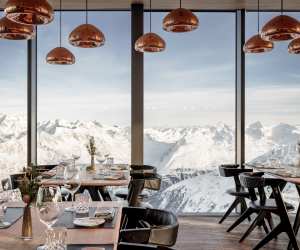
As the ping marks my arrival on the thirteenth floor, the lift doors slide open and my eyes are drawn towards curved windows framing the mountains. After a day of playing hide and seek with their peaks, snatching glimpses between downtown towers, they finally reveal themselves in full glory, and they don’t disappoint.
Sandwiched between the cobalt sky and a soft haze over the city’s greenery, their smooth silhouettes rise like brushstrokes on a vast canvas. With a prime golden-hour seat at Stellar Jay’s rooftop restaurant, where bison steaks hiss over the open fire, I sip a blueberry Bluebird Smash. The awakening tang of fresh lime juice eases the jet lag.
I’m in Denver, Colorado, which, at a mile high, feels closer to the sky than the sea, with a dining scene reaching just as ambitiously. Long associated with the Rocky Mountain fare of meat and potatoes, Denver is now home to a wave of creative restaurants and craft breweries, where altitude inspires experimentation and global flavours mingle with local traditions.
Sustainability and innovation are increasingly baked in, with restaurants embracing zero-waste techniques, local sourcing and farming ingenuity. More young professionals, wealthier newcomers and a growing immigrant population are fuelling demand for adventurous, cross-cultural dining. I’ve come to the foothills of the Rockies to taste this evolution first-hand, and to see what’s driving this creativity. Denver’s burgeoning food scene is rapidly becoming one of the most dynamic in all of the American West.
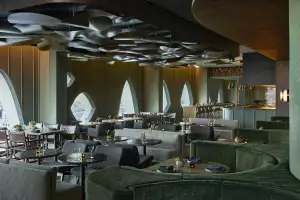
Rooftop restaurant Stellar Jay
Yoshihiro Makino
On a bright Denver afternoon, I meet Barry Klassen, my guide from Delicious Denver Food Tours, who is eager to show off not just the city’s food diversity, but its high quality as well. “In 2017, we were ranked the fourth most exciting food city in America,” he says, “and with that came Michelin and James Beard awards.”
In 2025, Denver’s culinary profile has surged thanks in part to achieving its first-ever two-Michelin-starred restaurant, The Wolf’s Tailor, and three new one-star honours, bringing the total up to six. Chefs like Johnny Curiel are also making waves with multiple restaurants featured in the guide, pushing innovation through global influences fused with regional ingredients.
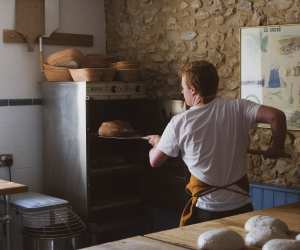
We dive straight into Michelin-recognised Marco’s Coal-Fired Pizzeria, where I learn that Denver’s altitude gives the dough a twist – crispy at the edges yet denser, with fewer air bubbles than its lowland counterparts. Made with San Marzano tomatoes grown on Vesuvius’ slopes, it’s an unexpected attention to detail that pays off and tastes as authentic as any in Naples.
Continuing our movable feast, we wander through Lower Downtown, peering down cobblestone alleys behind red-brick warehouses with faded signs that hint at the neighbourhood’s railroad past. At Lazo Empanadas, hidden raisins lend a gentle sweetness to super-flaky, meat-packed pastries, perfectly balanced by the chimichurri’s herbal punch.
Just around the corner at Cherry Cricket, steaming bowls of the hearty Colorado classic, ‘green chili’, arrive. Made with local pork and Pueblo chillies from the nearby Arkansas River Valley, it has a good kick and I leave my bowl empty.
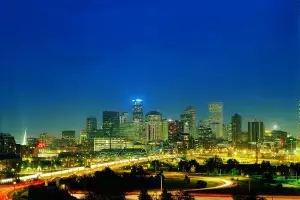
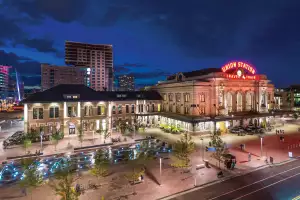
The Denver skyline at night
Marcia Ward
A few blocks on, Barry points out subtle signs above hidden doors that indicate the location of speakeasies and shows how colourful murals, inside and out, nod to local culture like the restaurant Kachina’s tribute to Native American resilience. Their fry-bread taco echoes that heritage, piled high with tequila-marinated pork and a coriander-heavy salsa verde.
We finish inside Denver’s Union Station, the city’s main railway hub as well as one of its high-end food halls. Vaulted ceilings and stately chandeliers frame the hum of conversation, sizzling skillets and clinking cutlery. The city’s diversity is showcased in our final few steps, as bakers, baristas and award-winning chefs share one roof.
Communal tables encourage strangers to sample flavours and creativity side by side. As train schedules tick overhead, I take one last bite into a flaky, custard-filled pastel de nata and marvel at the journey my taste buds have embarked upon.
That evening, I head to historic Larimer Square, where strings of fairy lights and Colorado state flags hang across a red brick façade with ornate Victorian cornicing. Mediterranean-inspired Rioja hums with cosmopolitan energy, soft lighting gleaming against a copper-topped bar, while an open kitchen gives diners a theatre show of chefs at work. James Beard award-winning chef Jennifer Jasinski’s menu celebrates Colorado’s bounty: handmade pastas intertwined with locally grown vegetables, and lamb sourced from nearby ranches.
Her signature artichoke tortellini is like nothing else I’ve tasted, a pillowy pasta filled with silky artichoke mousse rather than the usual cheese or meat fillings. Layered with aged manchego and white truffle broth that I mop with fragrant lavender sourdough, the dish shows Denver chefs are artists too, treating pasta not as tradition but
as a canvas for innovation.
The following day, tucked behind the vegan eatery Vital Roots, Beat Box Farms feels like I’ve stumbled upon a secret laboratory inside a refurbished shipping container. Vertical hydroponic towers hum softly, fans blow green salad leaves lit by ultra-bright lamps. Standing among the tatsoi, purple mustard frills and Red Russian kale, Cori Hunt tells me their motivation is simple: “freshness – you cannot get it any fresher, and we deliver 150 pounds of produce per week to our restaurant group, Edible Beats.”
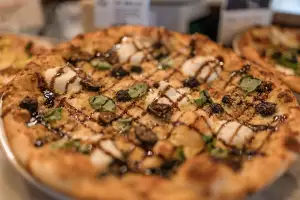
Pizza at Denver Central Market
Nikki A Rae
It’s a study in efficiency with zero waste, 100% wind power, closed loops and maximum flavour squeezed out of a surprisingly small footprint. Growing food just steps from Vital Roots is not only sustainable and convenient, but an act of creative problem-solving in a climate that resists such crops.
As Hunt shows me to my table at Vital Roots, the connection between the farm and menu is immediate. “The chefs choose new dishes based on seasonality,” Hunt says, “but we have the benefit of not needing to be tied to the seasons and can give them freshness in the winter.”
With a falafel wrap, cashew ‘queso’ nachos and a green ginger smoothie, each bite imbues my taste buds with simple yet compelling flavours. It’s a dining experience rooted in a farm-to-fork approach, but with the culture of creativity that seems to course through the city’s circulatory system.
If Beat Box Farms shows how technology can reimagine farming, the Oakwell Beer Spa proves Denver’s innovation extends well beyond the plate. As I lower myself into a private cedar hot tub infused with hops, barley and my chosen herbs of lemongrass and eucalyptus, I wonder what I’ve let myself in for. The scent is sweet and earthy, nothing like the sickly hops of a brewery.
Bubbles fizz around me, forming a frothy head and massaging my skin, making me feel suspended in a giant beer glass. At first playful, the experience deepens as my muscles relax and my skin softens. I sip a crisp Mexican lager, Rayo Blanco from Denver’s Diebolt Brewery, and realise this is what Denver does best: bringing pleasure, craft and experimentation together, where even drinking a beer becomes a creative act.

Oakwell Beer Spa
The next morning, I swap my fork for a spray can, at least in spirit, with a street art walking tour of the River North arts district, RiNo. In front of bold letters spelling DENVER against a geometric pattern of neon pinks and blues, Will Forrest from Denver Graffiti Tours starts with a history lesson. After World War II, the city’s sugar industry collapsed, sparking economic decline and an exodus of other industries, including, ironically, paint. “But it made this area conducive to artists, who eventually made it so desirable that now everybody wants to move here,” Forrest tells me.
RiNo unfolds like an outdoor art gallery where every wall tells a different story – or even multiple stories. Bold cartoon characters grin from garage doors, controversial stencils decorate hotel walls and wild-style graffiti tangles neon lettering across alleyways. RiNo’s art pulses with its roots. “When industry left, it hit once-thriving African American and Latino communities hard,” Forrest explains, “so what they’re trying to do is show unity and demonstrate this chaotic beauty.”
City initiatives, including the Denver Walls Festival, have encouraged collaboration between artists and businesses, so now every café, brewery and restaurant seems to wear its street art emblematically. It’s little wonder this same experimental energy spills onto Denver’s plates. Staring up at a giant kaleidoscopic mural representing the movement of time, I feel a pull towards one of the city’s top attractions: Meow Wolf’s Convergence Station.
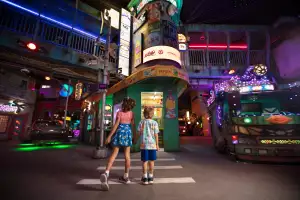
Meow Wolf
Kate Russell
Stepping through a glowing portal into one of four alien worlds, I brush my hands across walls that ripple with light, speak into listening ears and pull levers to create organ-like sounds that shift the feel of the space. Some rooms I drift through, in others I lose track of time, experimenting with how my body bends the sound and light around me. “You’re encouraged to touch and pull everything,” Cade Davis, a manager at Meow Wolf, tells me. “That means things break and our artists get to rebuild the exhibition every day, which they love.” Designed by more than 300 creators, many Denver locals, the installation feeds off the same experimental energy that fuels the city’s street art.
Immersive art like this has taught Denver’s restaurateurs that diners crave experiences, not just meals. Stepping through the pink stucco façade of one of Denver’s most kitsch icons, Casa Bonita, it’s clear this is no ordinary restaurant – and that’s before I reach the cliff-diving pool, twinkling grottoes and mock-Mayan temples. Opened in 1973, it was infamous for a fun night out with terrible food until South Park creators Trey Parker and Matt Stone bought it, enlisting James Beard-nominated chef Dana Rodriguez to overhaul the menu.
I weave past torch-lit caves and mariachi stages before settling into vegan corn tacos, creamy beans and fried poblanos. The effect is pure immersion: I’m not just eating, I’m part of a production, pulled into a cheesy magic show mid-meal before being nudged to finish my drink at a puppet performance. Where Meow Wolf invites you to lose yourself in fantastical worlds, Casa Bonita transforms dinner into an experience fusing nostalgia with culinary ambition.

The lagoon at Trey Parker and Matt Stone's restaurant Casa Bonita
Casa Bonita
As I admire the Rocky Mountains behind the evening haze, I contemplate how Denver’s dining scene is pushing upwards with the same restless energy, but in a quiet, unassuming way. Few people I’ve spoken to feel that the city is doing anything special, most consider it just a natural evolution. Walking the streets where the artwork is continuously changing and pushing boundaries, it’s little wonder that this potent creativity flows into its kitchens and dining spaces too.
Denver’s altitude will keep nudging chefs to climb higher, pushing doughs, brews and flavours into new territory, while its creative spirit will ensure global influences continue to blend with its Rocky Mountain bedrock.
Coupled with an appetite for sustainability – from local ingredients and seasonal produce to hydroponic farms to zero-waste kitchens – Denver is poised to shape food trends that value experimentation, immersion and cross-cultural dining, setting a model other American cities may soon emulate.
It’s this psyche that makes Denver’s food so bold, fun and experimental, and it’s redefining what it means to eat in the American West. In Denver, the food scene rises as steadily as the Rockies themselves – lofty, unpredictable, and impossible to ignore on the horizon.