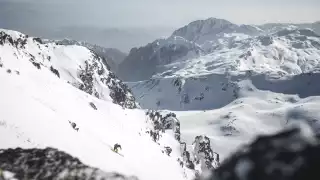
In many ways, the journey to Lynx Freeride’s hotel is like the journey to any ski lodge anywhere in the world. I land at the nearest city airport, buy an e-SIM from a local who speaks embarrassingly perfect English, jump in a taxi, and am whisked to a restaurant at the bottom of the mountain, from where the hotel transfer will pick me up.
There are two other ski bags by the door, and their owners – instantly recognisable inside – turn out to be Brits heading to the same place. Before long, we’ve bought a round, and Henry, Kris and I are sharing stories of powdery adventures past like old friends. So far, so normal.
In fact, there’s nothing abnormal about the drive up the mountain either. The battered Nissan Patrol that picks us up is an Alpine archetype, the kind of car that could be found bringing guests to remote backcountry lodges anywhere from northern Canada to New Zealand.
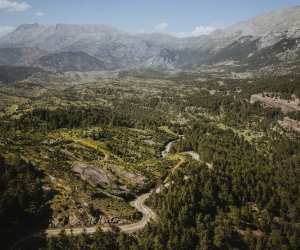
But as we motor up through the forest, I start to notice something that instantly indicates that we’re not travelling to either of those places, such as signs by the road’s verge bearing the logo of The Halo Trust, which cautions: “This area is being cleared of landmines.”
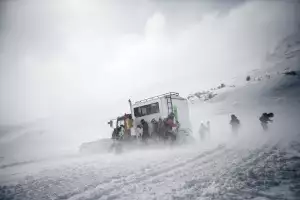
Beds at the Grand Gjeravica are comfortable, the food is plentiful, the showers are hot and the beer is cheap
Moritz Ablinger
Kosovo is not a place that’s renowned for its backcountry skiing. Or any kind of skiing, for that matter. Members of Gen Z who pay attention to such things may know it as the birthplace of Rita Ora, or that Dua Lipa, who has Kosovan parents, spent a chunk of her childhood there. But for anyone older, the country is best known, not for its pop stars, but for its brutal war of independence.
In February 1998, after years of simmering tensions, this tiny country succumbed to the violence that swept across the Balkans as Yugoslavia tore itself apart. Fighting between the Ushtria Çlirimtare e Kosovës (UÇK), or Kosovo Liberation Army, and the Serbian forces of the Yugoslav National Army was fierce. There were well-documented instances of ethnic cleansing, and in the border regions, like the mountains we’re driving into, the conflict left a lot of unexploded ordnance.
Of course, all of this was a generation ago. The fighting ended in June 1999. Despite Serbia’s continuing objections, Kosovo formally declared its independence in 2008 and has been on a path to EU membership since 2018. Tourism is on the increase, and although Lynx Freeride was the first, they’re no longer the only dedicated backcountry skiing operation in the country.
“Even the locals considered us completely crazy when we first came here,” says Seb Fleiss of Lynx. But since 2018, he and his co-founder Hamda Hisari have transformed their trailblazing idea into a successful business that’s won praise from the Kosovan government and several major EU grants for tourism development.
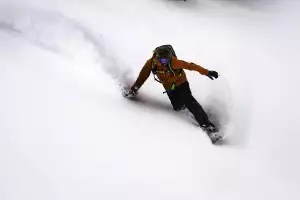
There are wide-open faces, and technical-looking couloirs snaking down from the peak
Tristan Kennedy
Universally known as Super-Hamda, Hisari, who was born and raised in Kosovo, is a one-man Swiss army knife: driver, mechanic, guide and fixer all rolled into one. Seb, a laid-back ex-pro snowboarder from Croatia, handles the business development, accounts and marketing side of things.
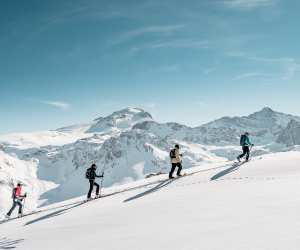
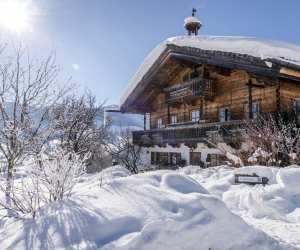
One look at the position of the Lynx Lodge – officially known as the Grand Gjeravica Hotel – and it’s immediately obvious why they chose Kosovo, and this part of Kosovo in particular, as a base. The hotel sits at 1,750m above sea level, on one side of a huge, high-alpine bowl beneath the summit of Gjeravica, the country’s second-highest peak.
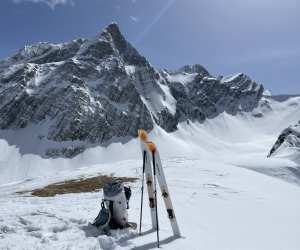
Spread in front of us is a laundry list of every conceivable kind of terrain a powder-loving skier could want. There are wide-open faces, and technical-looking couloirs snaking down from the peak of Gjeravica itself, 2,656m above sea level. There are gulleys that look like natural halfpipes, and cliff bands to drop off. There are windlips for slashing, pillows for jumping into, and well-spaced pine trees, promising sheltered tree runs in case the weather turns bad.
And all of it is blanketed in several metres of snow. Because of its proximity to the Adriatic Sea, where winter storms scoop up moisture, these mountains can get up to 15 metres of fluffy white stuff in a good year, according to Seb. Best of all, as his guests, we have this all to ourselves.
The range crowned by Mount Gjeravica is known as the Accursed Mountains – Bjeshkët e Nemuna in Kosovar Albanian. The exact origins of this name are unclear. Some say they were created by the devil himself. Others, that a medieval Serbian army cursed them when they struggled between the impassable peaks.
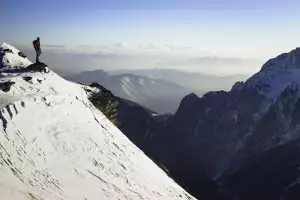
The range crowned by Mount Gjeravica is known as the Accursed Mountains
Tristan Kennedy
Whatever the truth, they’re wild, inaccessible and completely empty. Seb explains that they chose their name, Lynx Freeride, because you can find the elusive wild cats in this vast wilderness. But the Accursed Mountains are also home to Europe’s largest population of grey wolves, as well as around 50 brown bears.
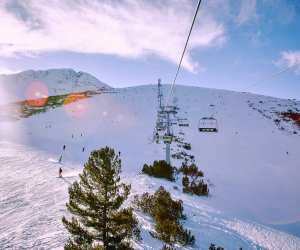
Of course, there are no lifts or pisted ski runs in a place as remote as this. Instead, Lynx run what’s called a ‘cat-skiing’ operation. First popularised in Canada, this involves using modified piste bashers (or ‘snow cats’ as they’re known in North America) to ferry skiers to the top of pristine, powdery slopes.
It’s often referred to as ‘the poor man’s heli-skiing’, but if the vehicles are slower on the uphills, the rides down are just as enjoyable. Needless to say, Kris, Henry and I waste no time wolfing down our breakfast each morning – soft Balkan flatbread, honey, cheese and strong Turkish coffee – and piling into the snow cats with the other guests.
Our first run screams through a wide open powder field, before funnelling into a tight gulley, filled with little obstacles to dodge and jump off. The cat meets us at the bottom, and within just 20 minutes we’re back on the same ridgeline, skiing a fresh line next door. “I need to get my ski legs back,” jokes Henry after hammering down for the second time. He skis like a demon, but this is his first trip of the winter, and
the pace is unrelenting.
What’s perhaps most impressive is how well the Lynx guides – led by a North Macedonian snowboarder named Marko Darkov – manage the snow. They have two snow cats operating at any one time, each carrying up to 12 guests. And yet over a week after the last snowfall, Marko and his team are still finding their clients fresh tracks to carve on every run.
Perhaps most importantly, they also run a tight ship in terms of safety. Thanks to Seb’s contacts, Lynx can offer guests the use of the latest kit from snowboard brands like Nitro and Volcom. And everyone is equipped with a mandatory avalanche transceiver, shovel, probe and airbag backpack. There are briefings every evening, covering safety and what conditions to expect the next day, and if there’s a wait for a cat between runs, Marko and the team conduct avalanche rescue drills.
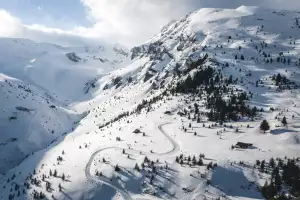
Lynx Lodge sits at 1,750m above sea level, on one side of a huge, high-alpine bowl beneath the summit of Gjeravica
Moritz Ablinger
If the on-snow operations run by Seb, Hamda and their team are world-class, the lodge is a little more rustic. Ultimately, Seb and Hamda would like to build their own accommodation, but for the moment they rent the Grand Gjeravica each winter, and have to work closely with its idiosyncratic owner, Iusuf Krasniqi.
As the son of a senior UÇK commander, Krasniqi was heavily involved in the war. He fought the Serbs, ran guns across the border from Albania, and lost friends in combat. One evening, after dinner, several beers and a shot of local brandy, he pulls up his shirt to show me the scar left by a Serbian sniper’s bullet.
Krasniqi’s taste in decor reflects his political persuasions – animal skins alternate with Albanian eagle flags on the walls, and the UÇK logo is displayed proudly over the fireplace. He likes playing cards, smoking inside, and occasionally shooting off a few rounds from his pistol into the snow – sometimes inviting guests to join him. But the beds at the Grand Gjeravica are comfortable, the food is plentiful, the showers are hot and the beer is cheap. And really, the chance to experience rural Kosovan culture is part of the place’s charm.
At least, that’s the way my fellow guests see it – I share the week with people from all backgrounds. There’s a Norwegian start-up founder who cashed out and now chases snow around the world. There’s an American from Jackson Hole who wanted to experience something a little different. There are French and Swiss and Austrian skiers, and a large crew of Germans led by an ex-pro snowboarder-turned-guide who loves it so much he brings at least 20 clients back here every year.
There are wide-open faces, and technical-looking couloirs snaking down from the peak
Tristan Kennedy
As a country, Kosovo is on the up and up. Before catching my flight home, I spend a day exploring the capital Pristina. I chuckle at the statue of Bill Clinton and the road named after Tony Blair – the pair are considered heroes in this part of the world for sending Nato jets against the Serbs in 1999. But I love the combination of modern and former Yugoslav architecture, and the young, buzzy atmosphere of the place is infectious.
With legs weary from long days on the mountain, as well as my city tour, I stop for a cold beer in Medlin Olbrajt Square. It takes me a while to work out that it’s named after the former US Secretary of State Madeleine Albright. Not the normal spelling of her name perhaps, but then Kosovo isn’t a place that’s bound by western conventions – and that is precisely its appeal.
A few days after I get home from Kosovo, I feel my phone buzzing. It’s a text from Henry, who’d stayed on at Lynx with his buddy Kris after I left. “Looking at going back next year,” he says. “We’ve got a spare spot if you can wangle it?”