The things we carry
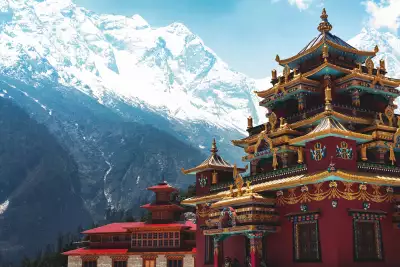
At 3,400 metres, inside a Tibetan Buddhist monastery in the village of Lho in Nepal, I’m surprised to find my cheeks hot with salt. My guide, Janak Bomjan Tamang, and I have climbed through fields where a farmer, toothless and mute, laughs soundlessly as I stumble behind the wooden harrow of his ox, ploughing furrows for potatoes. Then we continue upwards along winding stone trails towards Ribung Gompa, where the dim interior is so saturated with detail that, on entering from the high Himalayan afternoon, it takes a few moments for the eye to adjust.
Technicolour tapestries, mandalas and mantra books, carved pillars, offerings of grapes and pomegranates, gongs and golden figures crowd the room. Beyond the walls, wind whistles across the mountain col. Monks and workmen converse in the courtyard. The monastery feels uterine, the noises outside muffled as though heard through water. As Janak and I lean back against the wooden beams to rest our legs, breathing slowly in the incense-thickened air, something catches in my chest.
I wipe my cheeks dry, hoping he hasn’t noticed. What is this softheadedness? There is no grief I can identify, no memory to explain it. I am not thinking about my family, or loss, or anything in particular. The absence of a cause disorients me, because the sadness is accompanied by something closer to wonder: an almost painful awareness of where I am and that, for this brief moment, I am here at all.
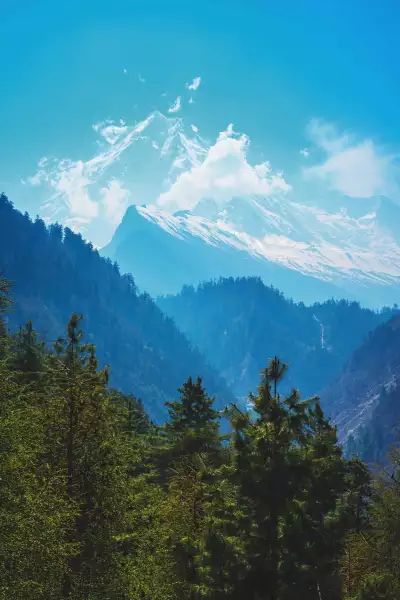
The enormous peak of Manaslu as seen from the monastery at Lho
Nick Savage
Later that evening, Janak tells me about the valley’s Tibetan Buddhist funeral practices: death, reincarnation, and the bardo, the interval between one life and whatever may follow. Sometime after midnight, I wake to bells and drums moving through the darkness. I scramble from bed and climb onto a rickety wooden platform on the teahouse roof, where a phantasmagoric procession passes through the stone village below. Monks emerge and disappear between buildings, striking handbells and damaru drums and blowing into thighbone trumpets, their shapes shifting in chiaroscuro and cold air. Janak has explained that midnight is considered a potent time, when the veil between life and the afterlife is at its thinnest. The noise is meant to cut through spiritual darkness and guide the deceased’s consciousness away from earthly attachments.
By dawn they are gone. I walk alone from Lho, past the blue temple gate and across a gentle meadow to a limestone precipice, beyond which the 8,163-metre Manaslu ascends, its snowfields and seracs catching the first light. I settle on the frost-firm ground and watch the peak brighten from alpenglow to brilliant white. After breakfast, we continue further up the sacred valley.
Machha Khola to Deng
A week earlier, the charged confluence of the Budhi Gandaki and its turbid tributary, Machha Khola, rushes into my ears as I awaken. I peel back the teahouse curtains to find men, women and mules plodding along the shadowed riverbanks, freighted with cargo. Roads have reached farther into the Manaslu region in recent years, but beyond their ends almost everything still travels at least part of the way by muscle, whether human or animal. I carry a daypack containing some of my possessions. Milan Dong Tamang, our porter, bears the rest in a load supported by a nylon tumpline across his forehead. I’m here with Royal Mountain Travel, whose sister organisation, Community Homestay Network, connects travellers with locally run homestays across Nepal. They have paired me with one of their most experienced guides, Janak, who grew up with Milan in the village of Saramthali, about 50 kilometres outside of Kathmandu.
The Manaslu Circuit is a 177-kilometre trek that follows the Budhi Gandaki river valley towards the Tibetan border, loops around the Manaslu massif, and climbs more than 4,200 vertical metres from Machha Khola to the 5,106-metre Larkya La pass before dropping towards the Annapurna region. Weeks before I arrive, Nepal scrapped a rule requiring at least two foreign trekkers to obtain permits for restricted areas such as Manaslu, meaning an individual trekker could, for the first time, undertake the circuit without being paired with another tourist. This is also the first time Janak has spent two weeks travelling alone with a single client.
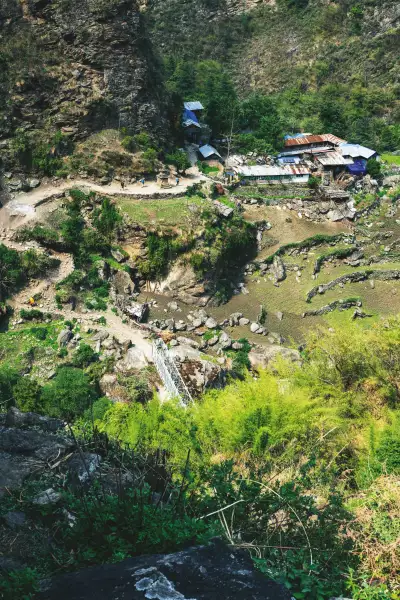
The village of Deng, a key stop on the Manaslu Circuit at 1,860m in altitude
Nick Savage
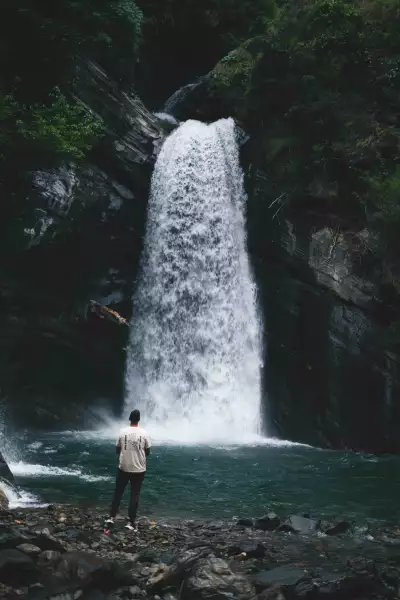
The author surveys a waterfall in Jagat
Nick Savage
“It’s usually a group,” he says. “12 or 13 days is often too long for a single person to spend with a guide.” He says he will try to share the local life and culture offered by Community Homestay Network. He is 33, with broad, freckled cheekbones and an open face that people instinctively respond to. As we set off along the trail, passing through villages and exchanging greetings with locals, I begin to understand why.
Initially I feel faintly self-conscious pressing my palms together, bowing my head and offering a namaste to everyone that we encounter. It carries the whiff of an awkward encounter at the yoga studio, but Janak explains that a simple ‘hello’ can seem abrupt or impolite here, whereas the traditional greeting is a mark of respect.
For the first few days, the walking has an intoxicating rhythm. Each morning offers another 20km of suspension bridges, temples, terraced fields and an incredible number of waterfalls. The trail periodically joins the rough roads carved into the valley before peeling away again, while the Budhi Gandaki appears and disappears below us, grey and furious, compressed through gorges whose cliffs rise so vertiginously that my London-calibrated sense of scale struggles to process the distances. Most of these mountains have no names, Janak tells me, because there are simply too many. Any one of these rock formations, transported to the United Kingdom, would be more famous than Ben Nevis. Those holding snow year-round are more likely to have earned one. When Shringi Himal appears above us, its summit five kilometres higher than where we stand, I find myself failing to reconcile the visual information with the numbers.
Once we leave the road behind, not to see it again until the circuit’s end, something in me begins to loosen
We pass the trail to Barpak, near the epicentre of Nepal’s devastating 2015 earthquake. The tremors killed nearly 9,000 people nationwide and brought down countless traditional stone houses, their heavy slate roofs collapsing inward. Along our route, corrugated metal and concrete pillars replace the old dry-stone buildings, reminding us that the mountains are continuously moving, a reality made clear by the catastrophic flooding that struck Nepal just as I began writing this piece.
Once we leave the road behind, not to see it again until the circuit’s end, something in me begins to loosen. Macaques scramble over landslides, Himalayan griffons cast enormous moving shadows across the cliffs, cannabis grows untended beside the trail, and elderly women laugh together in village courtyards. We pass mani walls and stupas clockwise, as Buddhist tradition dictates, and I find strange comfort in knowing that everything here, from mules to beer, arrives on the back of man or animal; an antidote to machine-driven existence.
Yet the mountains have their own ways of puncturing that serenity. As we admire the sturdy stone walls of Bihi, a percussive thud echoes from upslope. A boulder crashes down the hillside and across the trail, likely dislodged by livestock, its progress into the valley marked by drum-like beats. Janak and I look at each other, shrug, and smile.
Deng to Samagaun
We enter a steep, uninhabited gorge that continues through bamboo forests, where we keep our eyes peeled for red pandas, before arriving at Deng, perched precariously above a dark ravine. After Janak and I submerge ourselves in the deep-freeze rapids of the Deng Khola waterfall, we climb past monkey houses, where farmers ward off macaques and black bears, towards a small slate cottage. A silver-haired man steps outside. His face is deeply lined, and he wears a thick brown shearling-style collar over a crimson jumper, with black beads and several pendants around his neck. Thinking we have wandered onto private land, we stop. Instead, he invites us for tea. Janak translates, as he will throughout the trek. His smile and easy manner invite confidences; before long, he is doing much of my job.
The farmer’s name is Dolzelama. As we sit with him, his grandchildren, four and six, stand silently in the doorway with soot on their cheeks, wearing matching teddy-bear hats. Woodsmoke billows around them as they stare at me with such intense concentration that Janak eventually suggests they may never have seen a Western man before. Dolzelama tells us that the earthquake destroyed the home he grew up in farther up the mountainside. He does not know how many generations of his family came before him here, or where they came from before that. He has never been to a hospital and can recall taking medicine only once. When I tell him his home is beautiful, he says it is not as nice as what they have in Kathmandu, though he hasn’t been. Looking down at Deng, deep in the enclosed Budhi Gandaki gorge – an immense crack yawning into the heart of the earth – I gently disagree.
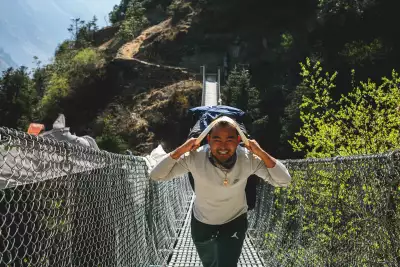
Milan Tamang, with tumpline on his forehead
Nick Savage
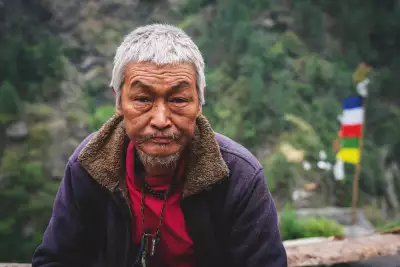
Dolzelama, a farmer and grandfather of two
Nick Savage
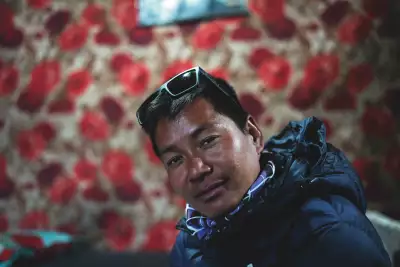
Janak, the author's guide
Nick Savage
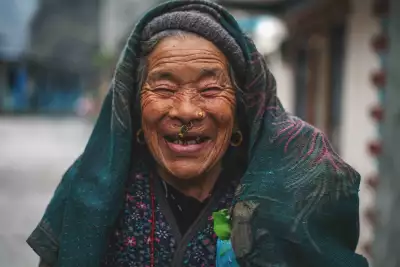
A woman in the square
Nick Savage
From the village, the subtropical landscape begins to transition into high alpine. The trail winds beneath dense copses of Himalayan alder, chestnut and oak. As we gain altitude, pine and rhododendron mingle with the broadleaf forest. In spring, rhododendrons – Nepal’s national flower – set the hillsides ablaze with scarlet, pink and white. We grind their leaves into our palms to perfume our hands.
At Suksung, beneath an enormous basalt boulder, we cross the Budhi Gandaki on yet another suspension bridge. On the eastern bank, two cream-and-gold mongooses slink like quicksilver across enormous white boulders. They pause atop a rock, regard us, then continue on their way. “They mate for life,” Janak says. “They never leave each other. They’re always in a pair.”
“Just like us,” I joke.
We cross into Lho, where I visit the monastery. It’s easy to mistake this remote corner of the Himalayas for a backwater, but for centuries the Budhi Gandaki valley was a bustling artery of trade between Tibet and Nepal. Long before trekkers walked the Manaslu Circuit, merchants, pilgrims and caravans of pack animals negotiated its precipitous gorge, carrying Tibetan salt south and grain north. The wealth this exchange generated helped fund the monasteries, towering chortens and slate-roofed settlements that still punctuate the valley. What now feels like a journey to the edge of the world was once a crossroads of commerce and culture, its prosperity inscribed into the very stones of villages such as Lho.
Two cream-and-gold mongooses slink like quicksilver across white boulders
By now we climb steadily higher, and with the altitude comes an unfamiliar emotional permeability, though it is hard to tell whether it belongs to oxygen, exhaustion or the place itself. I meet Shelyna Rice at a suspension bridge on the approach to Syala, cradled by four peaks rising more than 6,000 metres: Syala Peak, Naike, North Manaslu and Manaslu East. A Tanzanian-born nurse who has worked in remote communities across the United States, she has trekked extensively in the Himalayas and is writing a book about what it was like to travel with her now-grown children.
“I was overcome earlier,” she tells me, looking out over the valley. “I wept. I’m always overcome by these landscapes.”
Psychologists including Barbara Shukitt-Hale and Louis Banderet have studied how low oxygen levels can affect mood and cognition, leaving people more susceptible to anxiety, irritability and other emotional shifts. Janak has a more practical philosophy for emotional upheaval. At the end of the suspension bridge, I jokingly ask him to give the camera a supermodel pout while I photograph him and Milan. He chuckles.
“People always laugh at my smile. It comes automatic, from the inside. No matter the pain or what’s going on in my life, I want people to feel positive energy and share happiness.” I mention that smiling can help alleviate pain. “There is no life without suffering,” Janak replies. “Embrace it, and maybe you create positive energy.”
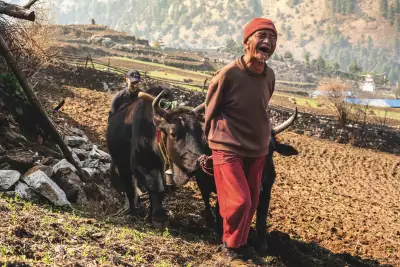
Helping a farmer plough his fields for potatoes outside the village of Lho near Manaslu
Nick Savage
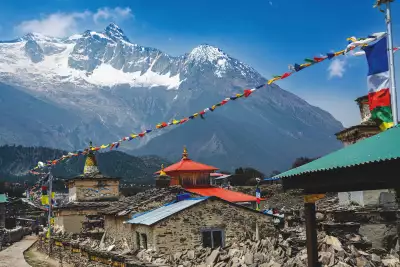
Buddhist chortens and prayer flags stand against a spectacular backdrop in Samagaun
Nick Savage
Over the following days, I become increasingly conscious of an anticipatory sense of loss. I know this journey is temporary, but up here, in the thin air, I feel clear and connected.
At one point, a pack mule nearly bodies me off a 20-metre ledge. We peer over the edge and carry on. It’s peculiar how little the encounter registers.
“If I’m dead, who cares? It doesn’t matter!” Janak announces cheerfully as we skirt the cliff. Whether this is philosophy, fatalism or simply Janak being himself, he seems to carry the prospect of death more lightly than I do. We pass through a long green plain past grazing yak and dzho to Samagaun, the area’s largest town, buzzing with activity and construction supporting mountaineers climbing Manaslu. “People seem happier here than they do chasing ideas on social media,” Janak says. “But the reality is here. It’s a different world.” It is also a hard one. Women sit on the ground, breaking river rocks into uniform pieces of gravel with tiny hammers. Janak points to one of them. “That woman will work for the entire day and make 1,000 rupees. Their lives are hard.” The bottle of Coca-Cola I bought the previous evening wasn’t far off in price.
At 3,530 metres, the stone-walled village of Samagaun is the last stop before mountaineers ascend Manaslu, but the valley’s spiritual heart lies higher still. Climbing to 4,000 metres, we reach Phung Gyen Monastery, a sanctuary built in honour of the mountain’s fierce protector deity. Inside, hundreds of butter lamps burn continuously, each devoted to a reincarnated, enlightened spirit.
I’m invited to sit by a young monk named Karma. 40 men and women in traditional auburn-hued robes chant mantras with the head monk, whose voice seems to rise from the most resonant recesses of the throat. Conchs, gongs, bells, cymbals and castanets let loose, until a giant silver dungchen horn cuts through with a baritone thunderclap.
Karma hands me milk tea, biscuits, popcorn and crunchy ramen noodles. The room’s warmth contrasts sharply with the unforgiving alpine world outside: a refuge in a valley regarded as a beyul, a sacred hidden sanctuary. Local tradition links these mountains to Padmasambhava, said to have blessed hidden Himalayan valleys as refuges for the faithful. Revered as the Second Buddha, he remains a powerful presence in the Tibetan Buddhism practised here. The Tibetan Book of the Dead, traditionally attributed to him, is intended to guide consciousness through the bardo, the uncertain passage between death and rebirth. I think of the procession in Lho.
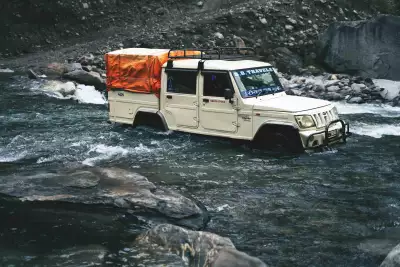
A tributary crossing on the Manaslu Circuit
The next morning, we set off early on an acclimatisation hike to Manaslu Base Camp, a climb of more than 1,200 vertical metres from Samagaun to a rocky glacial moraine at around 4,800 metres. Himalayan pikas dart between boulders and, beside a glacial lake, blue sheep stand backlit against jade-coloured water. Above everything rises Manaslu itself, alabaster-white, surging upward into a limpid cobalt sky.
As we climb, the mountain grows louder, like a city coming to life, and I feel the altitude in the occipital region at the base of my skull, nausea rising every now and then. We count seven avalanches breaking across the ice field, while somewhere inside the glacier crevasses shift and fracture, their deep crepitations reverberating through rock and air. We traverse a steep slope of loose scree before reaching the final pitch, where switchbacks stitch their way towards a sharp, snowy ridge. Beyond it, the gradient eases and the landscape opens into broad snowfields blanketed in fresh powder. At base camp, where expedition tents gather during the climbing season, there is now only snow and silence.
Even here, witnessing the mountain’s violence, there is a sense of serenity
I settle down to share my pancake with an inquisitive Himalayan sparrow and Prue and Shannon, two Australian flying nurses I’ve befriended on the trail. Across the ice field, another avalanche lets go, sending a plume of snow billowing down the mountainside. Even here, surrounded by immense and indifferent forces, witnessing the mountain’s violence, there is a suprising sense of serenity.
Janak and I are silent and lightheaded as we descend. We take a route he hasn’t taken before, skirting a meltwater lake, where we stop to skim stones across the surface. Farther down, we reach a glacial river, untie our boots and knot the laces together around our necks before wading barefoot through the freezing water. For a moment, there is only the bite of cold on the feet, stones beneath the soles and breath through the lungs. All else is smudged out, effaced.
Samagaun to Samdo
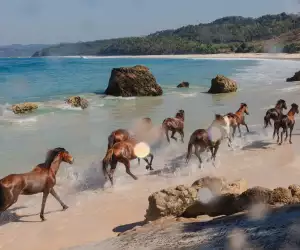
We walk just 7km and climb 300 metres to Samdo, a crossroads with the Tibetan border a few kilometres to the northeast. Unlike older, established trading hubs lower in the Nubri Valley, Tibetans forged Samdo from the wilderness relatively recently as they fled geopolitical upheaval. Following the 1959 Tibetan uprising against Chinese annexation and the subsequent exile of the Dalai Lama, thousands of Tibetans escaped across the Himalayas. Cloud cover clears and Samdo peak rises above to 6,500 metres; a few downy white lenticular clouds drift around its summit. I hike up a talus slope, then jog down through a green meadow networked with marmot warrens. As I focus on not trapping a foot in one of their holes, I startle one of the rodents. It bleats a warning to its neighbours, so high and clear it sounds digital. Himalayan horses buck, kick and play in the pastures.
I happen upon a woman who has been clearing a plot of land to plant potatoes all day, and help her finish the job. Her name is Dawa Lama, a surname that implies she is Tibetan. Her grandparents fled the Chinese in 1959. I ask where she learned English.
“I studied for eight years in India. Some of my relatives settled in Mysore, in the Tibetan refugee camp. Some of them returned to Tibet, or China. And some came back here. The border opens once a year, so that we can visit our family and ancestral land in Tibet. Samdo comes from the Tibetan word thamdo, ‘between’. We are between Nepal and Tibet.”
Dawa invites me for tea in her house to thank me for the help. Its outer walls are made from slate. Inside, it is neat and orderly: bowls and plates are colour-coded. She takes a pot from a shelf crowded with others, puts it on her iron woodstove and lights a fire of juniper needles, softwood and dried yak dung. Beer, raksi and Khukri rum line a separate shelf; she sells them to locals, who sometimes come to drink at her house. Dawa does not drink.
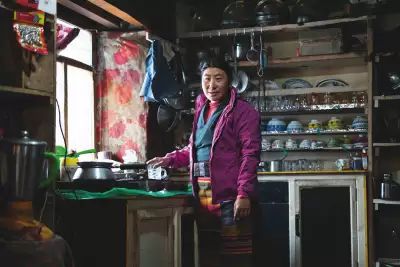
The author was the first foreign visitor welcomed into Dawa Lama's home
Nick Savage
In the corner of the room are a Tibetan flag and a shrine with the Dalai Lama’s photo, a young reincarnated monk’s photo, and a black-and-white picture of her parents. She is the spitting image of her mother. She tells me that when she was living in Mysore, she heard her father was terminally ill in Samdo, but could not get back in time to say goodbye. The farewell letter she sent him arrived seven months after she did.
Dawa notices how soft my hands are when she hands me the tea. She asks how old I am and is surprised when I tell her. “We age faster here. Life is hard in Samdo,” she says. “It’s impossible to be weak and live here.”
Samdo to Bimtang
Dharamsala, at around 4,460 metres, is less a village than a temporary encampment. The food is basic, the air noticeably thin, and there is little beyond tents and shared rudimentary concrete shelters for trekkers waiting to cross the pass the following morning. I climb to a cairn above camp to look towards Larkya La, then find a quiet patch of sun-bleached alpine grass away from the tents, in an amphitheatre of black gneiss, granite and schist, and lie back watching a pair of ravens thread figure eights into the mountain air.
We leave at 4am for Larkya La. The trail climbs steadily across the moraine of the Larkya Glacier, the cold sharpening as first light reaches the surrounding peaks. Janak has been carefully watching me to ensure I am properly acclimatised, but now we push as hard as we can, turning it into a sprint to the top. Sometimes the altitude becomes so gelid that it is like a forcefield holding you down, and your lungs can never quite get enough oxygen. But it’s the kind of pain that intoxicates. Dawn washes the sky in bands of peach, apricot and pale gold. At 5,106 metres, a battered sign marks the pass, almost submerged beneath layers of prayer flags. Beyond it, Himlung Himal, Cheo Himal and Annapurna II rise across the horizon.
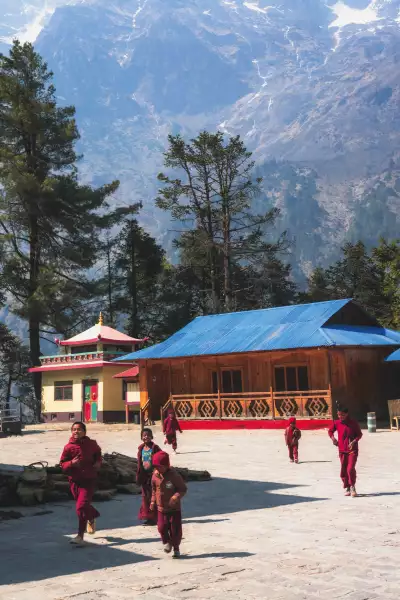
Young monks at a monastery
Nick Savage
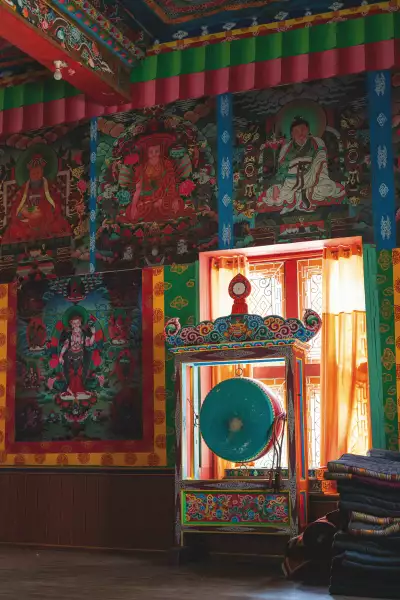
Buddhist murals inside
Nick Savage
Janak is giddy. “We did it! We finished first!” Like many races, there is a sense of deflation at the finish line. I am a little sad that it is over as I sit beneath the sign. We photograph each other on a rock and laugh about our height difference, then continue a vertical mile downward, sometimes sliding on our bottoms like brothers sledging, mostly walking, watching our feet to ensure we don’t slip, to reach the village of Bimtang.
On the final day, after drinking too much raksi spirit with Milan and Janak the evening before, I attempt to carry Milan’s load. I wrap the tumpline around my forehead and lean into the weight, the strap digging into my skin as I teeter to find balance. For nearly two weeks, Milan has carried half of my possessions while I have been free to admire the scenery and ruminate.
This creates an uncomfortable contradiction. I have found liberation in a landscape where physical hardship is a fact of everyday life. Yet the labour I have found so restorative is, for many of the people I have met, a necessity rather than a choice. I think of Dawa’s roughened hands and the woman breaking stones for the price of a bottle of Coke; of Dolzelama, who has never visited a hospital; and of Milan, who carried my belongings across the Himalayas.
I have spent much of the journey wishing I could remain here indefinitely, but I have the privilege of leaving. I can’t pretend that a few minutes beneath Milan’s load will teach me what his life feels like. But as I strain against the tumpline, I begin to understand the limits of romanticism. The mountains have given me an extraordinary sense of freedom, much of it made possible by the labour of people whose own freedom looks very different from mine.
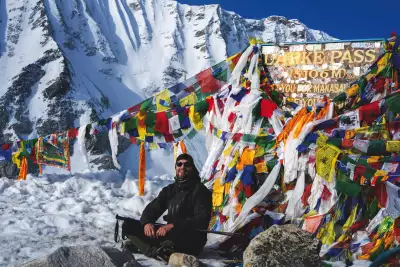
The sign at the zenith of the Larkya La Pass, festooned with prayer flags
Nick Savage
Kathmandu to London
Two thousand metres above the alluvial floodplains near New Delhi, I prepare my body to let go. “Remove and stow your shoes, spectacles and anything sharp from your person,” the Air India purser barks anxiously, marching down the aircraft aisle. “There are 300 of us here. We’re all in this together. Think positive thoughts.” He repeats the last line three times, which doesn’t inspire the confidence he wants. My father served as a helicopter pilot and airline captain and always told me to watch the flight attendants to determine whether to be concerned. The purser is frantic.
Five minutes earlier, I had been asleep. The previous night, a cyclone had forced our flight from Kathmandu to divert to Lucknow after two failed, turbulent landings. The woman next to me vomited repeatedly as the plane swung in long, greasy parabolas. The man in front clasped his father and cried, while other passengers screamed and fainted. The flight attendants were relaxed.
After finally reaching Delhi in the small hours, and spending much of the next day waiting for a connection, we take off for London. I wake to the news that a serious problem has occurred: a landing-gear malfunction means we must return to Delhi and brace for an emergency landing.
Somewhere in the back of my mind, Final Destination logic takes control
The cabin has fallen eerily silent. Conversations are hushed. Some passengers whimper or weep. Others stare queasily at the live feed from the aircraft’s external cameras, or at the arid landscape beneath us through the windows. Somewhere in the back of my mind, a trapdoor opens and Final Destination logic takes control.
I follow a black thread of tarmac crawling with slow-moving lorries and rickshaws, wondering whether we can land there, whether the fuel in the belly of the aircraft will ignite on impact, whether my body will survive the conflagration, and whether my phone might somehow outlive the wreckage.
I open WhatsApp and start typing a message to my wife and daughter, hoping that, if the aircraft comes apart, the phone will retain enough signal to deliver it. But most of all, I wonder what to say.
My mind contracts around the illuminated rectangle. I try to explain how much I love them, how grateful I am for our life together, how viscerally I want our daughter to grow up surrounded by love. I think of the willow in our back garden and ask my wife to nurture her like the tree: help her set her roots so she can grow up strong and supple.
Then I begin to lose my grip on language. I flick through Spotify, the edges of the screen blurring and pixelating, and play Tibetan Buddhist chants. I draw long, measured breaths through my nose, inflating my lungs as though blowing up a balloon in reverse. The voices in my earbuds take me back to the monasteries of Manaslu, to the incense-soaked air and the low, resonant cadence of monks chanting in unison. I try to inhabit that memory, to make the aircraft disappear around me. But I am acutely conscious of the pressure of the seatbelt against my abdomen, the drone of the machine, and the unbridgeable distance between myself and my young family.
The engines change pitch. A mechanical thud sounds beneath us as the landing gear deploys. I squeeze the armrests and brace. A few seconds dilate before the wheels strike the runway. We land bumpily, safely. I push my head into the seat in front of me and grimace as a tumpline of pressure releases from my temples. I delete the messages.
I have watched monks perform rituals for the dead and listened to Janak cheerfully dismiss the prospect of his own death. “If I’m dead, who cares? It doesn’t matter!”
I find that I care very much.
Do it yourself
The trek
Royal Mountain Travel offers a 17-day Manaslu Circuit Trek from £975 per person, based on a group of ten; royalmt.com.np
Flood relief
To support communities affected by flooding in Nepal, donations can be made to the Prime Minister’s Disaster Relief Fund; pmdrf.nchl.com.np