At the turn of the millennium, a seminal film hit the silver screen. Dude, Where’s My Car?, starring Ashton Kutcher and Seann William Scott, follows its two protagonists as they wake up and… well, it does what it says on the tin: they can’t find their car.
According to mountain-biking guide Bartal í Gongini, this is a surprisingly common occurrence in the Faroe Islands, where winds can grow powerful enough to blow parked vehicles away and, allegedly, even shift houses.
But this self-governing Danish territory, cast roughly halfway between Scotland and Iceland, has considerably more to recommend it than, erm, extreme wind.
Winds can grow powerful enough to blow parked vehicles away and, allegedly, even shift houses
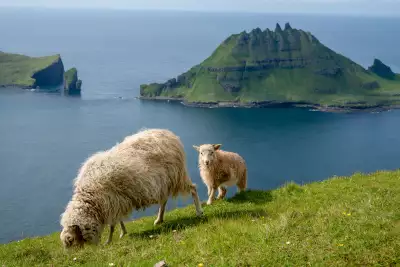
Travellers have been drawn here since the sixth century, when a community of Irish monks and hermits is said to have sought out its neon-green landscapes. Legend has it that they described the archipelago as the “Islands of the Sheep and the Paradise of Birds”.
As an exclusively male community, how they managed to establish a settlement lasting multiple generations is another question. A few centuries later, in the ninth century, Norwegian farmers fleeing King Harald I arrived, bringing sheep that would soon roam freely across the islands’ steep hillsides and narrow valleys, helping to shape the landscape that defines the Faroes today.
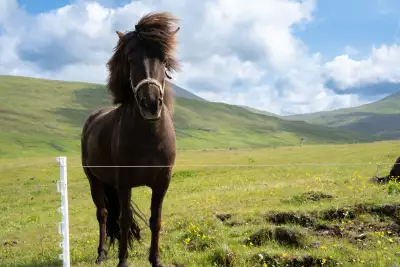
A Faroese horse
Nick Savage
In terms of terrain, the Faroe Islands feel a bit like the lovechild of Iceland and the Scottish Highlands: vertical like the former, with towering sea cliffs that plummet thousands of feet; and verdant like the latter, with endless green pastures winding around volcanic rock.
The archipelago’s 18 main islands, connected by ferries and a world-leading subsea tunnel system, support a population of 56,365 islanders. That isolation has helped forge a culture that is distinctly its own, shaped by Norse settlement and a determined effort to preserve the Faroese language, oral traditions, chain dancing, seafaring customs and unique culinary traditions.
Life here still revolves around the sea, the weather and the seasons. If you have a soft spot for seafood, nautical culture or adventure, Dude, you’ve come to the right coolcation.
Do
Hit the trails
Óluva Zachariasen was the first woman to climb all 280 mountains in the Faroese archipelago, and offers some excellent tips, whether you’re trail running, summit-chasing or just out for a wee plod. L
et’s start with the iconic hikes. Trælanípa is one of the Faroe Islands’ most famous hikes, known for its dramatic ‘floating lake’ viewpoint overlooking Lake Sørvágsvatn and the nearby Bøsdalafossur waterfall, but be prepared to contend with (relatively) large crowds for parking spots.
Nearby, The Postman’s Path is the historic route on Vágar that linked Bøur to the isolated village of Gásadalur until the tunnel opened in 2004, and it’s now a popular scenic hike with views toward Múlafossur waterfall. Slættaratindur is the Faroe Islands’ highest mountain at 880 metres, on Eysturoy, and its name means ‘flat summit’.
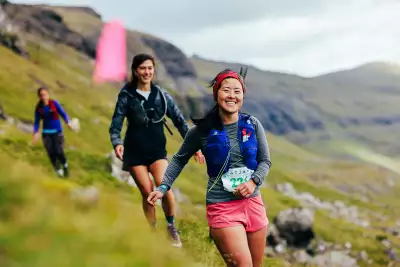
Trail running in the Faroe Islands
Tanya Raab / @atjanfestival
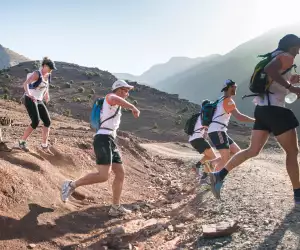
But my favourite by far was the lesser-known fell run I did with Zachariasen, largely off-trail, from the gorgeous black-sand beach and remote village of Tjørnuvík up a broad basalt basin haired with white waterfalls.
The circuit took in Snubburnar and Mylingar, two incredible rock formations that rise like scalene triangles above the water before nosediving 620 metres to the sea, with fulmars and herring gulls circling below. The islands host abundant seabird life, and you’re likely to see the nationally beloved oystercatchers, kittiwakes, storm petrels, guillemots, gannets and great skuas, which dive-bombed us persistently as we passed through their nesting grounds.
The scenery in this archipelago is peerless, the wind bracing and the wildlife astounding. It wouldn’t be a complete visit to the Faroes without a rosy-cheeked, bipedal excursion.
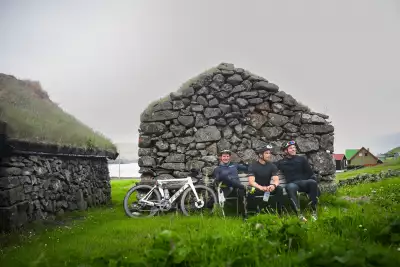
A well-earned rest on the Faroe Islands
VisitFaroe
Cycling and mountain biking
Even Tórshavn, the capital of the Faroe Islands, offers remarkable access to wilderness, with trails winding out of the very small city and into the valleys and mountains that circumscribe it. Bartal í Gongini, owner of Rent a Bike & Outdoor, knows them intimately, guiding cycling, mountain-biking and e-biking trips for riders of varying abilities.
I followed him beneath enormous fishing vessels in dry dock at Eystaravág harbour, past Sandagerð beach and its salmon ladder, then uphill beside the fast-running waters of the Sandá and into Havnardalur. We reached Havnadalsvatn at the head of the valley before looping back along muddy riverside singletrack and fording the water at one point.
The return into town was faster and considerably less restrained. We plunged hundreds of metres down the steep hillside, then threaded through a city knitted together by narrow paths and hidden cut-throughs, rocketing off kerbs, ducking beneath wooded copses and fishtailing along alleyways. Gongini is plainly passionate about the sport and can dial the intensity up or down according to appetite.
Sverrisgøta 20, FO-100 Tórshavn; rentabike.fo
Motoring
Driving is one of the best ways to experience the Faroe Islands: the road network turns the archipelago’s difficult geography into part of the attraction. Four subsea tunnels now connect much of the country, placing more than 90% of the Faroese population on a single road network. The most spectacular is the 11.2km Eysturoy Tunnel, which descends to 189 metres below sea level and contains the world’s first undersea roundabout, illuminated in blue and decorated with figures performing the Faroese chain dance. Elsewhere, rough-hewn single-lane tunnels burrow through mountains, with passing bays cut into the rock, before depositing drivers beside deep fjords, turf-roofed villages or waterfalls streaming down near-vertical slopes. Roads curl around the coastline, climb into low cloud and descend through hairpin bends towards settlements wedged between mountain and sea. Distances are short, traffic is generally light and the scenery changes so rapidly that even an ordinary journey can feel like a condensed road trip.
Eat and drink
Roks
Roks has impeccable DNA. From the team behind the retired two-Michelin-starred institution Koks, its two-starred successor Paz, and fermentation-forward eatery Ræst, it served one of my favourite meals of the year.
Occupying an old turf-roofed house beside Tórshavn’s harbour, the restaurant has low ceilings, timber panelling and a chequerboard floor, giving it more the feel of an eccentric maritime tavern than a polished Nordic dining room. Faroese artist Tóroddur Poulsen supplied much of its playful visual identity, including an octopus that appeared to have developed a particular enthusiasm for wine.
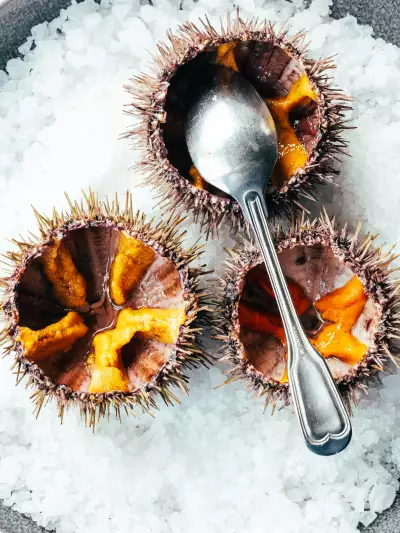
Sea urchin at Roks
The same spirit carried into the food: a relaxed, hands-on procession of Faroese fish and shellfish, treated with modern and classical techniques while interfering with them as little as possible. Two dishes in particular tipped into the emotional. Sweet, just-landed snow crab arrived with deeply caramelised onion butter and a glass of Egon Müller riesling that seemed to illuminate both. Then came an outrageous pairing – a heroic bump of Gastrounika caviar, a shot of frozen Subsea Vodka and brioche ice cream. My heart melted.
Gongin 5, FO-100 Tórshavn; roks.fo
Katrina Christiansen Restaurant
Fiskastykkið
Opened as a café in 2019, Fiskastykkið occupies a restored salt-cod warehouse built in 1912 beside the village’s historic fish-drying ground, where gaps between stones once channelled the sea air needed to cure Faroese bacalao. The creaking floorboards, exposed timber and communal tables retain the atmosphere of a working waterfront building, while the kitchen translates that history into generous daytime food, centred on local fish, seasonal vegetables, homemade bread and excellent cakes and coffee. The chowder was otherworldly, with a potent broth of bacalao and leeks sprinkled with croutons and an inky green oil made with dill, parsley and spinach. Rather than treating the past as decoration, Fiskastykkið feels rooted in the community that once worked there, offering an accessible taste of Faroese food culture without sanding away its character.
Úti á Bakka 12, FO-360 Sandavágur; fiskastykkid.fo
Oy Brewery
For a population of under 60,000, the Faroese have their beer game locked in. For something on the craftier side, head to Oy Brewery. Founded in 2021, it operates as a brewery, taproom, food hall and live-music venue housed in a former industrial building on the edge of Tórshavn. Alongside pilsners as crisp as a clear winter day, Oy dishes out equally shattering fish and chips and an array of barbecue dishes.
Falkavegur 4, FO-100 Tórshavn; oy.fo
Katrina Christiansen Restaurant
Katrina Christiansen
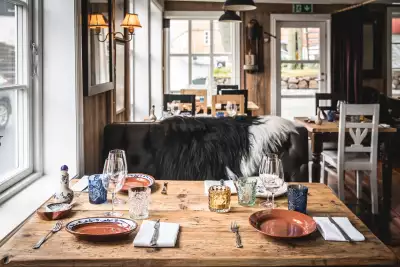
Katrina Christiansen offers a more convivial take on Faroese dining, serving local ingredients through a Spanish-inspired tapas format. The restaurant occupies a 300-year-old house in Tórshavn’s historic centre, once home to the celebrated Faroese writer and artist William Heinesen, with small timber-lined rooms that suited its sociable, sharing-style menu.
Bringsnagøta 6, FO-100 Tórshavn; katrina.fo
Mikkeller
Housed inside a 500-year-old timber building on Gongin in the heart of the capital’s old town, Mikkeller Tórshavn combines creaking floorboards, low beams and intimate rooms with 16 constantly rotating taps pouring Mikkeller favourites alongside guest beers from the Faroes and further afield. Few beer bars can claim such a dramatic setting, and fewer still feel so naturally woven into the fabric of the place. Skål!
Gongin 2, FO-100 Tórshavn; mikkeller.fo
Stay
Hotel Føroyar
Hotel Føroyar offers a particularly appropriate base for exploring the archipelago, combining easy access to Tórshavn with the feeling of staying out in the landscape. Opened in 1983 and designed by Danish architects Friis & Moltke, the building has a long, low profile that follows the contours of the hillside, while a turf roof helps it recede into the surrounding moorland.
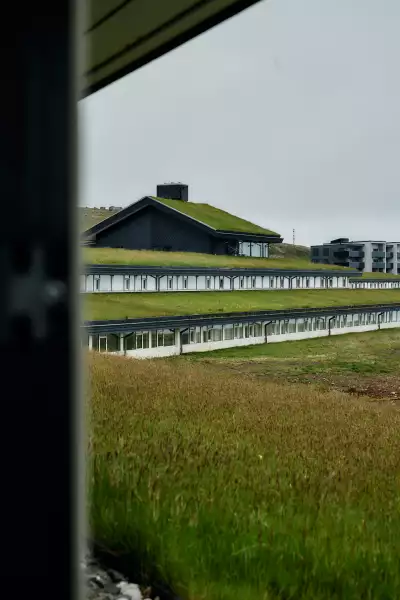
Hotel Føroyar
Ingrid Hofstra
Most of its 200 rooms look out over the capital and fjord towards Nólsoy and the North Atlantic, giving even periods of horizontal rain a certain theatrical quality. A wooded footpath leads downhill into central Tórshavn in about 15 minutes, while the hotel itself features Ress Spa, a lobby bar and Ruts Restaurant, where seasonal dishes are served against the same panoramic backdrop. It works equally well as a retreat from the elements and as a practical launchpad for journeys around the islands.
Rooms from £215 per night. Gilsvegur 10, FO-100 Tórshavn; hotelforoyar.com