I’m uncurling my yoga mat when the woman next to me catches my eye and asks how I am. I crack a polite half-smile. “Uh, yeah, fine, I guess – you?”
“Uh, yeah, fine, I guess – you?”
“I slept so badly last night,” she sighs. “Scorpio moon.”
I feel the blood in my veins rise by about a degree. Scorpio moon? Imagine the cosmos being your biggest concern. It’s currently my sixth day stranded in Bali, where I’ve been doing yoga classes at the rate of a newly divorced Malibu housewife, mostly in an attempt to distract my brain from the fairly impressive pile-up of events currently precipitating in my life. My flight home has been cancelled, and the next one the airline could offer me was ten days later. So I’m stuck on the island of Eat, Pray, Love, minus the spiritual awakening and – on an entry-level journalist salary – the funds typically required to simulate one.
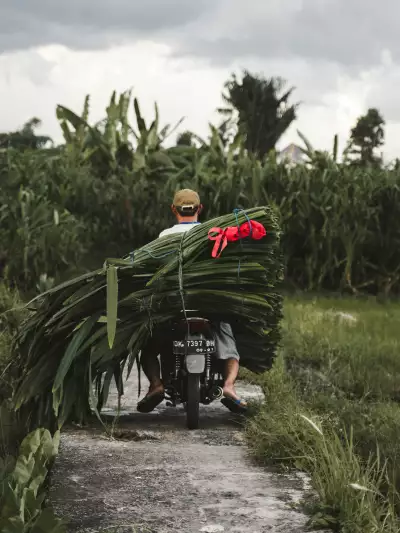
A man riding a motorcycle in Ubud, transporting a large bundle of leaves
Polina Kuzovkova
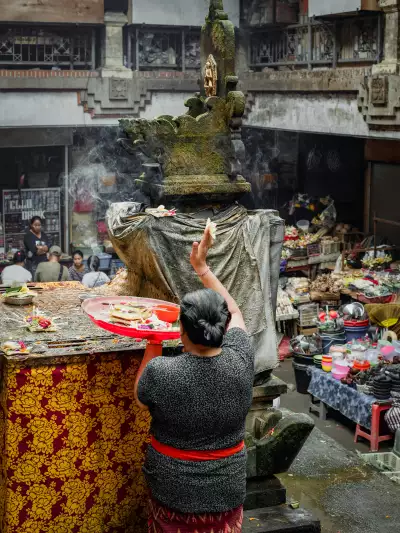
A woman at a market in Ubud
Mark Chaves
Oh, and there’s also the small matter of my dad’s major heart surgery, which takes place in a week’s time with a roughly 50% success rate. So while the woman beside me wrestles with planetary alignments, I am mainly preoccupied with the possibility of returning home with one fewer parent. So yeah, Scorpio moon.
The whole thing started unravelling at Bali airport, which had taken on the atmosphere of a natural-disaster evacuation centre. Mass flooding across Dubai – which witnessed record-breaking rainfall in a 24-hour period, surpassing Emirati meteorological data since records began – meant that flights bound for that direction began collapsing across departure boards like dominoes. Mine was one of them. With no functioning phone line and the Emirates app proving ornamental at best, the only option was to join the queue, which involved two plates of nasi goreng and, at one point, a microphone so passengers could air their grievances to a single member of airport staff about an entirely uncontrollable meteorological event.
Oh, and there’s also the small matter of my dad’s major heart surgery, which takes place in a week’s time
Once I reach the front of the queue, I’m ushered into a small office where a man taps a few keys and informs me that the next available flight would be in ten days.
“Ten days?” I gasp before erupting into full, shoulder-shrugging sobs. “But my dad is having heart surgery next week,” I blubber. “I need to get back before then. In case… you know.” My eyes widen, hoping he’ll get the gist of what I’m trying to suggest. He looks at me blankly, taps a few keys and offers a premium economy flight in eight days for the bargain of £500.
I ask if anything is leaving sooner.
“No.”
Will the airline cover accommodation while I wait?
“No.”
At around three in the morning, I’m spat back out of the airport into the humid dark with my suitcase and a fairly intense sense that things were not, broadly speaking, going well. In a state of panic, I withdraw cash from an ATM and manage to leave not one but two debit cards inside the machine before wandering outside to order a taxi to an Airbnb I had booked thirty seconds earlier near Jimbaran Bay, not far from the airport.
So, if you happen to be looking for a complete guide to experiencing Bali when your flight has been cancelled for over a week, money is scant, the airline has offered absolutely no compensation, and you are attempting not to think too hard about a looming family medical crisis several thousand miles away, then congratulations – you’ve come to the right place.
Uluwatu
Coming to the realisation that spending more than a week in an airport hotel might be roughly as enjoyable as camping inside Westfield Stratford, I decide that if I’m going to be stranded in Bali for ten days, I may as well attempt to see some of the island people keep talking about.
I set my coordinates for Uluwatu, a town on the southwestern edge of the Bukit Peninsula known for dramatic limestone cliffs, world-class surf breaks and a thriving yoga scene. I am neither a surfer nor a yogi. But I do know two people there – Zak and Jesse – a couple I met earlier in the trip on the neighbouring island of Sumba. They are on what is technically a romantic holiday.
At this point, I have been through enough emotional bruising that the etiquette of third-wheeling a couple’s break feels like an entirely secondary concern. I am simply relieved to see two familiar human faces who are not wearing Emirates lanyards.
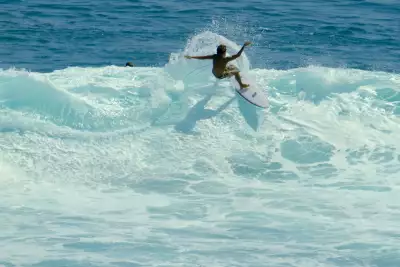
A surfer in Uluwatu
The road to my accommodation is uneven and not designed for wheeled luggage. I drag a 23kg suitcase through the dust and foliage toward a hostel called Village Bali. It consists of small wooden cabins clustered around a pool and the usual inventory of hostel signifiers – harem pants, açaí bowls, yoga classes. Ordinarily, this aesthetic might provoke cynicism. But after ten hours in an airport queue and the loss of two debit cards, the soft-focus wellness atmosphere feels containing.
That evening, we go to Single Fin, an iconic beach bar perched on a cliff above Pantai Suluban, known for sunset drinks and a 1:1 ratio of jacked twentysomethings to margaritas. We manage to snag a table overlooking the water and order cocktails. Alcohol is, unsurprisingly, an excellent salve for the emotional abrasions of the previous twenty-four hours and a welcome conversational lubricant. We watch the sun drop into the sea as a trio.
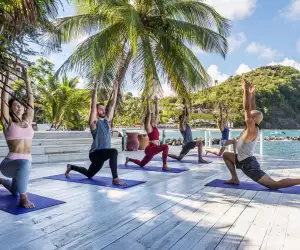
Unable to surf, I decide it is probably best to lean into Uluwatu’s other great export: yoga. Zak gamely agrees to join me for a vinyasa class at Alchemy Yoga, a well-known studio perched above Bingin Beach, and one of the better places to roll out a mat in Uluwatu. If this cannot soothe my anxious mind, it seems reasonable to escalate matters to something clinical.
Bali’s status as a global yoga hub rests on a tidy convergence of older spirituality and newer economics
Bali’s status as a global yoga hub rests on a tidy convergence of older spirituality and newer economics. Hindu-Buddhist traditions arrived from India and Java in the first millennium, leaving a culture rich in temples, rituals and daily offerings of flowers and incense. From the early twentieth century onwards, the island attracted artists, anthropologists and spiritual seekers. By the late twentieth – aided by cheap flights, glossy travel writing and the wellness boom – various towns evolved into retreat economies. Institutions like The Yoga Barn in Ubud, which grew from two studios in 2007 into one of the most influential wellness centres in Southeast Asia, formalised this into something scalable: teacher trainings, workshops, cafes and a global clientele. The result is a distinctly Balinese hybrid – part ancient spirituality, part wellness industry, part self-improvement pilgrimage.
The class takes place in a grand open-air studio beneath a wooden domed roof resembling the inside of a tortoise shell. Vinyasa flow, for the uninitiated, is a dynamic style of yoga in which poses are linked together in a smooth sequence synchronised with the breath. I quickly learn that Balinese yoga classes are significantly more difficult than those at the leisure centre back in London. Within minutes, my arms, propping me up in something called a three-legged dog, have the structural integrity of cooked noodles.
Zak and Jesse depart for New York the following morning, leaving me once again scrambling for a plan. Uluwatu feels, at times, like a place that has quickly adapted to its visitors’ expectations. Tourism and digital nomadism – particularly from Australia and Europe – have boomed over the last decade, reshaping parts of the Bukit Peninsula into something serviceable and recognisable. You’re more likely to find menus of pasta, pizza, pastel de nata, poke and posters for Camden Hells than you will Indonesian food, and retail is calibrated to a steady visual language of wellness in the form of ruched gym leggings and thong bikinis. After a few days here, the effect is slightly flattening. In an effort to avoid this, I consult my best friend Reddit, which suggests that Uluwatu is at least reliable for beaches where one can lie down without being deepthroated by smoothie bowls.
Movement between these beaches is less straightforward, however. Uluwatu is not especially pedestrianised, nor is it particularly well lit by streetlights, which makes walking feel like an avoidable risk. On the advice of someone in the hostel, I download Grab, a taxi app that also offers motorbike rides for roughly the price of a Freddo. Clinging to a stranger’s damp back like a koala, I travel to Padang Padang Beach, a small cove populated by sunbathers and opportunistic monkeys. Signs advise you to secure your belongings. Drop your guard for a moment, and you may just lose your Ray-Bans to the macaques.
Later, I’m told that sunset is particularly magical on Bingin Beach, which is unfortunately the exact moment I decide to Google my father’s heart condition and surgery in forensic detail. He developed atrial fibrillation the previous year – a disorder in which the heart’s electrical signals misfire, producing an irregular rhythm. When medication stops working, as it has in his case, the only treatment is a cardiac ablation: a complex procedure that attempts to correct the faulty circuitry. Somewhere between NHS pages and medical journals, I learn that the success rate of the procedure hovers at around 50%.
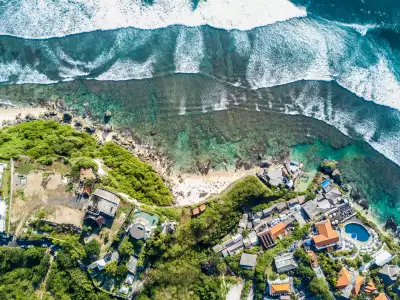
The shore in Uluwatu
My stomach tightens, as if wrung out. The sunset, moments ago cinematic, becomes contaminated by thoughts of my father’s mortality. I attempt to call my partner, but patchy reception reduces the conversation to fragments and echoes. I’m not sure I’ve ever felt quite so alone while processing something so large. Unable to soothe myself with a phone call, I lean only on the other way I know to seek comfort: dinner.
On the sand nearby sits a row of plastic tables beside charcoal grills, sending thick smoke into the evening air. Blue cool boxes hold fish for selection. I peer inside to see a collection of snappers that look and smell as though they’ve had a long day. Channelling the spirit of my dad, who is a committed disbeliever in sell-by dates and is often caught slicing the mould off food before guzzling – I take the plunge, say a brief, private prayer for my gut microbiome, and order one. It arrives with blistered, flame-marked flesh, sambal matah, rice and a small portion of wilted morning glory for just £13. I have long maintained that if you feel yourself unravelling, sitting down to eat a hot meal can always temporarily restore the sense of being a functioning human.
Ubud
After visiting a surfeit of yoga studios and beaches in Uluwatu to return my body image back to 2015 private girls’ school levels – and developing a creeping fatigue for the topless earnestness of 22-year-old Australian men, I decide to relocate. Ubud, Bali’s cultural capital, lies a two-hour drive inland, in the island’s misty, moss-lacquered centre. The journey is stodgy with traffic, not helped by my worsening case of Bali belly (it turns out fish do have sell-by dates).
The town unfurls across a series of river valleys at the foothills of the central highlands – a place that was, not so long ago, a loose constellation of villages with a taste for itinerant painters, mystics and filmmakers. Balinese Hinduism here is a well-tended accumulation – animist residues, Buddhist inflexions and Shaivite leanings. There is always something being marked in Ubud. Ceremonies proliferate: marriages, funerals, the hoisting of parasols and the appeasement of deities.
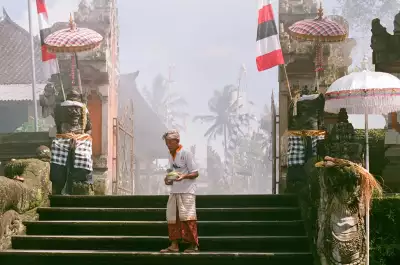
A man with an offering at the sacred Tirta Empul water temple
Spirituality, in Ubud, is less an abstract condition than a tripping hazard. Daily offerings or canang sari – small, delicate arrangements of sticky rice, bright flowers, snacks and burning incense arranged on banana or coconut palm leaves – appear at near-metronomic intervals along the pavement. You learn quickly to walk with extreme care, if only out of self-preservation. I am not, at this stage, in a position to accumulate further bad juju.
Keen to avoid the hostel circuit – those fluorescent ecosystems of beer pong and oversharing – I book into a homestay instead. It is called Nikon Homestay and sits behind a lichen-covered stone arch, opposite Radiantly Alive, one of Ubud’s more revered yoga studios. My room is simple, clean, and on the first floor, overlooking a courtyard where the family conducts the choreography of daily life: sweeping, washing up, folding, and mending. Given the situation of my dad’s ill health, watching a grandmother hanging up washing alongside her grandchildren can’t help but sting a little.
Sleep arrives with the distant thud of karaoke, and there is no need for an alarm each morning. The grandmother of the house has a cough and regular phlegm-clearing ritual suggestive of a long and committed relationship with Golden Virginia, and the children supplement this with a percussion section composed largely of saucepans and spoons.

Two long-tailed macaques rest on an ancient stone statue in the Sacred Monkey Forest Sanctuary located in Ubud
Ernests Vaga/UnSplash
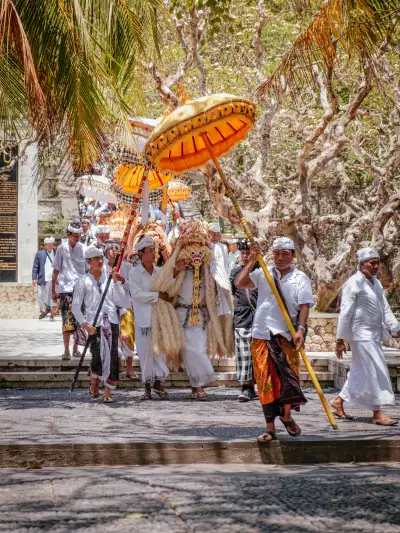
The Melasti ritual is a Balinese Hindu purification ceremony held before Nyepi
Johan Mouchet/UnSplash
It is a curious thing that when you find yourself alone somewhere unfamiliar, feeling unmoored, the day begins to organise itself around the proxies of home. You reach, almost involuntarily, for what feels knowable. For me, this translates into occupation of the hands – tasks with edges and tangible outcomes. I book a ring-making workshop and a cooking class back-to-back.
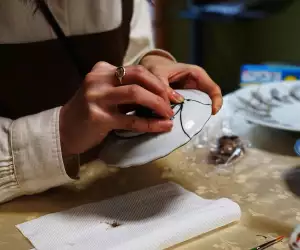
Sok Wayah Silver Class sits atop a hill; the rice paddies surrounding it are an uncompromising green. The workshop itself is conducted under a corrugated metal roof, which amplifies both the heat and the sound of labour. You are taken through the sequence by artisans – melt, pour, hammer, anneal, repeat – and at a certain point, the hammering of silver into shape becomes a surprisingly efficient vehicle for processing the previous week’s disasters.
He has always maintained that the only genuinely uncontrollable variable in life is its end date
My dad has many qualities I admire, but the one I love most is his equanimity. Last Christmas, the cat came in through the back door with a half-chewed sachet of mouse poison, and he managed the looming prospect of the family pet dying on 25 December with the composure of a man who had seen considerably worse – and had. He lost both parents in his twenties, supporting himself by working as a window cleaner, a BT phone engineer, and selling fishing tackle, before going back to school and qualifying as a doctor at 30. He has always maintained that the only genuinely uncontrollable variable in life is its end date.
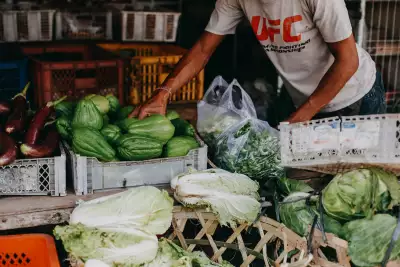
Food market in Bali
This is what I turn over on the 17-hour flight home, phone on flight mode, eating plane food, trying to locate something of that particular quality – that Mark Spring calm – in myself. When the wheels touch the tarmac at Heathrow, and the phone finds a signal somewhere over the M4, my mum’s message is short. It was good news.