What’s the score?
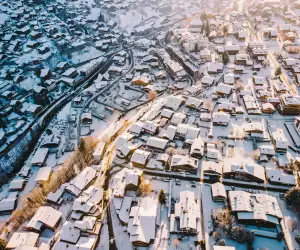
I’ve never encountered so many ‘skiers’ who couldn’t ski as I have in St. Moritz. There are world-class pistes here, and some seriously good backcountry beyond them, but skiing has never been the whole point. In St. Moritz, the mountain is as much a backdrop as a playground. That goes back to the very beginnings of winter tourism. In 1864, hotelier Johannes Badrutt famously persuaded his well-heeled British summer guests to return to the Engadin for winter, helping transform what had been a mountain and spa retreat into Europe’s original winter resort. The British aristocracy followed, bringing with them an appetite for tobogganing, skating and finding increasingly eccentric ways of hurtling down ice.
For anyone curious to see how the one percent does mountain towns, St Moritz is 100% worth the visit
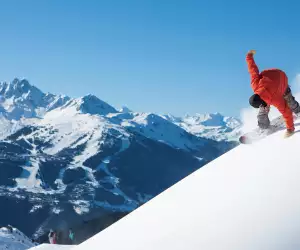
Along the way, they established a template built as much on opulence as on outdoor sport. That legacy never really went away. St. Moritz evolved into a winter meeting place for European nobility, old money and, eventually, the international jet set, with horse racing and polo on the frozen lake, grand hotels, private clubs and luxury boutiques becoming as central to its identity as the lifts. Today, plenty of visitors still come less to ski than to participate in the spectacle of being in St. Moritz. Sure, you’ll encounter the occasional freestyle wunderkind whipping into a misty flip off a big ramp, but for every one of those, you’ll see a dozen fur-clad, immaculately manicured socialites puffing on Sobranies. For anyone curious to see how the one percent does mountain towns, St. Moritz is 100% worth the visit. These are the places to do it properly.
Where to stay
Carlton Hotel
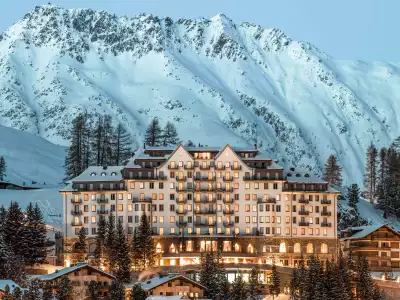
If St. Moritz is a town built for people who like their mountain air served with a side of theatre, the Carlton Hotel understands the assignment better than most. Perched above the lake in a grand Belle Époque pile dating to 1913, it has all the pomp you want from a five-star address here, but somehow avoids feeling like a museum piece. The scale helps. With just 60 rooms and suites, it’s the smallest of St. Moritz’s grand five-star hotels, and every one faces south over the lake and Engadin mountains. The best place to take it all in is the Bel Etage, where deep sofas, roaring fires, and enormous windows turn an afternoon drink into something dangerously close to an occupation. The sun terrace does much the same thing outdoors, only with better people-watching and the sort of view that makes St. Moritz drink prices feel briefly defensible.
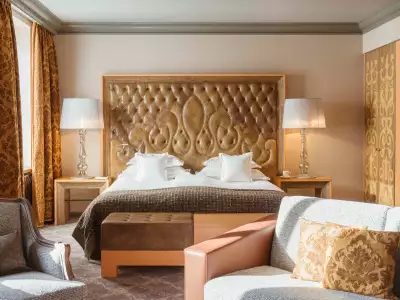
A spacious room at Carlton House
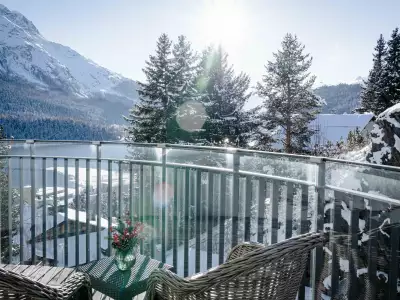
Views out to the mountains from a balcony
Food is taken seriously, too. Da Vittorio, the hotel’s Italian flagship, holds two Michelin stars and brings the Cerea family’s Bergamo-born cooking to the Alps, while the Grand Restaurant keeps things closer to home with local produce and wild ingredients from the surrounding landscape. There’s also a 1,200sq m spa, but the Carlton’s real luxury is the feeling that you don’t actually need to go anywhere. St. Moritz has plenty of places to be seen; the Carlton is where you can disappear above it all, order something cold and expensive, and watch everyone else perform below. Even the journey into town can be outsourced to the hotel’s fleet of chauffeured Bentleys.
Suites from £1,555 per night. Via Johannes Badrutt 11, 7500 St. Moritz; carlton-stmoritz.ch
Suvretta House
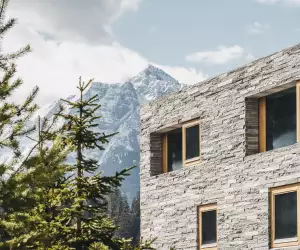
Sitting among the forests and meadows a couple of kilometres outside town, the château-like hotel was deliberately conceived as a retreat for wealthy visitors who preferred discretion to the social whirl. More than a century later, that still feels like the point. Hotelier Anton Bon opened Suvretta House in 1912, and it remains in the hands of his descendants today. Inside, the mood is magnificently old-school: liveried service, afternoon tea to the sound of a piano and a Grand Restaurant where gentlemen are still expected to wear a dark suit and tie. I discovered this only after turning up inadequately dressed and borrowing both, probably the closest I’ll ever come to being issued formalwear by a finishing school.
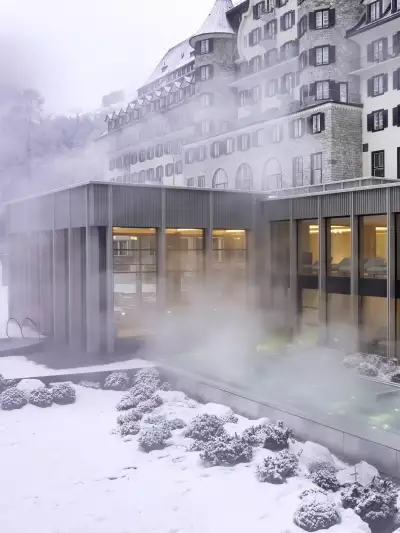
Suvretta House's rooms, suites and amenities from the outside
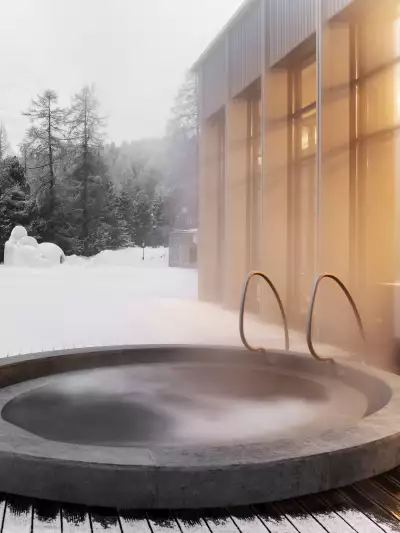
The outdoor hot tub at Suvretta House offers a welcome opportunity to unwind
Unlike some of the town’s grand hotels, though, Suvretta has serious skiing credentials. In 1935 it helped open one of Switzerland’s first ski lifts, inaugurated by Hollywood star Douglas Fairbanks, and today it remains St. Moritz’s only ski-in, ski-out hotel with its own private lift providing direct access to the Corviglia ski area. That combination is what makes it special. You can spend the morning properly hammering the mountain, return for lunch without going anywhere near a shuttle bus, then disappear into the enormous spa or settle into the lobby for tea. With 176 rooms and suites, it’s hardly intimate, but its secluded setting makes it feel like its own little principality. St. Moritz may be built around being seen; Suvretta House is for people sufficiently established not to care who’s looking.
Suites from £550 per night. Via Chasellas 1, 7500 St. Moritz; suvrettahouse.ch
What to do
Ski or snowboard
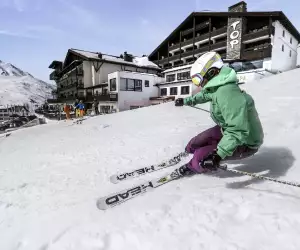
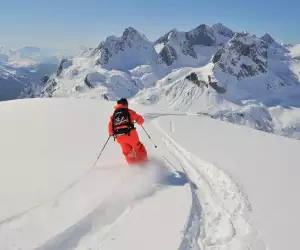
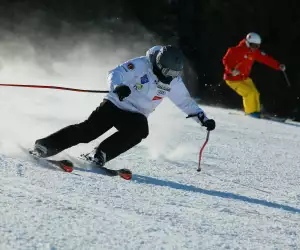
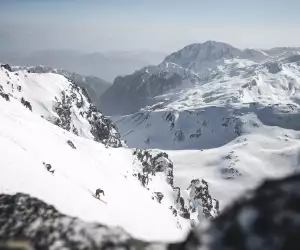
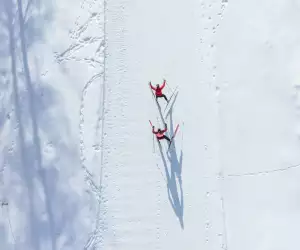
St. Moritz offers two very different flavours of skiing. Corviglia, the resort’s sun-drenched home mountain, is the more polished of the pair, with 155km of immaculately groomed pistes, sweeping views across the Engadin valley and mountain restaurants where lunch can easily become an afternoon affair. Across the valley, Corvatsch is a wilder proposition. Rising to 3,451 metres, its 120km of slopes offer steeper terrain, excellent freeriding and some of the region’s most exhilarating descents. The highlight is the 9km black run down Hahnensee, which plunges towards St. Moritz Bad through open mountainside and forest. Both are great, but Corvatsch has the edge for adventurous skiers.
Board a train
The train journey from St. Moritz to Zurich Airport is a final love letter to the Swiss Alps. Following the Unesco-listed Albula Railway, part of the same network as the celebrated Bernina Express, the cherry-red carriages look as though they’ve rolled straight off the set of a Wes Anderson film. The train winds through snow-laden forests, skirts precipitous valleys and crosses soaring stone viaducts, most spectacularly the Landwasser Viaduct, which curves across a dizzying drop before disappearing into a sheer rock face. Beyond Chur, the mountains gradually surrender to rolling hills and lakes. It’s a journey best spent with your nose pressed against the window, wishing you didn’t have to catch the flight back to Heathrow.
Where to eat
The Grand Restaurant
Suvretta House
Few restaurants do old-school glamour quite like the Grand Restaurant at St. Moritz’s Suvretta House. Beneath an ornate coffered ceiling, executive chef Fabrizio Zanetti serves French-led cuisine that has earned 17 GaultMillau points.
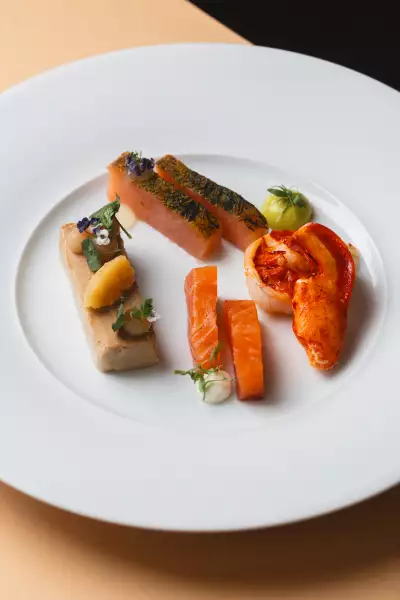
Digitale Massarbeit
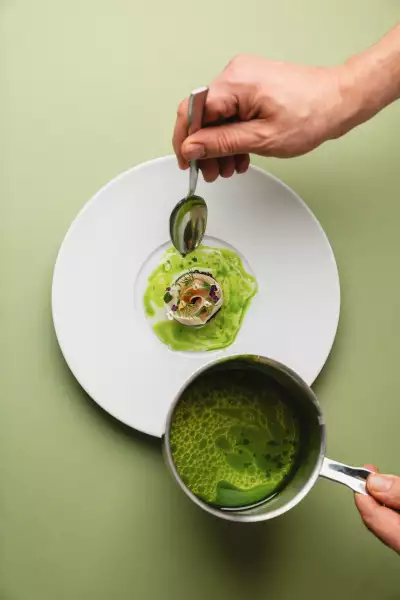
Digitale Massarbeit
Expect all the trappings of grand European dining: hand-cut beef tartare prepared tableside, lobster thermidor, beef wellington and crêpes suzette, accompanied by the sort of service that makes you feel vaguely aristocratic. The dress code is suitably traditional, with jackets and ties mandatory. Turn up without either, and you may find yourself sheepishly raiding the concierge’s wardrobe before dinner (as I did).
Bel Etage
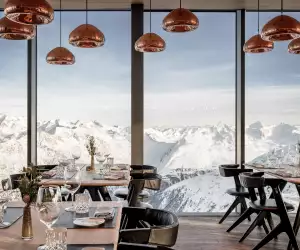
At the Carlton Hotel, après-ski is less about clattering ski boots than sinking into a plush armchair with a glass of champers and surreptitiously checking out your neighbours. The Carlton Bar and adjoining Bel Etage are the hotel’s beating heart: a handsome, wood-panelled salon warmed by two roaring fireplaces, with panoramic windows framing frozen Lake St. Moritz and the surrounding peaks.
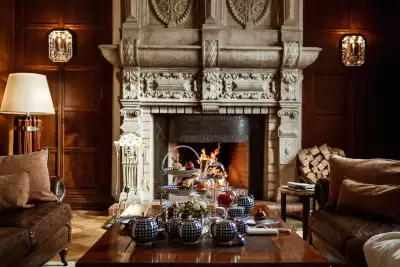
Afternoons unfold over elaborate tiers of finger sandwiches, scones and pastries, accompanied by the gentle tinkling of a piano, while evenings call for expert cocktails and conversation.
Key information
Getting there
Swiss operates more than 160 weekly flights from London Heathrow, London City, Manchester, Birmingham and Edinburgh to Zurich and Geneva, with one-way fares from £76 and £54 respectively. Fares include 23kg of checked luggage and hand luggage, while ski and snowboard equipment travels free on eligible fares, subject to availability.
Getting around
Switzerland’s extensive public transport network connects the country by train, bus, boat and mountain railway, with spectacular alpine scenery along the way. Point-to-point tickets start at £40 one-way, while a three-day Swiss Travel Pass costs from £229.