It is Friday night on Santa Cruz island, and as I stagger out of an air-conditioned souvenir shop into a humidity you could ladle, the thud of music pulls me to a courtyard off the street. A dozen children, none older than six, are zipped into neon tutus performing dance routines to a sequence of reggaeton tracks. It’s all fairly unremarkable until I notice that the figure on the bench facing them – recumbent and settled in for the duration – isn’t a parent but a fully grown sea lion.
Witness a sea lion on a public bench in London, and you’d assume your microdosing had graduated to a macro habit. But in the Galápagos, they’re as common as pigeons. Put on the map by Charles Darwin, this scatter of volcanic islands is among the most fiercely protected habitats on the planet, with 95% of original biodiversity still intact. With little to fear from human predators, the wildlife has developed the brass neck of the genuinely unbothered. Sea lions lollop down the pavement like late commuters, and marine iguanas hang around by water taxi stops as though waiting for a ride.
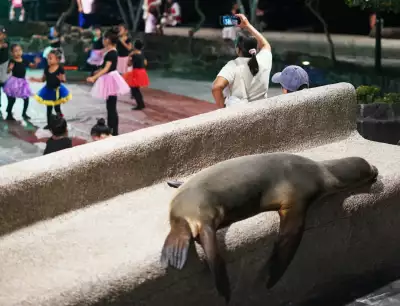
A sea lion at a dance recital on Santa Cruz island
Visitors to these islands arrive with a mental Rolodex of wildlife to tick off: the blue-footed booby, the equatorial penguin and the finches that underpin Darwin’s theory of evolution. But far fewer are curious about the people behind the culture and wildlife here – those who decide what’s worth protecting and preserving, on the islands and in mainland Ecuador. I’m visiting with Metropolitan Touring, the country’s largest tour operator, to learn about some of them.
Spirit level
Some 1,326 kilometres inland, in Quito’s Mercado de San Francisco – the city’s oldest covered market – a woman named Rosa rolls up my sleeves, bares my midriff and, with little preamble, begins to thrash me with stinging nettles. It’s a necessary first step in coaxing the chakras open for a reading.
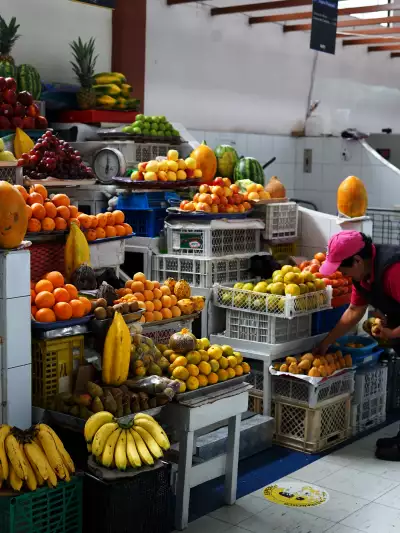
Mercado de San Francisco
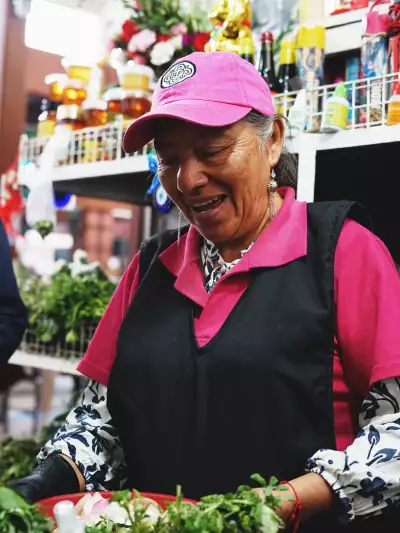
Curandera Rosa
Christy Spring
Rosa keeps one of a row of stalls along the market wall, their proprietors uniformed in matching pink polos, visors and black aprons – the livery that distinguishes a licensed curandera (ancestral healer) from a backstreet charlatan. To reach her, you run a gauntlet of glass cabinets stacked with cow trotters bound for caldo de pata. She presides over upwards of two hundred herbs: valerian for the nerves, sangre de drago – dragon’s blood, bled from an Amazonian tree – for the gut, a coca-and-cannabis salve for aches, coca leaves for altitude sickness.
And the altitude here is no joke. Quito sits at 2,850 metres on the haunch of Pichincha, an active volcano a whisker south of the equator, high enough to rank as the second loftiest capital on Earth after La Paz – which is to say the equatorial sun never quite lives up to its latitude, and the thin air leaves the unaccustomed wheezing like a punctured accordion. The city is often wreathed in cloud – the mist pooling over a Skittle-coloured colonial core and a winged Virgin Madonna taller than Rio’s Redeemer lording it over the lot from the hill of El Panecillo.
Our escort through the market is Alexander Naranjo, an Indigenous Quiteño in a traditional fedora, working for Metropolitan Touring – which makes a point of keeping tourism in local hands. Ecuador’s Indigenous communities have long been on the wrong end of the country’s sums, and twice in recent memory the resentment has boiled over, in 2019 and 2022, when cuts to fuel subsidies shouldered by Indigenous farmers emptied the villages into Quito. The 2019 uprising alone left eight dead and sent the government scuttling to the coastal city of Guayaquil to wait out the storm.
Rosa works the sour herbs over me and runs through the rhythms of her trade. She’s busiest during the dependable December rush, when the city queues to be scoured spiritually clean before the new year. Loyalty along the row runs deep and through bloodlines: much as you stay faithful to the greengrocer who slips an extra bunch of parsley into the bag, people keep to the healer their family has always used, and switching is the sort of thing that gets noticed. As a histamine bloom spreads across me in a leopard-print of welts, Rosa pronounces my energy, regrettably, a little ‘disturbed’ today.
I carry my defective chakras a few streets east to a man several generations into a different family trade, keeping faith of another kind – not the one the Spanish found here but the one they shipped in to supplant it. Gonzalo Gallardo is a fourth-generation restorer of Catholic icons. His workshop, perfumed with the astringent smell of solvent, is a triage ward of saints and infant Christs in assorted states of disrepair. He holds up his proudest work with paint-marked fingers, a ginormous 120-year-old Christ child whose glass eyes he repaints freehand. Like Rosa, he does his briskest business around papal rush hour – Christmas and Easter, naturally.
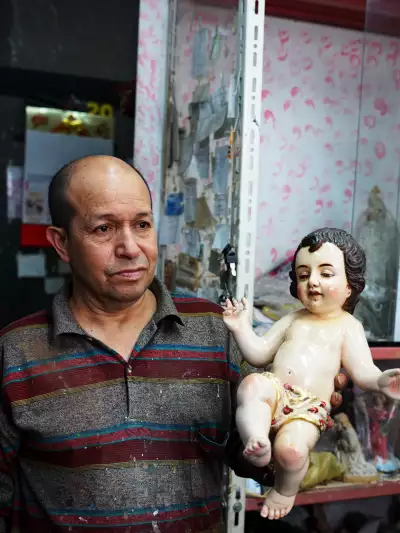
Gonzalo Gallardo
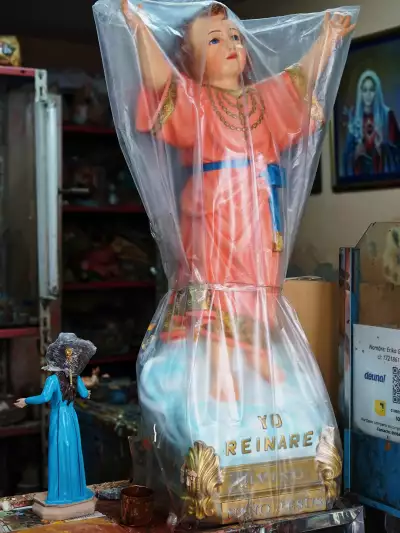
One of Gallardo's repaired icons
Christy Spring
And, like Rosa, he plies a craft in retreat. Why pay to restore, he shrugs, when a mass-produced replacement from China is cheaper and quicker to the door? He came to fixing icons as a boy, school holidays spent at the workbench, but his own children have done the sums. With better-paid work elsewhere, they’ve declined to follow, so the line very likely ends with him. What keeps the trade upright for now is Ecuador’s rampant Catholicism: an estimated 80% of the population identifies as Catholic, the faith visibly woven into the capital, from dinky shrines to the Virgin on street corners to La Compañía, a church gilded with a modest 52 kg of gold. Devotion on that mass scale keeps the ruddy-cheeked cherubs passing down the generations, and Gonzalo in saints to mend.
Against the grain
The drive west from Quito is a sustained pogo-stick affair over landslide-patched track. As a JCB clears a fall from the road, I parse the cursive tattooed along its flank: Jesús es mi pastor – Jesus is my shepherd – about the grade of divine intervention I’m beginning to need to keep this morning’s tamales on the inside. The destination, three hours and several climatic zones away, is Mashpi Lodge, which belongs to a former mayor of the capital I’ve just left.
Roque Sevilla bought a 600-hectare plot in the Ecuadorian Chocó in 2001 from a bankrupt logging company, alarmed by how fast it was vanishing – 98% of the cloud forest already felled for logging, mining and agriculture. The lodge stands on the exact footprint of the old sawmill, so that not a single tree was felled in its construction. To manage the feat, the structure was preassembled in Quito – an Ikea flatpack of monstrous proportions – and flown in. The gesture is roughly equivalent to Sadiq Khan buying up a slice of Epping Forest and turning it into a glamping site to save it. Though that corner of Essex does not, to my knowledge, harbour 350 species of amphibian, as this one does.
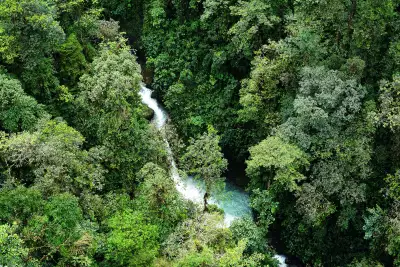
The view from The Dragonfly
Christy Spring
The staffing here is as radical as the architecture. Seven in ten of the staff are local – many of whom would once have felled the very trees whose Latin names they now reel off. Rather than import a workforce, Sevilla brought in biologists, herbalists, naturalists and English teachers to retrain the people who already knew the forest better than anyone.
The lodge is wrapped in glass, so that little more than a membrane separates you from one of the most biodiverse rainforests on Earth, and you spend your days here exploring it – in our case under Santiago, who has worked here for close to a decade. His brain is a card-index of the place, and he is not one to romanticise it, having once spent three days lost in the cloud forest, drinking rainwater wrung from his coat, before a hunter found him. To walk with him is to submit to a sustained, thoroughly diverting factual ambush. A snail the size of an avocado labours past – a hermaphrodite that prefers to mate as a male to dodge the childcare, Santiago explains. It sometimes fights so hard not to be the mum that it kills its partner in the process.
The nature at Mashpi doesn’t just stay behind the glass; roughly 13% of what reaches the kitchen is grown in the surrounding area. The menu, a roll-call of many fruits, vegetables and herbs endemic to the forest – a figure that sounds modest until you reckon with the cloud region’s thin, leached soils. The first meal carries particular significance, too: the screws of a two-Michelin-Key plaque are being driven into the wall as we eat, no mean haul for a lodge several hours’ drive into a rainforest. Rather than pander to assumed Western preferences, the daily-changing menu leans on local produce: locro of chola potato with purple corn and prawns, llapingachos slicked with chillangua oil, the day’s fish under a salsa de inchi pressed from Inca peanut, and a salak pie – the local fruit that tastes of pear, its shell scaly like an armadillo. Each evening hands a single ingredient its own table; the highlight is tuber night, a spread on a central table of crisps fried from roots that have never infiltrated a packet of Walkers – cassava, oca, melloco and mashua among them.
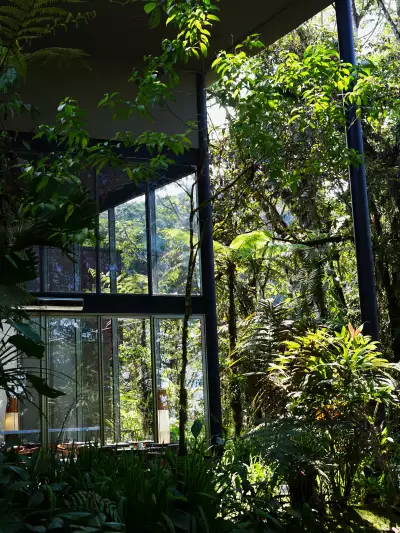
Mashpi Lodge
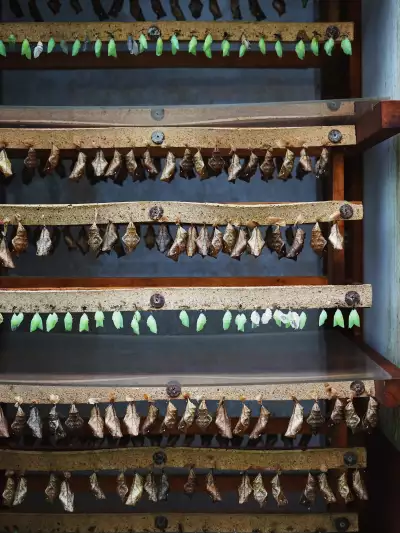
Chrysalis' at Mashpi Lodge
Christy Spring
The next day, we board the Dragonfly – not the winged predator but a ski-lift-ish contraption that rises 220 metres above the forest floor and out over the canopy. It is sturdier than it looks, which I tell myself as – slightly anxious about the cables after the tuber party – we sweep over a blanket of waxy leaves ornamented with toucans and the odd ornate hawk-eagle. The platform has a second use. The endangered Mashpi magnolia flowers up here, and the Dragonfly’s height lets perfumers harvest its essence – a tidy virtuous circle engineered with the perfume house Mane: the scent goes into the lodge’s own shampoo and shower gel and is sold on to other perfumers, the proceeds underwriting the regeneration of the very trees it’s drawn from. Knowingly or not, when a guest lathers up, they help fund the magnolia’s survival.
While up here, Santiago also explains, binoculars in hand, that the birds in Mashpi do something very unique to the forest. They move in mixed flocks – a tanager keeping watch for vipers while the woodcreepers and barbets feed below. As metaphors go, it’s a snug fit for Mashpi: not a single heroic species but a crowd of them, each keeping half an eye on the rest.
Survival of the fittest
Antonio, our Galapagueño guide onboard La Pinta – the small expedition ship Metropolitan Touring runs between the islands – waits until we are well into the clearing before asking whether everyone is over 18. Braced for whatever x-rated tableau the Galápagos have arranged, I follow his gaze to a 180kg male hauled aboard a female and groaning like a cellar door. The female, about as keen as any woman bought a single vodka Coke by a man in a Guildford nightclub, has begun her getaway at the pace of continental drift, the male bludgeoning her with his shell to detain her. Courtship in the Galápagos, Antonio explains, is a days-long siege. Tortoises are no revelation here – the archipelago’s chosen mascot, stamped on every snow globe from Baltra to San Cristóbal. What is surprising is the venue – an ex-cattle ranch.
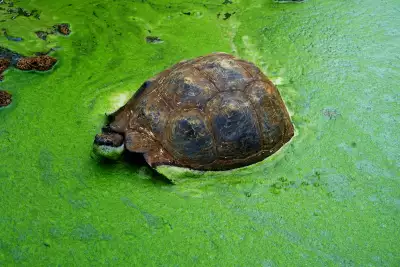
Giant tortoise
Christy Spring
El Chato, on Santa Cruz, once ran cattle on ground that suits giant tortoises just as well, drawn up to these wet, fecund highlands for the grazing. As tourism overtook every other industry on the island, the sums shifted. The family abandoned cattle farming, dismantled fences and let the tortoises run riot. The cattle ranch now operates as a reserve with a restaurant bolted on, where you can watch the giants cavort, or decline to, over fried plátanos and a cocktail. Tourism on these islands does more than ferry the curious out to gawp at boobies. A few years ago, Ecuador struck the largest debt-for-nature deal in history, buying back more than a billion dollars of distressed sovereign bonds at a discount and pledging the savings – hundreds of millions over the best part of two decades – to policing the marine reserve.
Tourism’s dividends reach the science, too. There is a great deal to be learned from the place, Antonio explains, as we board a panga – a small boat – from La Pinta to nose along each island’s shore. Consider the wild tomato on the Chinese Hat (a volcanic islet resembling a traditional Asian conical hat) – surviving on bare lava with next to no water. It arrived as a seed on the current, and now has researchers trying to breed its bloody-minded drought tolerance into a commercial crop. For a scientist, a posting in the Galápagos is what Lourdes is to the pilgrim – and not only for the cataloguing of new species. The islands have proved just as useful for demolishing theories held as gospel for centuries, for example the fixity of species – the pre-Darwinian belief that every living organism has remained exactly the same since its creation.
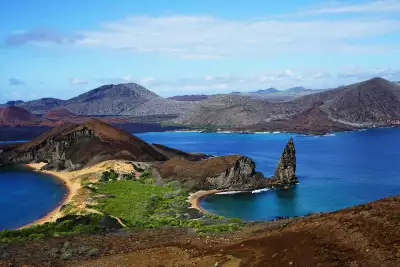
Bartolomé Island
Christy Spring
Much of that science happens at the Charles Darwin Research Station – which we visit on our final day on Santa Cruz while staying at the Finch Bay hotel. Set up under Unesco in 1959, it has run as a non-profit ever since, conservation its sole purpose, with some two dozen projects in train at any one time across land, ocean and community – pioneering enough that a room of sepia photos shows the original researchers, captured at a time when climate change had yet to enter the lexicon.
The knot of people and nature is tied tightest by the station’s most fêted resident, Lonesome George – the last Pinta Island tortoise, dead since 2012 and now taxidermied, in an air-conditioned room of his own. He was the most expensive bachelor in conservation. Researchers tried everything to make him breed: a rotation of consorts, a $10,000 reward for a better-matched female, even a heart-shaped pool sunk into his pen. George remained unmoved, dying without an heir and taking the subspecies with him.
Which makes the timing of what comes next feel almost staged. During the voyage on La Pinta, my phone lights up with a BBC News alert: giant tortoises have returned to Floreana after almost two centuries. The island’s own had been carried off by whalers, who prized them as a living larder that kept for months in a ship’s hold, and by the 1840s, the last was gone. But some, tipped overboard, made it ashore on neighbouring Isabela and bred – which is how, generations on, researchers came to find tortoises on Wolf Volcano still carrying Floreana blood. Twenty-three of the closest matches went into a breeding programme, and this February their offspring – 158 of them – were set down on Floreana to begin the line again.
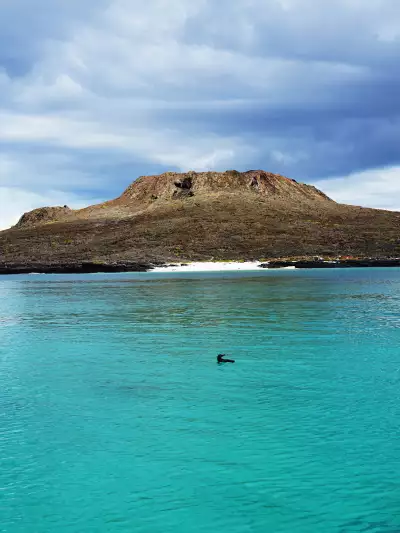
A penguin swims in front of the Chinese Hat island
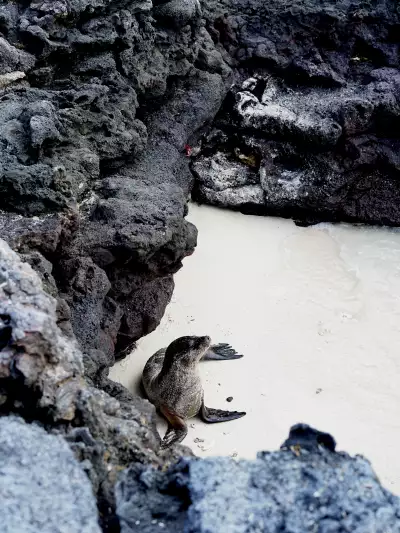
A baby sea lion on the Chinese Hat island
Christy Spring
Ecuador has taken that instinct to protect the environment furthest of all – into law. In a 2008 referendum shaped by Indigenous communities, Ecuadorians rewrote their constitution to grant nature itself – Pachamama – legal standing, the first country on Earth to do so. The clause has since been wielded to strike down mining permits, some of which are not far from Mashpi, and has bred imitators from Bolivia to New Zealand.
It resonates all the more, writing from London during the recent heatwave, which, beyond welding my thighs to every available seat, has me brooding on a city out of balance with everything around it. Nesting birds disturbed by sweaty swimmers in Hampstead Heath duck ponds, the cyclists with their legs broken under Uber’s e-bikes, Thames Water tipping raw sewage into the rivers it charges us to drink – a city careless of its wildlife and often its people too. What I found in a fortnight across these volcanic islands, in Quito and on the misty ridges of the Chocó, was something closer to equilibrium, determined by human decisions on scales both tiny and constitutional. Ecuador may be the richest country on Earth – not for its oil or ore, but for the fortune held in a vault of nature.