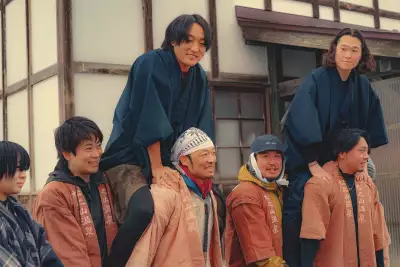
We’ve barely sat down for dinner at Tamakiya, the ryokan where we’re staying, when the owner appears in the doorway, one hand tucked into his jacket, Napoleon-style. He apologises for not being more present tonight. I brace for a childcare crisis or the flu, but instead he draws back the lapel to reveal an arm slung across his chest. He’s dislocated his shoulder – not through any fault of his own, but in the service of another man’s marriage. Not only that, but we watched it happen in real time today. This afternoon, he was one of four men who took a single groom on their shoulders and carried him, together, up a mountain to chuck him off the other side into the snow.
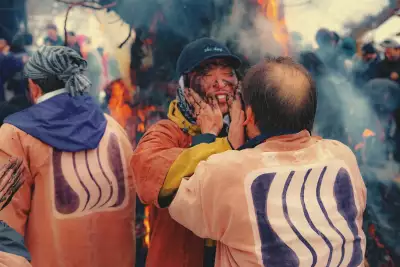
Mukonage, or groom-throwing, is a 600-year-old rite held every January in Matsunoyama, an onsen town in Niigata prefecture. It is, at heart, an act of communal heavy lifting – the town’s married men turning out as one to carry three of the previous year’s newlywed grooms up a mountain road to Yakushidō Shrine at the summit, and there hurl them off the mountainside – their new wives and a gaggle of schoolchildren watching. I clambered up to watch, spending most of the ascent on all fours. Quite how you get a grown man up that log-flume gradient (in rubber boots, no less) is beyond me. At the summit, each groom is handed a cup of sake and then dispatched – two men taking him by the wrists and ankles, swinging him between them like a hammock and pitching him over the side. As marital rites of passage go, it’s probably a more dignified one than an inflatable phallus in Magaluf.
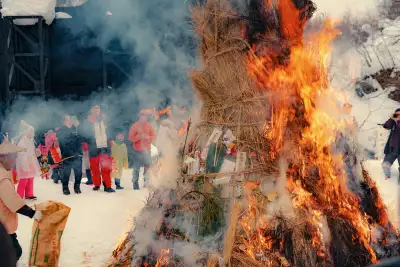
A straw tower for the suminuri purge
Christy Spring
Christy Spring
Christy Spring
Christy Spring
Christy Spring
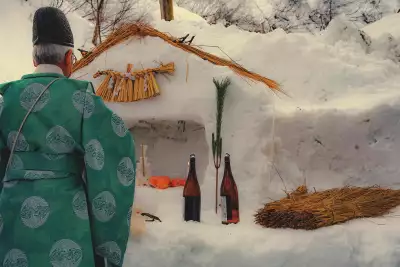
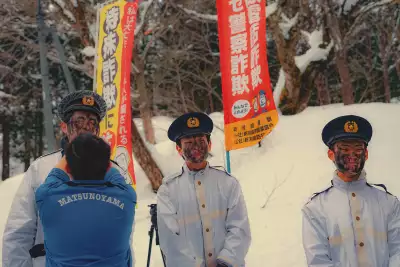
Local lore traces the whole thing to a match the town disapproved of – a daughter wed to an outsider, the groom flung into the snow from the shrine in protest. Centuries on, the grievance has mellowed into a blessing – for the three couples selected from the town, and a communal scrubbing-out of the old year’s bad luck. That purge, suminuri, begins with a straw tower (sai no kami) hung with the town’s written wishes for health, happiness and fertility. It’s set alight while a Shinto priest in green brocade officiates over a shrine built from snow and laid with daikon, carrots, fish and sake. Bottles circulate as it burns, satsumas are lobbed into the crowd to catch for luck, and ash is thumbed thickly onto faces. Nor is the fire squandered – squid and fish cakes are speared on sticks and plunged into the flames, sustenance for the remainder of the festival. This is one of the kisai, the “strange festivals” of old Echigo, and it certainly lives up to the billing.
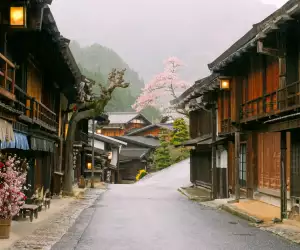
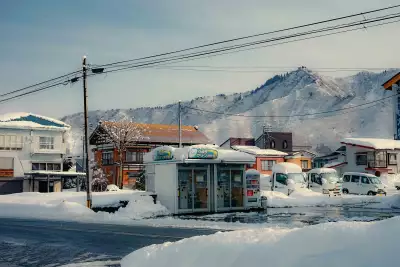
Picture Japan and you reach for the blossom-lined lanes of Kyoto or the neon sprawl of Tokyo – yet around 70% of the country is mountainous. Where the cities have spent centuries engineering themselves around the issue of density, the mountain communities – those of Niigata among them – have instead constructed a life around snow and the sparseness it imposes. This is a long coastal prefecture, 300 kilometres of it along the Sea of Japan, ninety minutes from Tokyo on the zippy Jōetsu Shinkansen, and it hoards its superlatives.
A street in Niigata prefecture freshly coated in a deluge of snow
Christy Spring
Among the snowiest inhabited places on earth (six metres is a typical winter), it grows some of Japan’s finest rice from the meltwater off the Echigo Mountains, and from that rice makes some of its best sake. The Sea of Japan supplies much of the rest, including the illustrious snow crab, and the small ski resorts are unburdened by queues. While great tracts of the country buckle under overtourism (my thoughts and prayers are with the Mount Fuji Lawson), there are whole swathes of Niigata, thick with culture, history and produce – free from the ring-light scrum.
Snow is the region’s great challenge but also its lifeblood – the water supply for the paddies that quilt the valleys. Niigata rice is prized the way Calabria prizes its Tropea onions or Orkney its scallops – exported to some of the most gilded dining rooms on earth, three-Michelin-starred outposts among them. This is rice with terroir, coveted like a grand cru. The devotion peaks with Yukitsubaki, a koshihikari grown in Tsunan that has taken gold at Japan’s largest rice-tasting evaluation five years running, despite making up around 0.0007% of all the koshihikari grown in the country.
Niigata rice is prized the way Calabria prizes its Tropea onions or Orkney its scallops – coveted like a grand cru
It comes from Tsunan, the snowiest town in the prefecture, fed by meltwater from Ryūgakubo, a spring counted among Japan’s hundred famous waters. We eat it for lunch at Yuki-Tsubaki Kitchen, in a repurposed three-storey building whose ground floor is bare concrete (a defence against the annual siege of snow). The rice is plump, pearlescent and faintly sweet, served just as it should be – barely adorned, pressed into onigiri and accompanied by a humble set menu spun from family recipes.
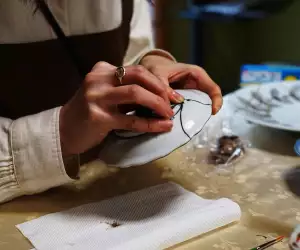
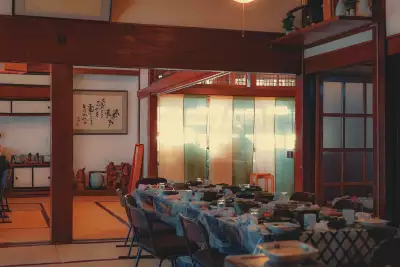
Rice here can take the form of sushi, though a less familiar kind. Sasazushi is a Myōkō speciality: a fishless sushi of rice pressed in a bamboo leaf and filled with fiddlehead ferns, shiitake, walnuts or bamboo shoots. Its origins are anything but peaceful – these neat little parcels were the perfect sustenance for soldiers on the battlefield. The bamboo wrapping doubles as a natural antibacterial agent, keeping it edible for around three days – sustenance for a samurai between skirmishes. You can learn to make them at Harumiso, a small inn housed in a 200-year-old farmhouse with a thatched roof and a sunken irori hearth.
Sasazushi-making at Harumiso inn
Christy Spring
Sasazushi is something of a dying craft, and the family here have appointed themselves its custodians. The idea began 20 years ago, when the mother of the house watched her favourite sushi shop close and decided the speciality would not die on her watch. Walking stick in hand, silver teeth glinting like a mouthful of loose change and eyebrows inked on in dark pen, she teaches us how to make these boats at a long wooden table, alongside her daughter Maria, who translates her Japanese for us. Her patience holds as we fumble the bamboo into boats. On the wall hangs her brush with fame – a clipping from the JR East magazine, her sasazushi in print – a tidy flotilla compared to the shipwrecks leaving our hands.
Rice, as anyone in Japan will tell you, is not solely for eating. Niigata has more sake breweries than any other prefecture in Japan (around 90), the drink coaxed from the region’s rice and pristine meltwater. The deluge of snow here is an equally important ingredient too, moonlighting as a fridge. At Hakkaisan, Niigata’s best-known sake maker, a cavernous snow room, or yukimuro, is packed with a thousand tonnes of snow, holding the interior at around 3°C year-round so the sake can rest and mature in stable, naturally chilled conditions. It takes five days to fill by truck, our guide explains, and its tanks hold some 360,000 litres of maturing sake. Before anyone attempted it at this scale, smaller producers in Niigata historically built themselves dinky igloos to do the job. Nor was the trick of the snow fridge confined to sake. Before the freezer, Niigata households kept snow larders of their own and sold the summer surplus to restaurants for chilling fish.

Tanks used for sake fermentation
Christy Spring
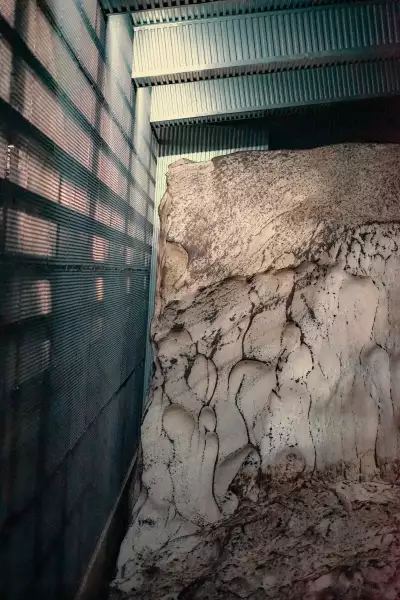
The yukimuro tank at Hakkaisan
Christy Spring
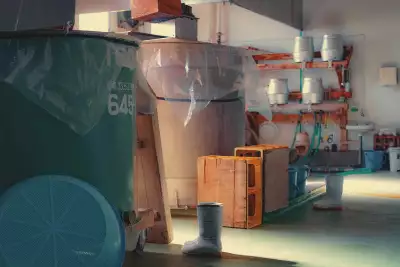
To trace the craft to its source, I visit Kiminoi Shuzō, one of the region’s oldest houses, in Myōkō – a seventh-generation brewery founded in 1842 (now 184 years old), in what was then the post-town of Arai-shuku on the Hokkoku Kaidō, a road once travelled by the local samurai lord and his commerce. 184 might sound like a lofty number, but it’s less surprising in Japan, the country with more century-old businesses than anywhere on earth. We meet the owner, Mr Tanaka, and the master brewer, Hiroshi Hayatsu, who grows the rice for his sake himself on two hectares of his own paddy – farming through the warm months, brewing through the cold, so that he sees the whole arc from seed to bottle. 50 years he’s spent making sake, more than 20 at the tanks. Water is what matters most, he says – it is, after all, 80% of what’s in the bottle.
Sake was first made by shrine maidens who chewed the rice and spat it into a tub, saliva doing the enzymatic work
He is liberal with both sake and lore as we progress through each style at a wooden table – notably the yamahai, made by the old natural method of coaxing a yeast starter, with a distinct umami tang and an earthy note. Sake, he explains, was first made by shrine maidens who chewed the rice and spat it into a large tub, saliva doing the enzymatic work now handled by kōji mould – a method called kuchikami. Aside from saliva, a good deal of superstition and pride is bound up in the making of sake, too – a whole pantheon to be kept onside, the mighty god of sake among them, who is no friend to a slack fermentation.
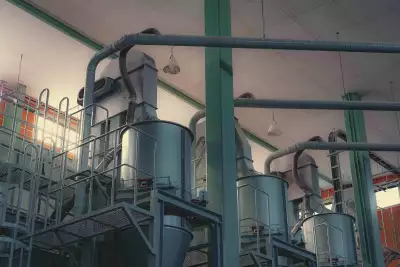
Inside the Kiminoi Shuzō sake brewery
Christy Spring

Christy Spring
Christy Spring
The more time I spend in Niigata, the more I find the customs as nourishing as the food or the landscape – partly because they can feel so bracingly alien to the English way of things. What lodges hardest are two concepts – firstly wa (social harmony), the cultural emphasis on maintaining cohesion, avoiding unnecessary conflict, and not disrupting the group. The second is shūdan shugi, or groupism – the practice of putting the goals and well-being of the collective, whether family, school or company, ahead of individual desire or personal success.
I start to notice it in Niigata, and to register how it surfaces – often in ways that are both surprising and unsparing. Plenty of people, I’m told, never take their annual leave, on the grounds that going away burdens the team. Someone recounts the story of a colleague who, having taken a few days off after his mother died, returned to the office with gifts, by way of apology for the imposition of his bereavement. There is even a word for the appearance side of all this: midashinami, which translates as grooming, or presentability. Our guide is keen that we understand it as more than vanity – a social duty, rooted in respect for others, to present yourself in an orderly way so as not to make anyone else around you feel uncomfortable.
Where I feel shūdan shugi most, though, is in the prefecture’s campaign of rural revitalisation to tackle depopulation – a chronic and pressing problem across much of rural Japan. I’d heard of the usual levers, among them a national scheme that pays urban families to decamp to abandoned country houses. Niigata’s answer is less expected – contemporary art.
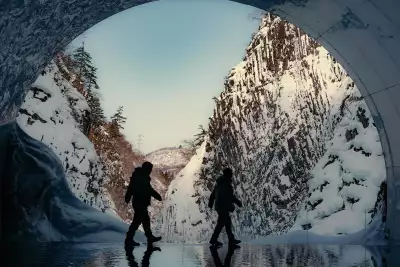
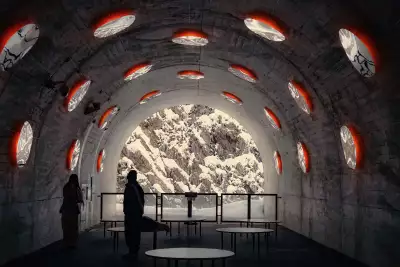
The Tunnel of Light frames the nearby mountain views
Christy Spring
The Echigo-Tsumari Art Triennale, first staged in 2000 and roughly every three years since, scatters the work of hundreds of artists (sculpture, painting and installations) across 760 square kilometres of rice terraces, forest, shuttered schools and emptied farmhouses, turning an entire region and its neglected buildings into a living gallery. The idea is to boost the local economy through tourism, reuse abandoned public spaces, and bridge generational divides by uniting elderly residents with international artists and young volunteers. The expanse is larger than all 23 wards of central Tokyo, and it is billed as the world’s largest open-air art festival. Its ninth edition in 2024 assembled more than 300 works by artists from over 40 countries. Some 200 are permanent, so that even in deep winter, with the festival months away, the art endures out there beneath the snow – as I see for myself.
One permanent piece reimagines the Kiyotsu Gorge Tunnel as the Tunnel of Light. In 2018, the Beijing firm Mad Architects took a 750-metre passage bored through the rock in 1996, after a fatal rockfall closed the gorge’s walking path, and reworked points along its length around the five elements: wood, earth, metal, fire, water. What had been a plain walk through a tunnel becomes something closer to a submarine’s-eye view of the gorge. Light, reflection and framed rock rearrange how you see the place.
A paddy must be flooded; flooding requires irrigation; irrigation binds every farmer to the one upstream
As my time in the prefecture runs out, two lessons stay with me. One, do not wear your finest cashmere to a suminuri unless you want to spend the evening wiping ash from threads. Two, in Niigata, almost everything can be traced back to rice. Chasing down why the place felt so tightly bound, I landed on a 2014 study led by the psychologist Thomas Talhelm, which proposes that the gap between the Western self and the Eastern one may come down to what a place has historically grown – wheat people versus rice people. Wheat, the European staple, asks little beyond rain, and a single family can work its own field. Rice drags in the whole village. A paddy must be flooded; flooding requires irrigation; irrigation binds every farmer to the one upstream, since the water you take is the water your neighbour goes without.
You needn’t have farmed a day in your life to inherit this way of thinking. Asked to sketch their social networks, people from wheat regions drew themselves larger than their friends. The rice growers drew their friends bigger than themselves. It culminates in Niigata with the sense that the prefecture runs on cooperation rather than the winner-takes-all individualism of other cities’ start-up-flooded streets. After all, wringing life from conditions this harsh – turning the hardness of winter into industry, tradition and routine – was never a solo act but a communal one. Winter here is something to be weathered together. Occasionally, that involves hurling several newlywed husbands down a mountainside.