Strolling around Baščaršija, Sarajevo’s twisty, maze-like, medieval bazaar, marked with streets named after its traditional craftsmen, such as Ulica Tabaci, the leatherworkers – and Ulica Bravadžiluk, the locksmiths – I come across some of the strangest souvenirs I’ve ever seen.
Mixed in with artfully made copperware, elegant coffee sets, and cloisonné sugar bowls are small models of tanks and fighter jets that appear to be constructed entirely out of… bullet casings.
I can’t work out whether they’re real or fake and stare at them in slight disbelief; surely, considering everything Bosnia went through in the 1990s, this is in pretty grotesque taste?
That ‘everything’ is probably the main, if not only, reason most people around my age – Gen X and millennials – have actually heard of the country. War in Bosnia broke out in 1992, following its creation as an independent nation after the complex breakup of the former Yugoslavia.
I remember grim BBC news reports referencing sieges – Sarajevo was effectively held in a stranglehold by Bosnian Serb forces for over three years, the entire length of the conflict – and genocide.
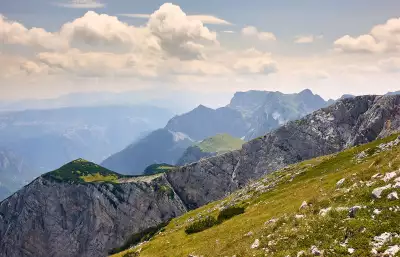
The Dinaric Alps in Bosnia and Herzegovina
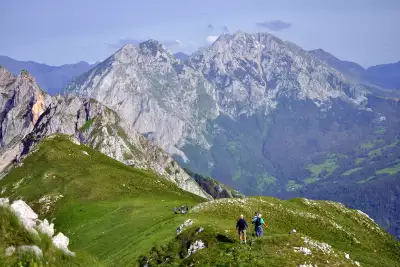
“The city was pretty helpless because it sits in a valley,” explains my affable guide, Samer Hajric; now aged 47, he was a teenager at the time. Sarajevo is ringed by mountains and hills where the military holed up, armed with mortars, anti-aircraft guns and tanks, which fired at will. In addition, hundreds of snipers positioned themselves strategically in buildings and treelines and, in the whole hideous aftermath, all their empty shells were left behind.
“People would come and collect kilos and kilos of them,” says Samer, somewhat matter-of-factly. And now they’re being turned into rather macabre mementoes.
The contrast between these items – as well as the sight of buildings still pockmarked by mortar damage – with the present day’s atmosphere of peace feels somewhat odd, and the small group I’m travelling with as part of a hiking and city tour of the region with Exodus Travels is as curious about the whole situation as I am.
But, unwilling to probe too deeply or stir up unwanted and emotional memories, we’ve been largely avoiding any questions about the war until Samer himself brings up the topic or we brush up against visible evidence, such as now.
In the meantime, we soak up Sarajevo’s heady atmosphere; the bazaar is doing a roaring trade selling items such as Bosnian – never Turkish! – delight and bags of strong Bosnian – never Turkish! – coffee.
The slight reluctance to acknowledge anything as actually influenced by, or originating from, Turkey is a hangover from when the original Kingdom of Bosnia was conquered by the Ottoman Empire in 1463 and subjected to its rule, and religion, for a further 400 years. Today, the whole country is still predominantly Muslim – 51% of the population identify as such (although overall, it’s secular) – and peppered with mosques.
The bazaar is doing a roaring trade selling items such as Bosnian – never Turkish! – delight and bags of strong Bosnian – never Turkish! – coffee
The bazaar’s ancient stone buildings, topped with terracotta roofs, abruptly stop at a point marking the meeting point of two cultures: a sign embedded into the pavement denotes the exact spot where the city’s two dominant historical and architectural eras, the Ottoman east and Austro-Hungarian west (yes, poor Bosnia was conquered yet again, in the 19th century), meet.
Amid the imperial yellow and pink buildings comes another discovery; a plaque outside the Museum of Sarajevo marks the exact spot where Archduke Franz Ferdinand was shot on 28 June 1914 – and that bullet effectively ignited World War I.
After all this history, it’s somewhat of a relief, the next day, to head into the mountains. Mount Trebević is the closest to the city, reached by a vertiginous cable car ride, and features a network of hiking trails. One of the most popular leads to Trebević’s peak, some 1,629m above sea level.
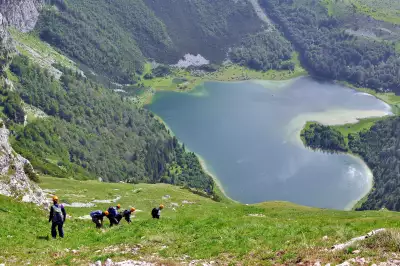
A lake in the Dinaric Alps
Up and up we valiantly ascend through thick pine and spruce forests, spotting the odd black-and-yellow-patterned salamander scuttling through the grass and listening to the soothing sounds of cuckoos, robins and chaffinches. Unfortunately, just as we’re about halfway, a low fog sets in and we have to change tack.
Fortunately, this means doglegging less steeply to the mountain hut we’d have reached a bit later, where we’re greeted enthusiastically by Dexter, a Black Russian terrier (the breed name is an utter misnomer – he’s gigantic).
We escape inside, out of the now quite filthy weather – drizzle, mist and whipping winds – and the hut’s (and Dexter’s) genial Slovenian owner, Primosz, furnishes us with cups of strong coffee and steaming bowls of homemade chicken or bean soup.
When the skies clear, we make our way back downhill, stopping off to admire one of Sarajevo’s quirkier sights: its abandoned and partially destroyed 1984 Winter Olympic bobsled and luge track. Samer informs us that it’s still used for training, mountain biking, and extreme cycling.
Covered in bright and colourful murals, it stands out amid the verdant landscape, and we walk slowly and carefully up it back towards the cable car station, trying to picture the scene where athletes would hurtle down it at dizzying speeds of up to 100 kph.
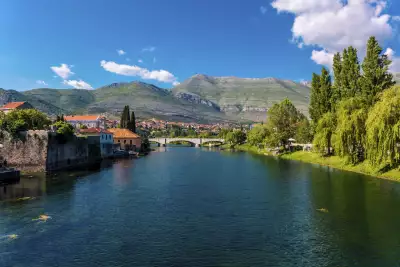
Arslanagić Bridge spanning the Trebišnjica River in the city of Trebinje
A couple of days later, we set off to Bjelašnica mountain for another hike, looping around the village of Umoljani, set amid Bosnia’s serene highlands.
Here, apart from a handful of villagers, our only other living companions are flocks of sheep and goats, and we follow a scenic trail through fields and up manageable hills, stopping at a viewpoint that offers a somewhat pant-wetting peek over the dramatic Rakitnica Canyon, the second-deepest in Europe. Posing for a photo right at its edge was a fairly hairy moment.
Towards the end of the hike, we walk along a wide yet sinuous stream, curving in a series of silvery ‘S’ shapes along a valley. “Legend has it,” begins Samer in true fairytale-telling style, “that this is the trail left by an ancient dragon which crawled out of the canyon to devour the villagers.”
Apparently, it was defeated by the power of prayer, when the local imam recited passages from the Koran at it, and when the dragon tried to escape up a nearby rock face, it turned to stone. When we reach it, you can just about see a shape that looks dragon-esque (if you squint), but I enjoy the story anyway.
Afterwards, we drive along a jolting ‘road’ that is yet to enjoy the sweet, sweet coverage of smooth tarmac to Lukomir, Bosnia’s highest and most remote village (with that road, it’s no wonder). Here, enterprising villagers knit woollen socks, gloves and scarves to sell to visitors, while you can stay in a local guesthouse or eat at a local tavern. C
hilled to the bone – it’s been another cold and foggy day – we cluster around the charcoal-filled heater in a small restaurant while the owner serves up freshly-baked
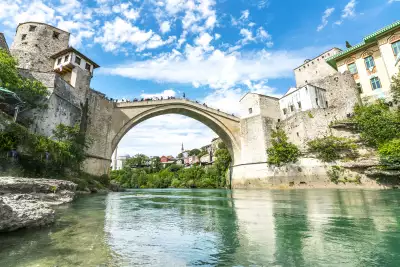
The Stari Most in Mostar, rebuilt in 2004
Our last 24 hours are spent in almost comically contrasting heat and sunshine; we drive south into Herzegovina, home to a more Mediterranean climate than its neighbouring region of Bosnia.
Its unofficial capital, Mostar, is one of the prettiest towns I’ve visited, complete with slippery paving stones, dozing stray dogs and its crown jewel, the Stari Most, or Old Bridge, which spans the translucent, bluey-green Neretva River.
It took eight years to build, starting in 1566. It is 28.9m long, approximately 24m high, and is made from exactly 456 stone blocks. These figures are important because the bridge was blown to bits during the Bosnian War, and in 2004 it was painstakingly reconstructed to the
There has been a tradition of jumping off it which has lasted almost as long as its creation; today, if you see a bloke clinging to the edge, it’s not because he’s feeling suicidal – although with such a high drop, you might wonder – it’s because he’s waiting till he’s earned around 50 euros in tourist tips, after which he will either swan dive gracefully into the river, or plunge in, feet first.
Either that, or he’s a cocky Australian who’s managed to talk one of these ‘professional divers’ – they’ve even got their own social club in one of the former watchtowers at the end of the bridge – into giving them a quick tutorial, for cash.
Bosnia is being hailed as the next European frontier for adventure travel. Based on the evidence – the bridge-jumping, bobsled-track-biking and the beautiful, if sometimes challenging, hikes – I can see why. Come while it’s still blissfully uncrowded to enjoy its lush mountains, shimmering green lakes and compelling cities.
Yes, you might have to get used to the constant smell of stale cigarette smoke – I’ve never seen so many people furiously participating in the habit – cows wandering into rural village roads, and an obsession with football hero Edin Džeko (his shirt is for sale everywhere), but it couldn’t be more worth it. This is a country which has weathered so much – and its defiant, but welcoming, spirit remains gloriously unbowed.
A nine-day trip, Walking in Bosnia & Herzegovina, starts from around £2,080 per person, excluding flights; exodus.co.uk